
Reviewed · GEORGIAN FOOD TOURS
Acquaintance with Georgia in half a day. History, Folklore, Supra
Georgia makes a first impression through food and song. This six-hour Tbilisi experience brings those pleasures together with a walk, an ethnographic museum, folk dancing, martial arts, cooking, and a family-style supra. I like the mix of hands-on activities and local tradition, especially the chance to learn khinkali and khachapuri preparation rather than simply eat them. I also like that the event moves beyond sightseeing, giving you a taste of Georgian music, dress, movement, and table customs.
The main drawback is the price: $300 per person is a serious outlay for six hours, particularly if you normally explore cities on your own. The value depends on how much you want in one carefully arranged afternoon. This is not a standard walking tour with a few photo stops. It is an organized cultural program built around participation.
In This Review
- Key points to know before booking
- Why this half-day program works
- Starting in Old Tbilisi at 3:00 pm
- Meeting Georgia’s past in a contact museum
- Learning Georgian dance instead of only watching it
- Polyphonic song and the force of Georgian martial arts
- Cooking khinkali and khachapuri with a Tbilisi family
- Sitting down to the Georgian supra
- Is $300 per person a fair price?
- Who will enjoy this experience most?
- Cancellation and planning advice
- Should you book Georgian Ethnos?
- FAQ
- Where does the experience begin?
- What time does the activity start?
- How long does the experience last?
- Where does the activity finish?
- What is included in the price?
- Is lunch included?
- Will I take part in Georgian cooking?
- Can I learn Georgian folk dances?
- How large can the group be?
- Can I cancel for a full refund?
- Is the ticket available on a phone?
- Are service animals allowed?
Key points to know before booking
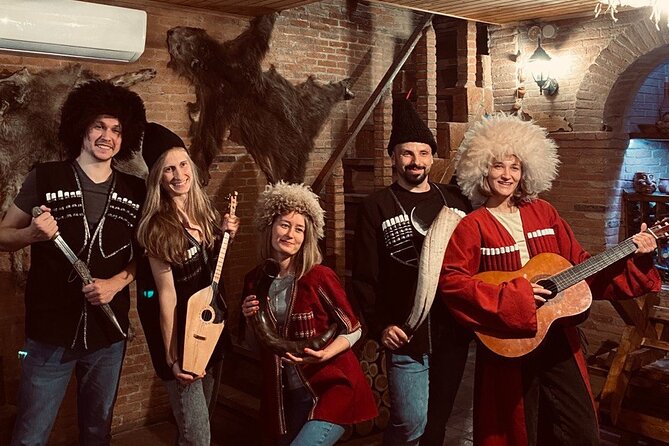
- A contact museum begins the afternoon: You can handle the cultural experience through a visit to a Tbilisi museum devoted to weapons and Georgian artifacts, led by its director.
- Traditional dress adds a personal touch: The museum visit includes the chance to put on Georgian folk costumes for photographs.
- You learn, then watch the professionals: A dance class is paired with performances by experienced dancers, musicians, and martial artists.
- The supra is both meal and lesson: You eat a Georgian dinner while learning toast order, table customs, and how to drink from a horn.
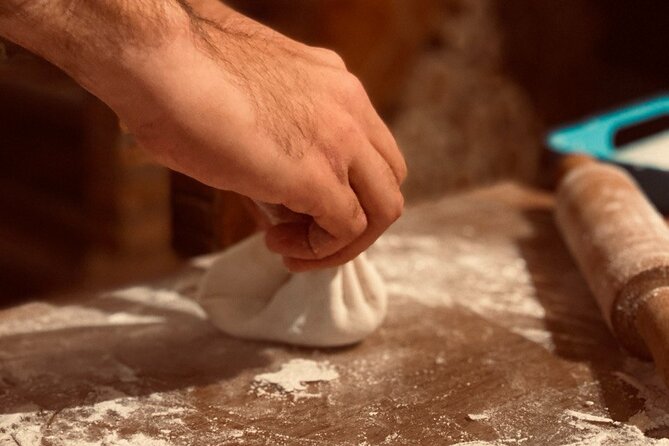
- Cooking is part of the program: You take part in preparing khinkali and khachapuri in a Tbilisi family home.
- The schedule is compact but full: The activity begins at 3:00 pm at 1 Jan Shardeni Street and ends at the same meeting point after about six hours.
Why this half-day program works
I see this experience as a concentrated introduction to several parts of Georgian life that are easy to miss on a normal city visit. Tbilisi offers churches, balconies, museums, and excellent restaurants, but a restaurant meal alone does not explain the role of toasts, the order of a supra, or why polyphonic singing matters.
Here, you get several forms of contact in one afternoon. You see historical objects, put on traditional clothing, move through a basic folk-dance lesson, hear Georgian instruments, watch martial arts, prepare food, and sit down for dinner. The result is less about checking off monuments and more about seeing how history and custom continue in ordinary social settings.
The program is also useful if your time in Georgia is short. It does not replace a longer trip through the country, but it can give you a working introduction before you visit other regions. You return with a few practical skills, including how Georgian dishes are made and how a formal toast fits into the meal.
The small maximum group of 18 matters here. A class involving dance, cooking, and photographs would become awkward with a very large crowd. Eighteen is not an intimate private visit, but it is manageable for activities that require some room and attention.
More Food Tours in Tbilisi:
- Tbilisi: Georgian Cooking Class with Khinkali and Khachapuri
★ 4.7 · 1,146 reviews - Private Tbilisi Food Tour: 9 Tastings Walk in Bohemian District
★ 5.0 · 227 reviews - Small-Group Khinkali and Khachapuri Cooking Class in Tbilisi
★ 4.5 · 224 reviews
Starting in Old Tbilisi at 3:00 pm
The meeting point is 1 Jan Shardeni Street, in the central Shardeni area of Tbilisi. This is a useful starting location for an afternoon program because it puts you in one of the city’s most visited central districts. The activity finishes at the same meeting point, which makes your evening plans easier.
The published duration is about six hours, so plan for the program to carry you from mid-afternoon into the evening. Do not schedule a separate dinner afterward. Dinner is included, along with alcoholic drinks, coffee or tea, and bottled water.
The opening walk is described as leisurely. That wording is important. This is not presented as a strenuous hike or a fast sightseeing circuit. You should still wear comfortable shoes, since the afternoon moves between several settings and includes standing, watching, and taking part in activities.
The meeting details are simple: confirmation arrives when you book, the ticket is mobile, and the activity is near public transportation. Those details make the experience fairly easy to fit into a Tbilisi itinerary, especially if you do not want to arrange several separate visits.
Meeting Georgia’s past in a contact museum
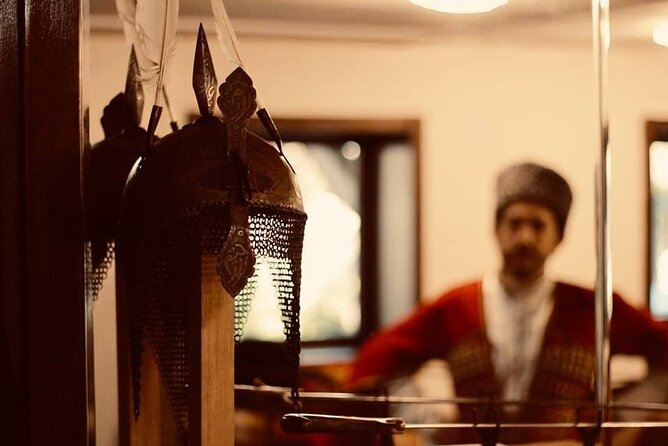
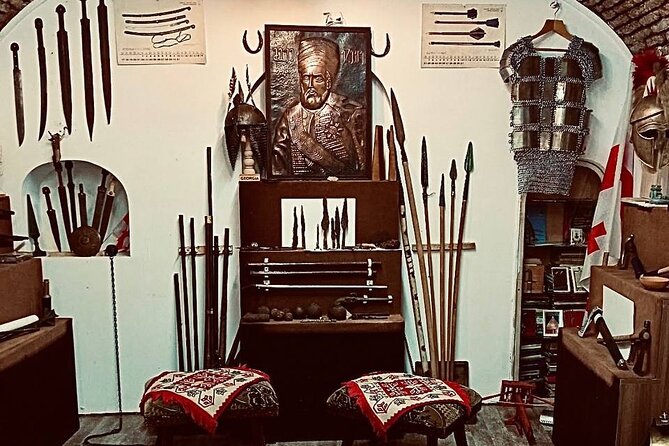
The first major stop is a contact museum of weapons, described as the only museum of its kind in Tbilisi. The collection includes artifacts found at different times across Georgia. The director presents the objects and explains lesser-known facts connected with the Middle Ages.
That personal format is one of the stronger parts of the experience. Instead of walking past glass cases with short labels, you hear the story of the collection from the person who assembled it. The focus on weapons also offers a different entry into Georgian history. You are looking at objects connected with defense, conflict, and daily life, not just royal portraits or church architecture.
The historical portion should suit you if you enjoy context but do not want a long academic lecture. The description promises an interactive presentation, and the available account of the experience highlights an interactive lecture at the museum. Expect the emphasis to be on objects and stories rather than a full survey of every period in Georgian history.
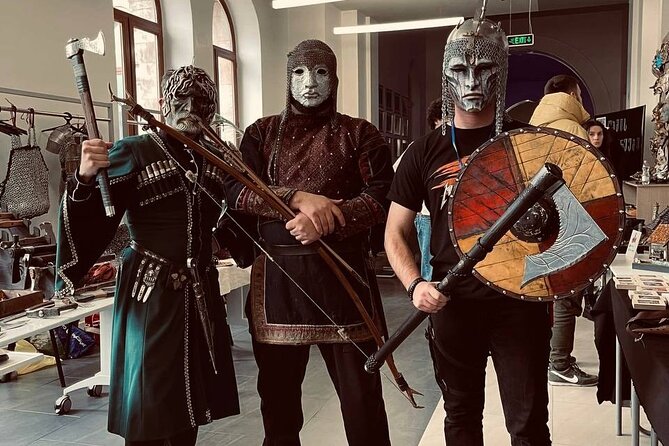
One particularly appealing feature is the costume photo session. You can dress in Georgian folk clothing and take photographs inside the museum. This is more than a quick picture opportunity. Clothing gives you a physical sense of how a culture presents identity, status, and regional tradition.
You should keep your expectations reasonable. The museum is one part of a packed afternoon, not a full day devoted to Georgian arms and archaeology. If you want to study every artifact at length, the group schedule may feel brisk. If you want a memorable introduction with a strong human guide, the format makes good sense.
Learning Georgian dance instead of only watching it

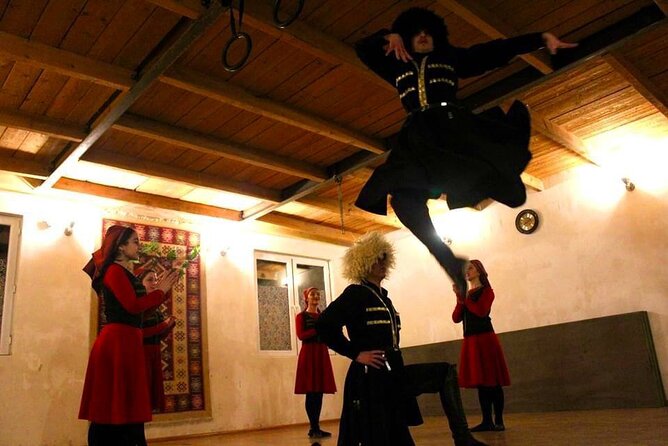
After the walk and museum, the program moves to a place where Georgian martial arts and folk dances are taught. A professional choreographer leads a class in one or two Georgian dances. You also watch experienced ensemble dancers perform two numbers.
I like this structure. Watching a skilled dance troupe can be thrilling, but it leaves you on the outside. A short class lets you feel the rhythm and coordination for yourself. You do not need to become a polished performer in one session. The point is to understand the energy, posture, and group movement from inside the activity.
The class is likely to be a highlight for people who enjoy participation. You may feel self-conscious at first, especially if you have little dance experience. That is normal. The program is designed as a master class for visitors, not as an audition. Go ready to laugh at your own footwork and you will get more from it.
The professional performances add a useful contrast. Once you have tried the steps, you can appreciate the precision and speed of trained dancers. Georgian dance often carries a strong sense of pride and controlled movement, and seeing the experts after your own attempt gives the performance more meaning.
The description does not specify exactly which dances you will learn. That is worth noting if you have a particular regional dance in mind. The promise is one or two folk dances, with the exact selection presumably determined by the class and performance schedule.
More History Tours in Tbilisi:
- Tbilisi: Guided Walking Tour of Historic City
★ 4.9 · 156 reviews - Mtskheta, Jvari, gori, uflistsikhe, history and panorama (group tours)
★ 4.5 · 107 reviews - Tbilisi old town & soviet heritage – Private driver-guided Tour
★ 5.0 · 83 reviews - Private Wine tasting in Historic Karalashvili Wine Cellar
★ 5.0 · 60 reviews
Polyphonic song and the force of Georgian martial arts
The musical section brings in traditional Georgian instruments and a folk song. Georgian polyphony is an important part of the country’s oral cultural tradition, and hearing it in a live setting gives the afternoon a different mood from the dance lesson.
You may find yourself wanting to sing along, although you should follow the performers’ lead. The attraction here is not a concert in a formal hall. It is the sound of a living tradition presented alongside dance and food, which helps you see how these customs connect.
The martial-arts demonstration is billed as a major part of the event. Professional performers show Georgian martial arts after the music and dance. This adds physical drama to the afternoon and connects back to the weapons and historical material presented earlier.
That sequence gives the program a clear rhythm: objects and stories first, then movement, music, and combat display. I appreciate that the experience does not treat folklore as a static costume show. You see traditions performed by specialists, then take part in simpler forms yourself.
You should expect to watch the martial arts rather than receive a full combat lesson. The hands-on class is tied to dance, while the martial arts section is a professional demonstration. That distinction helps set realistic expectations.
Cooking khinkali and khachapuri with a Tbilisi family
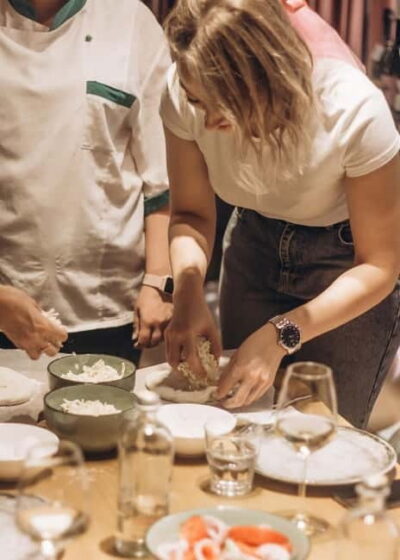
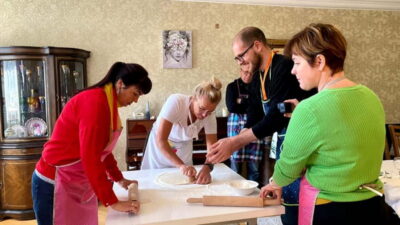
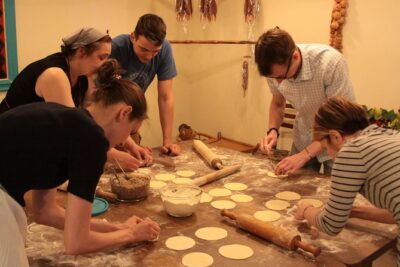
The final part of the experience takes place in a Tbilisi family home. You take part in a cooking class focused on khinkali and khachapuri, two of Georgia’s best-known foods.
Khinkali are Georgian dumplings, traditionally shaped with a gathered top. Khachapuri is Georgian cheese bread, with many regional versions. The activity gives you more than a recipe. You see how food becomes part of hospitality and shared time at home.
I especially like that the cooking takes place before the meal. You prepare food, then sit down to eat in the same setting. That simple order makes dinner feel connected to the rest of the afternoon instead of tacked on as a restaurant stop.
The information provided does not give a detailed recipe or specify how much of each dish you will make. Do not book this expecting a long professional cooking course. Think of it as a practical introduction, with enough participation to help you recognize the work behind dishes you may order throughout Georgia.
You may also return home with a useful party trick: the ability to make Georgian dumplings or cheese bread. The program specifically presents these new skills as part of what you take away. Even if your first khinkali is not perfectly shaped, you will understand the basic idea and the care involved.
Sitting down to the Georgian supra
Dinner is the social heart of the program. The family home serves a generous Georgian feast with assorted snacks and hot dishes, homemade wine, and chacha. Coffee, tea, and bottled water are also included.
A supra is not simply a large meal. It follows its own social rules, with a sequence of toasts led by a tamada, or toastmaster. During dinner, you learn how the toasts work, when to drink, and how to use a drinking horn.
This is where the program offers something a normal food tour often misses. You are not only tasting Georgian dishes. You are learning why conversation, ceremony, and hospitality are so closely tied to the table.
The drinking horn is a memorable detail, but alcohol deserves a practical note. Wine and chacha are included, while lunch is not. Since this is an evening dinner, you should pace yourself. You can enjoy the meal without treating every toast as a challenge.
The meal may be the most praised part of the overall concept because it brings the earlier subjects together. History explains some of the country’s traditions. Dance and song show them in motion. The supra gives you a place to participate in the social side of Georgian culture.
Still, the meal is not fully customizable according to the information available. If you have dietary restrictions, ask the provider before booking, since no special menu details are supplied. The same applies if you do not drink alcohol. Coffee, tea, and water are included, but the description does not explain how nonalcoholic guests are handled during the toast ritual.
Is $300 per person a fair price?
At $300 per person, this is expensive compared with a basic Tbilisi walking tour, museum visit, or dinner. It is also more than you would spend by arranging many of these elements independently.
The price makes more sense when you count the number of moving parts. You receive a museum visit, a specialist presentation, costume photographs, a dance class, professional dance performances, traditional music, martial arts, cooking instruction, dinner, alcoholic drinks, coffee or tea, and bottled water. The activity lasts about six hours and uses a group capped at 18.
You are paying for coordination as much as admission or food. Arranging a museum presentation, private dance instruction, a family meal, and a cooking session on your own would take time and local contacts. This experience places those pieces into one afternoon.
I would book it if you value access and structure more than low cost. I would skip it if you prefer choosing each stop yourself, dislike group activities, or want to spend $300 on several independent meals and visits.
The value also depends on your trip length. For a week or more in Georgia, you may be able to learn these subjects gradually through separate experiences. For a short stay, the concentrated format can be a sensible use of one afternoon.
Who will enjoy this experience most?
I would recommend it to first-time visitors who want a broad introduction to Georgian culture without spending several days arranging separate activities. It also suits people who enjoy food, music, costumes, and participation more than long monument tours.
Families and social groups may like the dance class and cooking session, though the supplied information does not specify a minimum age. Couples and solo visitors can also fit in comfortably, particularly if they enjoy meeting local people through food and performance.
The program is less suitable if you want a quiet museum afternoon or a detailed history lecture. It is also not the best choice if you need a tightly timed schedule, since the activity includes several transitions and live demonstrations.
Service animals are allowed. The experience is near public transportation, and the group can include up to 18 people. No further mobility information is provided, so ask the provider about access requirements before booking if you need step-free routes or seating arrangements.
Cancellation and planning advice
You can cancel at least 24 hours before the 3:00 pm start time for a full refund. Cancellations or changes made within 24 hours are not accepted for a refund, and the cut-off uses local Tbilisi time.
Use the mobile ticket and keep the confirmation available on your phone. Since the activity begins in the central Shardeni area and ends there, leave enough time to reach the meeting point before 3:00 pm.
I would also avoid eating a large late lunch. Dinner is included, and the program includes cooking before the supra. Arrive ready to take part, not simply watch.
Should you book Georgian Ethnos?
Book it if you want Georgia explained through people, food, sound, and movement. The combination of an artifact collection, folk costume photos, dance instruction, professional performances, martial arts, cooking, and a supra gives you a wide first look at the country in one well-filled afternoon.
Skip it if $300 feels too high for a six-hour activity or if you prefer independent travel with open-ended time. For the right person, the strongest value is not the number of stops. It is the chance to move from observer to participant, then sit at a Georgian table with enough context to understand what is happening.
FAQ
Where does the experience begin?
It begins at 1 Jan Shardeni Street in Tbilisi, Georgia.
What time does the activity start?
The start time is 3:00 pm.
How long does the experience last?
It lasts approximately six hours.
Where does the activity finish?
It ends back at the meeting point on 1 Jan Shardeni Street.
What is included in the price?
Dinner, alcoholic beverages, coffee or tea, and bottled water are included.
Is lunch included?
No. Lunch is not included.
Will I take part in Georgian cooking?
Yes. The program includes instruction in cooking khinkali and khachapuri in a Tbilisi family home.
Can I learn Georgian folk dances?
Yes. A professional choreographer teaches one or two folk dances during a class.
How large can the group be?
The activity has a maximum of 18 travelers.
Can I cancel for a full refund?
Yes. You can cancel at least 24 hours before the start time for a full refund. Cancellations or changes made less than 24 hours before the start are not refunded.
Is the ticket available on a phone?
Yes. The experience offers a mobile ticket, and booking confirmation is provided at the time of booking.
Are service animals allowed?
Yes. Service animals are allowed.
Just added in Tbilisi
- Wine Tasting feel the Difference of Qvevri or Classical Wine★ 4.4 · 10 reviews
- From Tbilisi: Kakheti and Kazbegi 2-Day 4X4 Jeep Tour pack★ 5.0 · 6 reviews
- Walking Tour in Old Tbilisi – Group Tour★ 4.5 · 8 reviews
- Uforgatable Kakheti Tour with wine tasting – in Georgia★ 4.9 · 5 reviews
- From Tbilisi: Uplistsikhe Caves and Mtskheta Town Day tour★ 5.0 · 2 reviews
- Tbilisi: Vintage Fashion and Secondhand Thrifting Tour★ 5.0 · 11 reviews
- Private Adorable City Tour of Tbilisi★ 5.0 · 3 reviews
- Tbilisi Airport to Gudauri, Bakuriani, Batumi, Tbilisi★ 5.0 · 3 reviews
Georgian Food Tours, compared.
Georgian Cooking Class with Khinkali and Khachapuri
Read our review →
Private Tbilisi Food Tour: 9 Tastings Walk in Bohemian District
Read our review →
Small-Group Khinkali and Khachapuri Cooking Class in Tbilisi
Read our review →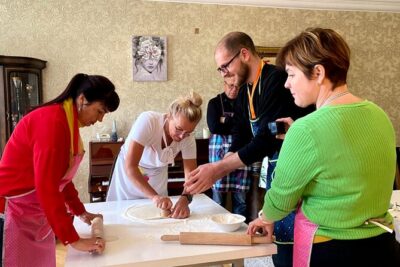
Cook True Ajarian Khachapuri and Khinkali in Highlanders Style
Read our review →
Old Town and Beyond: A Tbilisi Silk Road Feast with Culinary Backstreets
Read our review →
Taste of Kakheti: Wine Tour Bread Baking & Churchkhela Workshop
Read our review →Browse the lists this tour appears in