
Reviewed · GEORGIAN FOOD TOURS
Tbilisi Food Tour in a Local Family
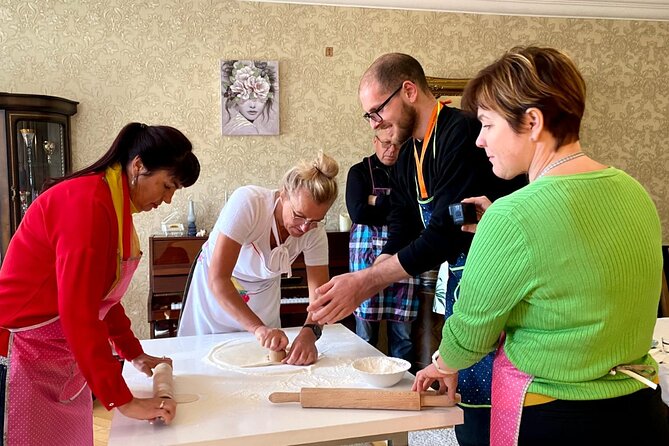
Come hungry, leave with recipes. This evening experience gets you beyond restaurant tables and into a Georgian kitchen, where you help make khinkali, khachapuri, eggplant rolls, salad, mchadi, and cheese. I especially like the hands-on cooking and the chance to share homemade wine and chacha with a real local family. The main consideration is timing: the tour begins at 6 p.m., ends at the family home, and return transport is not included.
I also like the friendly scale of the experience. The maximum is 30 people, but some departures may be much smaller, such as one solo participant joining a couple. Guides including Beka, Buta, Helen, Nina, and Tornike have been praised for warmth, humor, and clear explanations. Expect a generous meal, but not a quick tasting stop. This is an evening built around food, conversation, and a long sit-down meal.
In This Review
- Key things to know before you book
- Starting in Avlabari at 6 p.m.
- Entering a Georgian family kitchen
- Six dishes that explain Georgian cooking
- Homemade wine, chacha, and Georgian hospitality
- What makes the cooking class worth $49
- The practical shape of the evening
- Vegetarian and dietary considerations
- Who will enjoy this most
- The main strengths and limits
- Should you book the family cooking evening?
- FAQ
- How much does the Tbilisi family cooking tour cost?
- How long does the experience last?
- Where does the tour begin?
- Where does the tour finish?
- Is transportation included?
- What food and drinks are included?
- Can vegetarian participants join?
- What is the cancellation policy?
Key things to know before you book
- You cook six Georgian specialties: The menu includes salad, eggplant with walnuts, mchadi, sulguni cheese, khinkali, and khachapuri.
- The evening starts at 6 p.m.: You meet first at Traveler’s Meeting Point in Avlabari, then go by arranged transport to the family home.
- Wine and chacha are included: You receive homemade dry white wine, Georgian chacha, and water.
- The meal is your reward: You eat the food you prepare, so the cooking class also becomes a full Georgian dinner.
- Vegetarian khinkali is available: Ask for it when booking if you do not eat meat.
- Plan your trip home: Transport to the family is included, but transport away from the home is not.
Starting in Avlabari at 6 p.m.
Your evening begins at Traveler’s Meeting Point in Avlabari, a casual place with board games, music, and wine. The listed time here is 30 minutes, giving you a little room to meet the guide and settle in before the cooking part begins.
This first stop is useful if you are new to Tbilisi. It gives you a clear meeting place near public transportation rather than asking you to find a private home on your own. The tour is offered in English, and confirmation arrives when you book.
From the meeting point, transport takes you to the local family. The included ride matters because the end point is at 45 Gigo Zaziashvili Street, outside the starting location. The exact route may vary, and some accounts describe a taxi ride with the guide to a home in the suburbs.
The tour is listed at about three hours, with roughly 30 minutes at the meeting point and 2 hours 30 minutes in the kitchen. One description refers to a longer four-hour evening, and some guides have added city stops such as a cathedral or the funicular. Treat the cooking portion and family meal as the reliable core, while extra city sightseeing may depend on the departure.
More Food Tours in Tbilisi:
- Tbilisi: Georgian Cooking Class with Khinkali and Khachapuri
★ 4.7 · 1,146 reviews - Private Tbilisi Food Tour: 9 Tastings Walk in Bohemian District
★ 5.0 · 227 reviews - Small-Group Khinkali and Khachapuri Cooking Class in Tbilisi
★ 4.5 · 224 reviews
Entering a Georgian family kitchen
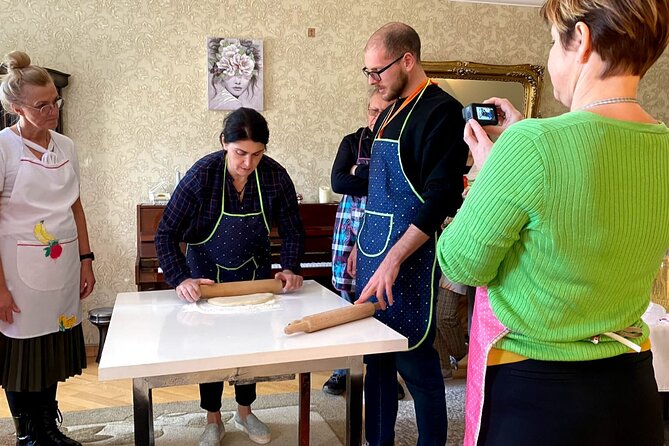
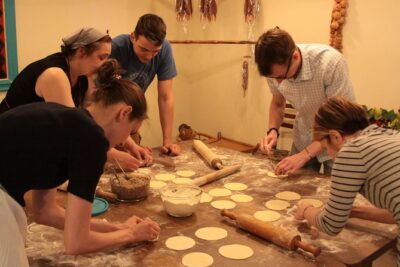
The heart of the evening is a traditional home kitchen. A local cook teaches you how to prepare several of Georgia’s best-known dishes, then you sit down and eat what you made.
That format gives you something a restaurant cannot. You learn how Georgian food is put together, not just how it tastes after someone else has done the work. You can ask questions as you go, and the pace allows time for conversation about daily life in Georgia.
The family setting is also the reason to choose this tour instead of a standard cooking school. You are not simply moving between workstations in a commercial kitchen. You are visiting a private home, meeting the people connected with the cooking, and sharing food in a setting that feels personal.
The experience is social, but it is not designed as a loud party. One account describes it as quiet, with plenty of time to discuss life in Georgia. That makes it a good fit if you want a relaxed evening rather than a crowded tasting crawl.
Six dishes that explain Georgian cooking
The menu covers a useful range of Georgian flavors and textures. You are not learning one showcase recipe and then leaving. You work through several dishes that together form a proper meal.
Cucumber and tomato salad is the simple opening course. Georgians commonly serve fresh vegetables alongside heavier foods, and this salad gives the meal a clean, crisp start.
Eggplant rolls with walnuts show one of Georgia’s most recognizable combinations. Soft eggplant is paired with a walnut filling, creating a filling but meat-free starter. If you enjoy plant-based food, this is one of the more interesting parts of the menu.
Mchadi is Georgian cornbread, traditionally served with beans and cheese. It is plain in appearance but important at the table. The meal uses it with sulguni, a mild semi-firm Georgian cheese.
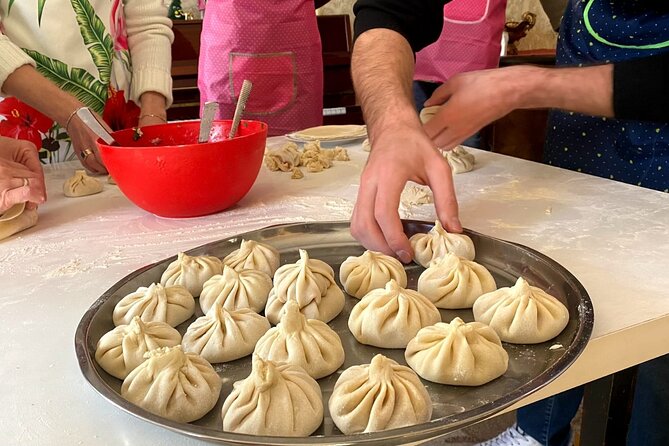
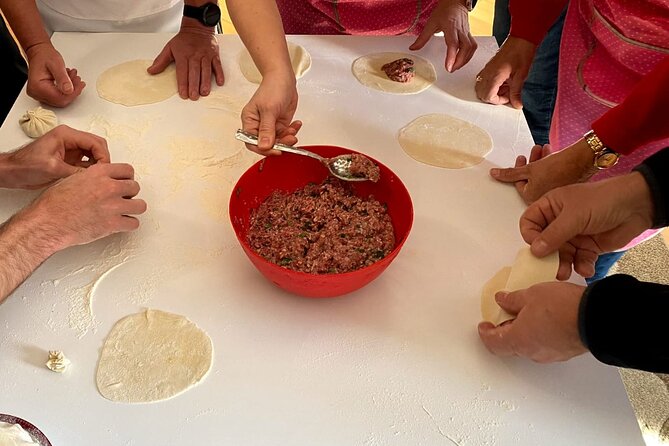
Khinkali are the famous dumplings. Making them is likely to be one of the most enjoyable tasks because shaping the dough and filling takes some practice. The menu can include meat dumplings, and vegetarian khinkali are available by request.
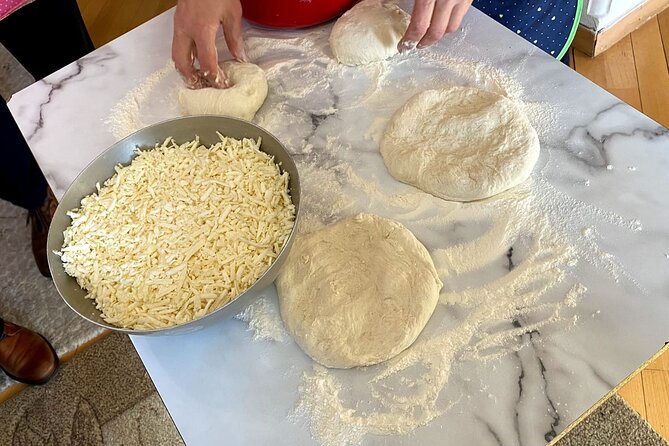
Khachapuri is cheese-filled bread, one of the dishes most visitors associate with Georgia. It is warm, filling, and best eaten fresh from the kitchen. The class lets you see the work behind the bread rather than treating it as a mysterious restaurant specialty.
The sixth element is sulguni cheese, served as part of the meal rather than treated as a separate lesson. It works well with mchadi and helps round out a table that leans toward bread, dough, vegetables, nuts, and cheese.
Together, these dishes make the meal substantial. Do not eat a large dinner beforehand. You will be making several courses, and the final table is described as more food than some people can finish.
Homemade wine, chacha, and Georgian hospitality
Wine is not an afterthought here. You receive homemade dry white wine with the meal, along with chacha, Georgia’s strong grape spirit. Water is also included, which is welcome during a food-heavy evening.
Chacha can be powerful, so pace yourself. The point is to taste it and enjoy the Georgian custom of raising a glass, not to turn the cooking class into a drinking contest. If you do not drink alcohol, the food and instruction remain the main reason to book, but the supplied information does not specify a nonalcoholic wine alternative.
The social side of the evening is one of its strongest features. Guides such as Beka, Buta, Helen, Nina, and Tornike have been singled out for being warm, funny, and easy to talk with. One solo participant felt included while joining a couple, which suggests the format can work well for people traveling alone.
The guide also helps connect the food to Georgian culture. Beka, in particular, has been praised for explaining the country’s food and history while helping people through each recipe. You may leave with more than a list of ingredients. You may also understand why shared meals matter so much in Georgia.
More things to do in Tbilisi:
- Tbilisi: Day Trip to Kazbegi, Gudauri, Gergeti, and Ananuri
★ 4.9 · 3,203 reviews - Day Trip to Kakheti Wine Region Including 9 Wine Tastings
★ 5.0 · 2,774 reviews - Highlights of Caucasus Mountains-Jinvali,Ananuri,Gudauri,Kazbegi(Group tour)
★ 5.0 · 2,682 reviews - From Tbilisi: Kakheti Wine Region Tour with 9 Wine Tastings
★ 4.9 · 2,541 reviews
What makes the cooking class worth $49
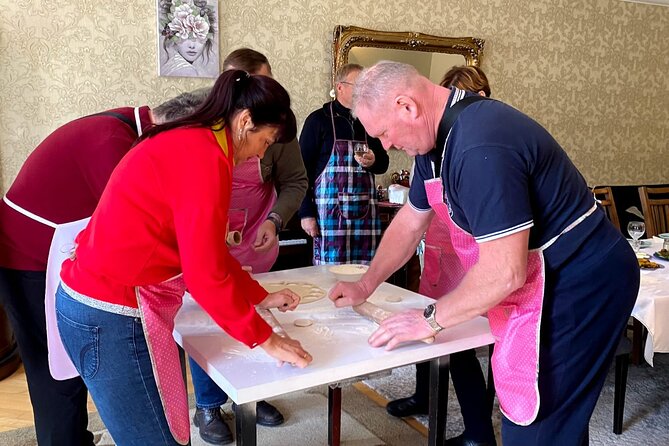
At $49 per person, this is not the cheapest way to eat in Tbilisi. You can order khachapuri or khinkali in a restaurant for far less. The price makes more sense when you count the full package: an English-speaking guide, transport to the home, instruction, six foods, homemade wine, chacha, water, and the meal you prepare.
You are also paying for access. A family kitchen is not something you can easily arrange on your own during a short visit. The guide handles the meeting point and transport, while the host provides the setting, food, equipment, and recipes.
The recipes add lasting value. One participant received recipes to recreate the meal at home in the United Kingdom. That changes the experience from a single dinner into a practical souvenir. Khinkali and khachapuri are far more memorable when you know you can try them again after returning home.
The tour is especially good value if you want one evening that combines cooking, cultural exchange, and dinner. It is less compelling if you only want quick food samples, a formal sightseeing route, or a short activity between other plans.
The practical shape of the evening
The start time is fixed at 6 p.m., and the tour operates in all weather. Dress for the conditions, especially since you will travel between the meeting point and the family home. The kitchen portion is indoors, but the transfer is part of the evening.
The tour can accept up to 30 people. That is a fairly large maximum for a home visit, so ask about the expected group size if a small gathering is important to you. Some departures have been notably intimate, with only three participants, while the published capacity allows for a much bigger group.
The meeting point is near public transportation, but the tour includes transport only from the meeting place to the family home. You must arrange your own way back from 45 Gigo Zaziashvili Street. This is the detail most likely to catch people out. Keep your phone charged, and decide in advance how you will return to your accommodation.
The tour ends at the family home rather than back in Avlabari. That arrangement is practical for the host, but less convenient if you have evening plans near the old city. I would not schedule a concert, theater performance, or timed reservation immediately afterward.
Gratuities for the guide are not included. Bring some cash if you feel the guide added value through translation, cooking help, or extra city explanations.
Vegetarian and dietary considerations
Vegetarian khinkali are available upon request, which is useful because the menu otherwise includes the possibility of meat dumplings. A participant who avoided pork was accommodated with beef and cheese khinkali, showing that the host can adjust at least some ingredients.
Still, you should state your needs before the tour rather than waiting until the kitchen. The supplied details confirm vegetarian khinkali and a pork-free adjustment, but they do not promise solutions for every allergy or dietary restriction.
The menu is naturally friendly to vegetarians in several places. Eggplant with walnuts, tomato and cucumber salad, mchadi, sulguni, and khachapuri can form a satisfying meal. If you need a strictly vegan menu, ask before booking because cheese, bread preparation, and shared cooking surfaces may matter.
Who will enjoy this most
I would choose this tour if you want to meet local people and prefer participation over passive sightseeing. It suits couples, solo visitors, and small groups who enjoy sitting down for a generous meal after doing some work.
It is also a strong choice for anyone planning to visit Georgia’s food markets or restaurants afterward. Once you have shaped a dumpling or handled the dough for khachapuri, menu terms become easier to recognize.
Families with older children may enjoy it, but the supplied information does not give a minimum age or child pricing. Anyone who dislikes long meals, group activities, or strong spirits may find the evening less appealing.
You should also consider your appetite. The cooking class produces a great deal of food, and the meal is not a small sampler. Come ready to eat, but do not arrive stuffed.
The main strengths and limits
The strongest part is the combination of instruction and hospitality. You are not only shown a dish. You make it, eat it, and can take the method home. That hands-on element receives the most consistent praise.
The guides are another major strength. Beka, Buta, Helen, Nina, and Tornike are associated with friendly service, clear help in the kitchen, humor, and stories about Georgia. A good guide matters here because translation and timing can make the difference between a relaxed class and a confusing one.
The biggest limits are logistical. The tour ends away from the starting point, return transport is excluded, and the evening may run longer than the advertised approximate three hours if extra sightseeing or conversation is added.
The 30-person maximum is also worth noting. A small group should feel personal, but a full group in a private home could feel less comfortable during food preparation. If quiet conversation is important, request the expected group size.
Should you book the family cooking evening?
Book it if your idea of a good Tbilisi night includes making dinner with local people, tasting homemade wine, and learning recipes you can use later. At $49, the value comes from the access, transport, instruction, drinks, and full meal rather than from the raw cost of the food.
Skip it if you need a quick activity, a guaranteed return to Avlabari, or a tightly timed sightseeing tour. For most food-focused visitors, though, this is a generous and friendly introduction to Georgian cooking, with enough conversation to make the meal feel personal rather than staged.
Free cancellation is available when you cancel at least 24 hours before the 6 p.m. start. Changes or cancellations inside that window are not accepted for a refund.
FAQ
How much does the Tbilisi family cooking tour cost?
The price is $49 per person.
How long does the experience last?
It is listed as approximately three hours, including 30 minutes at the meeting point and about 2 hours 30 minutes at the family home.
Where does the tour begin?
It begins at Traveler’s Meeting Point in Avlabari, Tbilisi, at 6 p.m.
Where does the tour finish?
The tour finishes at the local family home at 45 Gigo Zaziashvili Street, Tbilisi 0102.
Is transportation included?
Transportation from the meeting place to the family home is included. Transportation from the family home afterward is not included.
What food and drinks are included?
You prepare and eat cucumber and tomato salad, eggplant with walnuts, mchadi, sulguni cheese, khinkali, and khachapuri. Homemade dry white wine, homemade chacha, and water are also included.
Can vegetarian participants join?
Yes. Vegetarian khinkali are available upon request.
What is the cancellation policy?
You can cancel at least 24 hours before the experience start time for a full refund. Cancellations or changes made less than 24 hours before the start are not accepted for a refund.
Just added in Tbilisi
- Wine Tasting feel the Difference of Qvevri or Classical Wine★ 4.4 · 10 reviews
- From Tbilisi: Kakheti and Kazbegi 2-Day 4X4 Jeep Tour pack★ 5.0 · 6 reviews
- Walking Tour in Old Tbilisi – Group Tour★ 4.5 · 8 reviews
- Uforgatable Kakheti Tour with wine tasting – in Georgia★ 4.9 · 5 reviews
- From Tbilisi: Uplistsikhe Caves and Mtskheta Town Day tour★ 5.0 · 2 reviews
- Tbilisi: Vintage Fashion and Secondhand Thrifting Tour★ 5.0 · 11 reviews
- Tbilisi Airport to Gudauri, Bakuriani, Batumi, Tbilisi★ 5.0 · 3 reviews
- Private Adorable City Tour of Tbilisi★ 5.0 · 3 reviews
Georgian Food Tours, compared.
Georgian Cooking Class with Khinkali and Khachapuri
Read our review →
Private Tbilisi Food Tour: 9 Tastings Walk in Bohemian District
Read our review →
Small-Group Khinkali and Khachapuri Cooking Class in Tbilisi
Read our review →
Cook True Ajarian Khachapuri and Khinkali in Highlanders Style
Read our review →
Old Town and Beyond: A Tbilisi Silk Road Feast with Culinary Backstreets
Read our review →
Taste of Kakheti: Wine Tour Bread Baking & Churchkhela Workshop
Read our review →
Nana’s Kitchen – traditional Georgian cooking class at real Georgian family home
Read our review →Browse the lists this tour appears in