
Reviewed · GEORGIAN FOOD TOURS
Half-Day Food Tour of Tbilisi Dezerter’s Bazaar
Follow your appetite through Tbilisi. This five-and-a-half-hour outing combines the Dezerter’s Bazaar with a local meal and Georgian wine tasting, giving you a useful introduction to the city through food rather than formal sightseeing. I like the direct contact with market sellers, and I like the easy progression from shopping and tasting to lunch and wine.
The private format means your group gets the guide’s full attention, while Paul’s friendly ties with vendors add a personal touch. The main drawback is clear: the food stops may not suit anyone with a nut allergy, and the $125 price is high if you only want a quick market walk.
In This Review
- Key things to know before you book
- Why the Dezerter’s Bazaar matters
- Meeting Paul and getting the morning started
- Tasting your way through Georgian ingredients
- Georgian bread at the tone oven
- Lunch with ghobi, pkhali, cheese, and cornbread
- Georgian wine at a respected wine bar
- What the $125 price really covers
- Who will enjoy this Tbilisi food tour most
- Practical details that affect your day
- Should you book the Dezerter’s Bazaar tour?
- FAQ
- Where does the tour start?
- What time does the tour begin?
- How long does the experience last?
- Where does the tour end?
- Is the tour private?
- What language is the tour offered in?
- How much does the tour cost?
- What food is included?
- Is wine included?
- Is the tour suitable for people with nut allergies?
- Can I cancel for a full refund?
Key things to know before you book
- The market is the heart of the tour: You visit Tbilisi’s central Dezerter’s Bazaar, meet vendors, and sample local products.
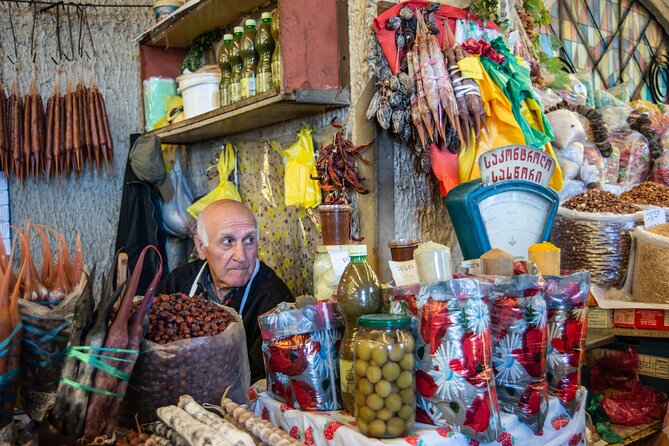
- Paul is the guide to look for: His local connections include the Spice Girl, a honey seller, and bakers known for traditional bread.
- The food keeps coming: Expect pkhali, jonjoli, Georgian cheeses, cornbread, lobiani, and tkemali.
- Lunch is part of the experience: A notable local restaurant provides a more settled meal after the market.
- Wine comes at the end: The tour finishes with a selective tasting of Georgian wines at a respected wine bar.
- It is a private English-language outing: Only your group participates, with a 10:00 am start and return to the meeting point.
Why the Dezerter’s Bazaar matters
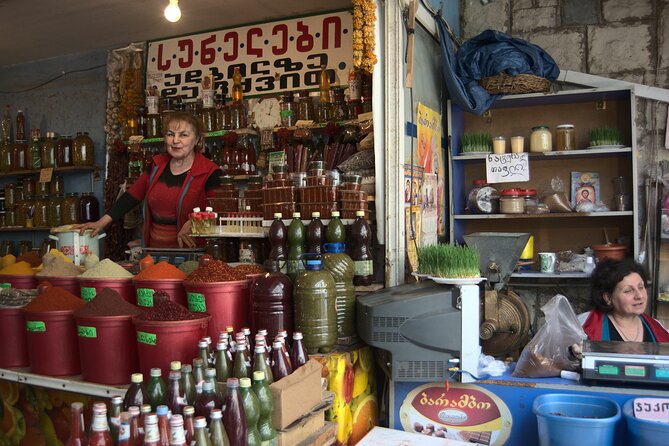
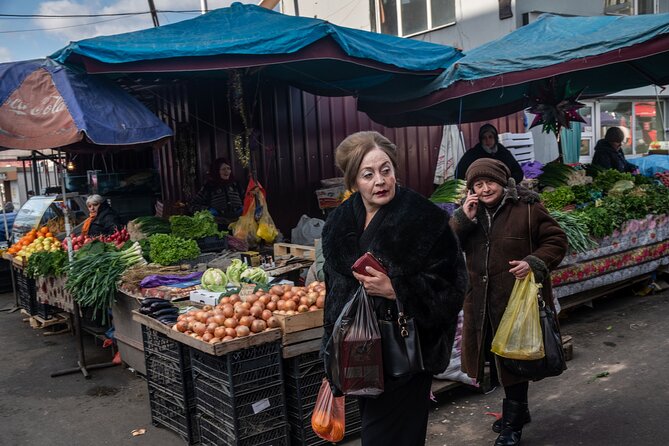
The Dezerter’s Bazaar is not simply a place to buy groceries. It is the working food market of central Tbilisi, where produce, spices, bread, dairy products, sauces, and other ingredients move through the hands of local sellers.
That makes it a smart first stop for anyone trying to understand Georgian cooking. Instead of seeing finished dishes on a restaurant plate, you get a look at the ingredients and techniques behind them. Your guide can help explain what you are seeing and turn a row of unfamiliar products into a useful food lesson.
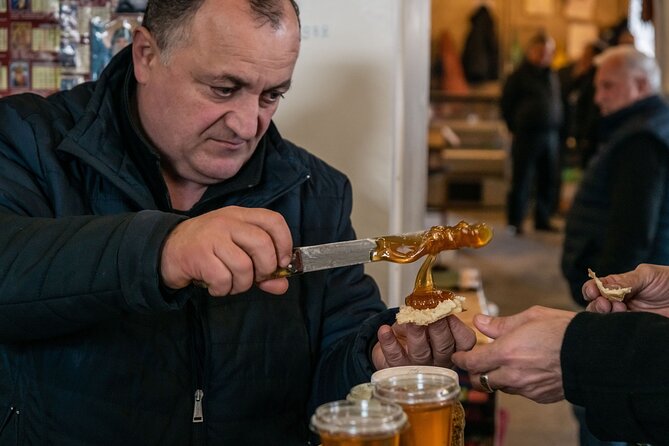
I especially like the focus on meeting vendors. A market can feel confusing if you do not know what to ask for or which products matter. Paul’s long-standing connections are meant to make the visit more personal, with introductions to sellers such as the Spice Girl, the honey lady, and skilled bakers.
Those details matter. A guide who knows the people behind the stalls can help you move beyond a quick photograph and a casual sample. You get context about how particular foods fit into Georgian meals and daily life.
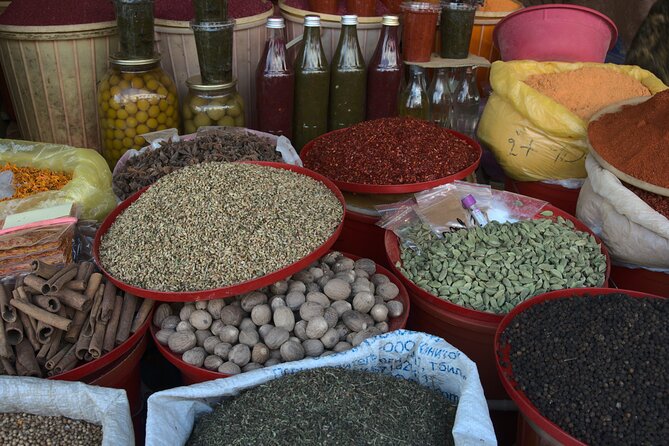
The market is also a good place to let your senses do some work. You might encounter strong spices, fresh herbs, cheeses, fruit products, bread, sauces, and sweets. The exact selection depends on the season and the vendors, so you should expect a food-focused visit rather than a fixed museum-style display.
More Food Tours in Tbilisi:
- Tbilisi: Georgian Cooking Class with Khinkali and Khachapuri
★ 4.7 · 1,146 reviews - Private Tbilisi Food Tour: 9 Tastings Walk in Bohemian District
★ 5.0 · 227 reviews - Small-Group Khinkali and Khachapuri Cooking Class in Tbilisi
★ 4.5 · 224 reviews
Meeting Paul and getting the morning started
The tour begins at 10:00 am by the Shota Rustaveli Monument at 2 Mikheil Zandukeli Street. That central meeting point is near public transportation, which makes it practical if you are staying elsewhere in Tbilisi.
Because this is a private tour, your group does not have to merge with strangers. That can make a real difference in a market, where a small group is easier to keep together and better suited to conversations with sellers.
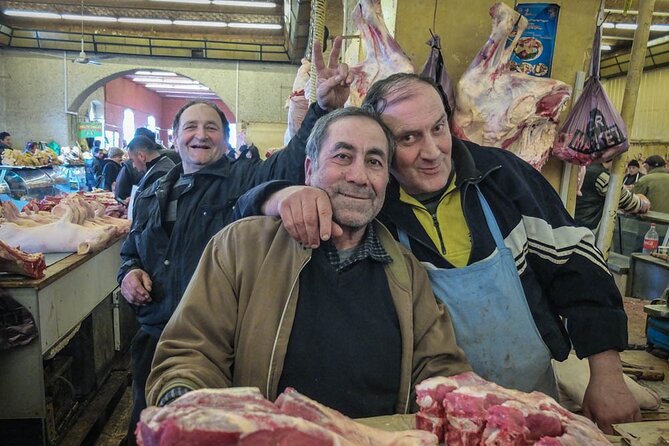
Paul is repeatedly praised for turning the morning into more than a sequence of tastings. His role is part guide, part food translator, and part social host. He is also described as having a strong grasp of Georgian and Tbilisi history, so you can ask questions about the city as you move between food stops.
You should still allow time to reach the monument early. The tour starts at a set time, and the cancellation terms become strict within 24 hours of departure. Confirmation arrives when you book, and the mobile ticket is convenient for a morning meeting.
Tasting your way through Georgian ingredients

The market section is where the tour feels most distinctive. You are not only being told what Georgian food is. You are tasting individual ingredients before seeing how they come together in a meal.
One likely focus is pkhali, a family of vegetable-based preparations often mixed with walnuts, herbs, and seasoning. It is an important part of Georgian food culture because it shows how vegetables can be turned into strongly flavored starters rather than treated as a side note.
Jonjoli is another useful introduction. These pickled flower buds have a sharp, unusual flavor and may be unfamiliar if Georgian food is new to you. A market tasting gives you a chance to try them in a small portion before ordering them at a restaurant.
You will also encounter Georgian cheeses and cornbread. These are simple foods, but they help show the everyday foundation of the cuisine. The meal later includes both as part of a larger ghobi, so the morning tasting can give you a preview of what comes next.
The vendor visits are also a chance to ask questions that are hard to answer from a menu. You can learn which products are seasonal, how sauces are used, and what locals buy for a family table. The tour is strongest when you stay curious and ask Paul to pause over things you do not recognize.
Georgian bread at the tone oven
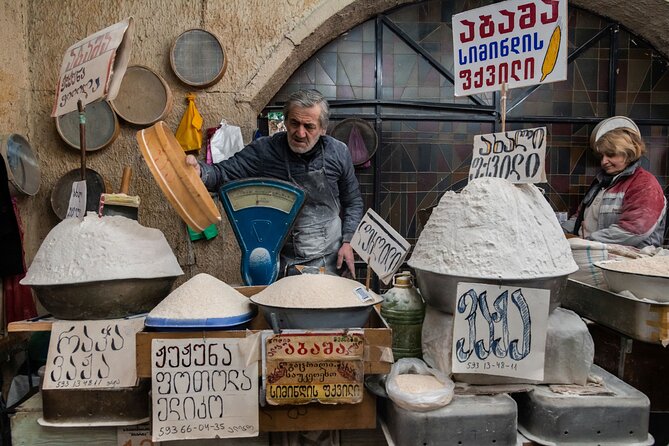
Bread gets its own moment with tonis lobiani, a bean-filled bread baked in a traditional tone oven. The bread is both a snack and a useful example of Georgian baking.
The tone oven is central to the character of this stop. It produces a firm, baked exterior and a warm interior filled with seasoned beans. Tonis lobiani is filling without being elaborate, which makes it a good market food during a long morning of walking and tasting.
This is one of the more practical parts of the itinerary. You are not only sampling a famous dish in a restaurant setting. You are seeing how a familiar Georgian food can be made and eaten in an everyday neighborhood setting.
Keep in mind that the menu is substantial. A bean-filled bread, market samples, lunch starters, and wine can add up quickly. If you prefer to eat lightly in the morning, take small portions and pace yourself.
More markets in Tbilisi:
- Tbilisi: Mtskheta Jvari Bazaar, Chronicles of Georgia & Wine
★ 5.0 · 1,088 reviews - Tbilisi:Mtskheta,Jvari,Bazaar,wine tasting,Chronicles of Georgia
★ 5.0 · 730 reviews - Tbilisi: Street Art & Dezerter Bazaar Tour w/ Tastings
★ 4.8 · 30 reviews - Join a Local for a Market Tour, Cooking Class and Meal in her Tbilisi Home
★ 5.0 · 15 reviews
Lunch with ghobi, pkhali, cheese, and cornbread
After the market, the group sits down at a notable local restaurant for regional specialties. This change of pace is useful. The bazaar provides movement, noise, and quick samples, while lunch lets you settle in and think about what you have tasted.
The main dish is ghobi, presented as a large bowl of seasonal starters. It includes pkhali, jonjoli, a cheese assortment, and cornbread. In Georgian dining, a spread of shared starters can be as important as a single main course, and this platter gives you several textures and flavors in one sitting.
The menu also lists homemade tkemali, a sour plum sauce made from spur plums. Tkemali is one of the key sauces associated with Georgian cooking. Its sharp fruit flavor cuts through richer foods and gives the meal a lively edge.
The exact menu may shift with the season, since the ghobi is built around seasonal starters. That is a positive for freshness, but it means you should not treat every item as guaranteed in precisely the same form. The listed menu gives you a reliable sense of the style: shared foods, vegetables, cheese, bread, and bold sauces.
Lunch also gives you a chance to ask Paul about what you have seen at the market. The meal is not an isolated restaurant reservation. It works as the middle chapter of a food lesson, connecting raw ingredients and vendor culture with dishes on the table.
Georgian wine at a respected wine bar
The final food-and-drink stop is a selective tasting of artisanal Georgian wines at a renowned wine bar. This is a fitting end because Georgian wine is not just another drink added to the itinerary. It is closely tied to the country’s food traditions and social life.
The word selective is useful here. You are not promised an endless drinking session or a giant list of labels. The point is to taste a chosen group of wines and understand more about what you are drinking.
The wine stop also slows the rhythm of the day. After a market, bread tasting, and full lunch, a seated tasting gives you time to compare styles and ask questions. The tour’s social atmosphere may include celebratory toasts with wine and chacha, according to the experience described by past participants, so you should expect a convivial rather than strictly formal tasting.
If you do not drink alcohol, the supplied details do not state what nonalcoholic alternatives are available. You should ask the provider before booking if that matters to you.
For wine lovers, this part may justify much of the tour’s price. Georgian wine can be difficult to understand if you encounter it only as a name on a restaurant list. A guide who can connect the wine to local food and customs makes the tasting more useful.
What the $125 price really covers
At $125 per person, this is not a budget market walk. You are paying for roughly five hours and thirty minutes of guiding, a private format, market tastings, restaurant food, and a wine experience.
The value depends on how you normally travel. If you would otherwise book a market visit, a restaurant meal, and a wine tasting separately, the combined structure is convenient and may offer better value than arranging each part yourself. You also gain Paul’s personal introductions, which are difficult to reproduce with a guidebook.
The price is less attractive if you only want to browse the bazaar or buy a few snacks. You could spend much less on an independent market visit and a casual meal. This tour earns its price through access, explanation, and the full food-to-wine sequence.
The private setup is another part of the calculation. Only your group participates, so you can ask more questions and move at a pace that suits you. Couples, families, and small groups who value personal attention will likely find this more worthwhile than solo visitors focused on keeping costs down.
Who will enjoy this Tbilisi food tour most
I would recommend this experience to people who plan trips around eating and want an introduction with local context. It is especially well suited to first-time visitors who want to understand Georgian food before ordering on their own.
It also fits people who enjoy markets but do not always know how to approach them. Paul’s vendor relationships give the bazaar a clearer shape, and the names attached to the stops make the morning more memorable than a simple walk past food stalls.
Wine drinkers should pay attention to the final tasting. The combination of market foods, lunch, and Georgian wine creates a useful picture of how ingredients, cooking, and social customs connect.
This may be less suitable for anyone who dislikes shared starters, has a nut allergy, or wants a quiet and minimalist meal. Pkhali often contains walnuts, and the tour explicitly says it is not recommended for people with nut allergies. You should not assume that an allergy can be handled safely without direct confirmation from the provider.
The tour also requires a fairly long morning and early afternoon commitment. At five and a half hours, it is not a quick stop between major sights. Plan your day around it rather than trying to squeeze it into a packed schedule.
Practical details that affect your day
The tour is offered in English and uses a mobile ticket. It begins at the Shota Rustaveli Monument and ends back at that same meeting point, which simplifies your plans afterward.
It is near public transportation, though the supplied details do not specify a particular bus, metro route, or walking time. You should check your route before the morning begins and arrive ready for the 10:00 am start.
Most people can participate, but the experience includes a market visit, several tastings, a restaurant meal, and a wine bar. If you have dietary restrictions beyond the stated nut warning, ask about them before reserving. The published menu is specific, but seasonal food and vendor samples can change.
Free cancellation is available if you cancel at least 24 hours before the start time. Cancellations made less than 24 hours ahead are not refunded, and late changes are not accepted. The cut-off follows Tbilisi local time, so keep that in mind if you are booking from another country.
Should you book the Dezerter’s Bazaar tour?
Book it if you want a guided introduction to Tbilisi through people, ingredients, shared food, and Georgian wine. The strongest reasons are the private format, Paul’s vendor connections, the market-to-restaurant progression, and the final tasting.
Skip it if you are mainly looking for a cheap market stroll, if you have a nut allergy, or if you prefer to choose every dish and drink yourself. At $125, the tour needs to be judged as a full half-day food program, not as a simple bazaar visit.
For the right visitor, it offers a clear and enjoyable way to get oriented. You leave with a better sense of pkhali, jonjoli, lobiani, tkemali, Georgian cheese, cornbread, and wine, along with a few local faces to remember.
FAQ
Where does the tour start?
The tour starts at the Shota Rustaveli Monument, 2 Mikheil Zandukeli Street, Tbilisi, Georgia.
What time does the tour begin?
The start time is 10:00 am.
How long does the experience last?
The tour lasts approximately five hours and thirty minutes.
Where does the tour end?
The activity ends back at the meeting point at the Shota Rustaveli Monument.
Is the tour private?
Yes. Only your group participates in the activity.
What language is the tour offered in?
The tour is offered in English.
How much does the tour cost?
The listed price is $125 per person.
What food is included?
The sample menu includes ghobi with pkhali, jonjoli, a cheese assortment, and cornbread. It also includes tonis lobiani, a bean-filled bread baked in a tone oven, and homemade tkemali sauce.
Is wine included?
The experience includes a select tasting of artisanal Georgian wines at a renowned wine bar.
Is the tour suitable for people with nut allergies?
It is not recommended for people with nut allergies.
Can I cancel for a full refund?
Yes, if you cancel at least 24 hours before the experience begins. Cancellations made less than 24 hours before the start time are not refunded.
Just added in Tbilisi
- Wine Tasting feel the Difference of Qvevri or Classical Wine★ 4.4 · 10 reviews
- From Tbilisi: Kakheti and Kazbegi 2-Day 4X4 Jeep Tour pack★ 5.0 · 6 reviews
- Walking Tour in Old Tbilisi – Group Tour★ 4.5 · 8 reviews
- Uforgatable Kakheti Tour with wine tasting – in Georgia★ 4.9 · 5 reviews
- From Tbilisi: Uplistsikhe Caves and Mtskheta Town Day tour★ 5.0 · 2 reviews
- Tbilisi: Vintage Fashion and Secondhand Thrifting Tour★ 5.0 · 11 reviews
- Tbilisi Airport to Gudauri, Bakuriani, Batumi, Tbilisi★ 5.0 · 3 reviews
- Private Adorable City Tour of Tbilisi★ 5.0 · 3 reviews
Georgian Food Tours, compared.

Georgian Cooking Class with Khinkali and Khachapuri
Read our review →
Private Tbilisi Food Tour: 9 Tastings Walk in Bohemian District
Read our review →
Small-Group Khinkali and Khachapuri Cooking Class in Tbilisi
Read our review →
Cook True Ajarian Khachapuri and Khinkali in Highlanders Style
Read our review →
Old Town and Beyond: A Tbilisi Silk Road Feast with Culinary Backstreets
Read our review →
Taste of Kakheti: Wine Tour Bread Baking & Churchkhela Workshop
Read our review →Browse the lists this tour appears in