

Reviewed · WALKING TOURS
Walking Tour Tbilisi: From the USSR to the 1st Female President
Politics comes alive on Tbilisi’s streets. This compact walking tour links the Parliament, April 9 Park, Orbeliani Palace, and House of Justice to explain how Georgia moved from Soviet rule toward its modern democratic system. I like the clear focus on recent history and the chance to connect grand civic buildings with real political events.
I also like the private format and the guide’s flexible conversation. Irakli is praised for making complex subjects understandable, answering questions, and fitting a surprising amount into 45 minutes to an hour. The main consideration is simple: you will see the buildings from outside, and the short length leaves little room for a broad tour of Tbilisi.
In This Review
- Key points at a glance
- Why this small tour matters in Tbilisi
- Starting at Parliament on Rustaveli Avenue
- April 9 Park and the memory of 1989
- Orbeliani Palace and Georgia’s first female president
- Finishing at the House of Justice
- What you can cover in one hour
- Who will get the most from this walk?
- Value when the tour has no listed price
- Practical details before you go
- Should you book Walking Tour Tbilisi?
- FAQ
- Where does the walking tour begin?
- Where does the tour end?
- How long does the tour last?
- What language is the tour offered in?
- Do visitors enter the Parliament, presidential palaces, or House of Justice?
- Is the tour private?
- What happens if bad weather cancels the tour?
Key points at a glance
- Parliament meeting point: Begin at 8 Shota Rustaveli Avenue, in front of one of Georgia’s main political institutions.
- April 9 Park: Learn about the tragic events of April 9, 1989, an important date in Georgia’s break from Soviet control.
- Two presidential palaces: Find out why Georgia has two presidential residences and why the country’s first female president moved to Orbeliani Palace in 2018.
- Private English tour: Your group participates alone, making it easier to ask direct questions about Georgia’s politics and society.
- House of Justice finish: End beside one of Tbilisi’s most recognizable public buildings while discussing the legal system and present-day politics.
- Short, useful introduction: The tour suits an arrival day, a tight schedule, or anyone wanting political context before exploring more of Georgia.
Why this small tour matters in Tbilisi
Many city walks focus on churches, balconies, baths, and old streets. Those are essential parts of Tbilisi, but they do not fully explain the country you are seeing today. Georgia’s recent past is written in its government buildings, memorial parks, public protests, and debates over national identity.
This walk takes a different route. It concentrates on the institutions and places tied to Georgian democracy. You will not spend hours moving between distant sights. Instead, the guide uses a handful of central locations to explain political change since the end of the Soviet period.
That narrow focus is the tour’s biggest strength. You are not given a rushed list of dates. The stops create a simple thread: Soviet rule, public resistance, independence, the presidency, and the legal institutions that shape daily life.
I would think of this as a history and civics lesson conducted outdoors, not as a standard sightseeing circuit. If you want interiors, museum exhibits, or a long architectural explanation, this will feel limited. If you want a quick way to understand why modern Georgia works and argues as it does, it offers good use of an hour.
More Walking Tours in Tbilisi:
- Tbilisi Walking Tour Including Cable Car and Traditional Bakery
★ 5.0 · 1,310 reviews - Tbilisi: City Highlights Guided Walking Tour
★ 4.9 · 1,114 reviews - Tbilisi:Evening Walking & Talking Tour with Wine & Boat Ride
★ 5.0 · 572 reviews
Starting at Parliament on Rustaveli Avenue

The meeting point is in front of the Parliament of Georgia at 8 Shota Rustaveli Avenue. That location immediately gives the walk a serious tone. Parliament is not simply a backdrop for photographs here. It is the starting point for a discussion of power, public life, and the difficult process of building a democratic state after the Soviet era.
Your guide, Irakli, is central to the experience. His role is not just to point toward buildings. He explains the political developments behind them and invites questions. Several comments describe him as attentive, committed, and able to make a complicated subject easier to follow.
That matters because Georgian politics can be hard to grasp from headlines alone. Names, parties, wars, constitutional changes, and relations with Russia can quickly blur together. A good guide gives you a basic framework, so later conversations and news reports make more sense.
The meeting area is near public transportation, which makes it practical to fit the tour into a day of sightseeing. You should arrive ready to walk at a moderate pace. The tour is short, but you will be outdoors and moving between stops, so comfortable shoes are sensible.
April 9 Park and the memory of 1989
The walk continues through April 9 Park, a pleasant green space with a painful political story. Here, the guide discusses the events of April 9, 1989, a date that remains important in Georgia’s modern national memory.
The value of this stop is the connection between an ordinary city park and a turning point in the country’s history. Without explanation, you might pass through it as a quiet shortcut. With context, the place becomes part of the story of Georgian resistance and the long road away from Soviet rule.
The tour does not promise a lengthy memorial visit or a formal museum presentation. Instead, expect a spoken account while walking through the park. That format keeps the tour moving, but it also means you should listen closely and ask questions when something is unclear.
This is probably the most emotionally important stop. It gives the political story a human side. You are not only learning how governments changed. You are considering the people and public events that helped shape Georgia’s future.
For first-time visitors, this background is useful well beyond the tour itself. It can change how you view later monuments, public squares, and conversations about independence. A short explanation here may give more context than a long list of dates elsewhere.
Orbeliani Palace and Georgia’s first female president
One of the most unusual parts of the walk is the discussion of Georgia’s two presidential palaces. The tour explains why both exist and why the country’s first female president moved to Orbeliani Palace in 2018.
This is a good example of the tour’s practical method. Instead of treating a palace as just an impressive façade, it uses the building to raise questions about how the presidency functions. Why are there two residences? What does a change in official location suggest about political style, symbolism, and the relationship between government and the public?
You will not enter the palace. That limitation should be clear before booking. The interest comes from the explanation and the exterior setting, not from grand rooms or official displays.
The palace stop also gives the tour a current feel. Some historical walks stop at the end of the Soviet Union. This one continues into the modern political era, including the arrival of Georgia’s first female president and her move to Orbeliani Palace in 2018.
If you enjoy architecture, you will get more from this stop by paying attention to the contrast between the building and the political role it represents. If you are mainly interested in palace interiors, you may find the visit too brief. The guide’s story is the main attraction.
More things to do in Tbilisi:
- Tbilisi: Day Trip to Kazbegi, Gudauri, Gergeti, and Ananuri
★ 4.9 · 3,203 reviews - Day Trip to Kakheti Wine Region Including 9 Wine Tastings
★ 5.0 · 2,774 reviews - Highlights of Caucasus Mountains-Jinvali,Ananuri,Gudauri,Kazbegi(Group tour)
★ 5.0 · 2,682 reviews - From Tbilisi: Kakheti Wine Region Tour with 9 Wine Tastings
★ 4.9 · 2,541 reviews
Finishing at the House of Justice
The final stop is the House of Justice on the right bank of the Mtkvari River, at 1 Zviad Gamsakhurdia Named Right Bank. This is both the end point and a useful final chapter in the tour.
Here, the discussion turns to Georgia’s legal system and its role in shaping present-day political life. The building represents public administration in a more direct way than a palace does. It is connected to the services people use and to the rules that organize the state.
Again, you do not go inside. The tour uses the exterior as a place to explain institutions rather than offering an architectural tour. That makes the stop especially useful for anyone trying to understand the gap between political ideals and the practical work of government.
Ending at the House of Justice is convenient if you plan to continue along the river or explore another part of central Tbilisi. Since the tour does not return to Parliament, plan your next stop from the right bank rather than assuming you will finish where you started.
The final discussion also ties the tour together. You begin with Parliament, look back at public resistance in April 9 Park, consider the presidency at Orbeliani Palace, and finish with the legal system. The route is short, but the sequence has a clear purpose.
What you can cover in one hour
A 45-minute to one-hour tour cannot explain every major event in Georgian history. That is not a weakness if you treat it as an introduction. The route is designed around a few stops, and the guide uses those stops to build a focused account of political change.
I like this approach for a first visit. You can get a working outline of Georgia’s recent past without giving up half a day. One person described being surprised by how much could fit into 45 minutes, and that seems to be the point: the tour stays narrow so the information does not become scattered.
The private format helps. With only your group taking part, you can ask about subjects that matter to you, such as the presidency, the Soviet period, legal institutions, or the role of ordinary citizens in political change. A larger group can make such a discussion harder.
The tradeoff is that the tour depends heavily on the guide. You are not moving through exhibits with printed explanations. Irakli’s storytelling and ability to respond to questions shape the quality of the hour. The available comments consistently praise his explanations and his pleasant, accommodating manner.
The tour is offered in English. It also has a mobile ticket, which keeps the booking process simple. Confirmation is provided when you book.
Who will get the most from this walk?
I would recommend this experience to you if you:
- Want a quick introduction to Georgia’s modern political story.
- Prefer discussion and context over a long list of monuments.
- Are curious about the Soviet period and the country’s move toward independence.
- Like asking questions in a private setting.
- Have already seen some of Tbilisi’s old town and want a different side of the city.
- Need a short activity that fits between other plans.
It is also a strong choice for visitors who feel that a destination’s politics and recent history are part of understanding its culture. One comment praised the tour as a way to learn about the country and its people, not just its government. That is an important distinction.
I would be more cautious about booking it if you want an interior visit, a broad overview of Georgian art and architecture, or a full-day historical tour. You should also avoid treating this as a relaxed stroll with only occasional commentary. The subject is serious, and much of the value comes from listening.
A moderate level of physical fitness is recommended. The activity is a walking tour, and good weather is required. Service animals are allowed.
Value when the tour has no listed price
A price is not provided in the information available here, so I cannot judge the exact cost against similar tours. I can still explain where the value lies.
The experience offers a private guide, an English-language explanation, a central route, and a compact schedule. For a short tour, those features matter. You are paying for a focused conversation rather than admission to a building or a long transport route.
The value is strongest if this is your first day in Tbilisi. An hour of context can help you understand later sights and conversations. It may also save you from trying to piece together Georgia’s modern political story from disconnected articles.
The value is weaker if you are only looking for famous views or photo stops. The buildings are seen from the outside, and the tour is built around explanation. Before booking, compare the price with other private walking tours and ask yourself if recent political history is worth giving an hour of your schedule.
For me, the compact length is a plus. You do not need to commit to a large block of time, and the end point leaves you free to continue exploring.
Practical details before you go
The tour begins at Parliament and ends at the House of Justice. These are different locations, so plan your route afterward from the right bank. The tour is near public transportation, which helps if you are fitting it around other central Tbilisi plans.
Bring comfortable shoes and dress for the weather. The walk requires a moderate fitness level, and poor weather can lead to cancellation. If weather causes the cancellation, you will be offered another date or a full refund.
You can cancel for a full refund up to 24 hours before the start time. Cancellations made less than 24 hours in advance are not refunded, and changes within that period are not accepted. Cutoff times follow local time in Georgia.
The activity is private, so only your group participates. That is a useful advantage for a political subject, since you can ask direct questions without holding up a large party.
Should you book Walking Tour Tbilisi?
Book it if you want the political key to Tbilisi. The route is short, the subject is distinct, and Irakli’s explanations appear to be the heart of the experience. You will learn about Parliament, the events of April 9, 1989, Georgia’s two presidential palaces, the first female president’s move to Orbeliani Palace, and the legal system represented by the House of Justice.
Do not book it expecting palace interiors or a complete tour of Georgian history. This is a focused outdoor lesson, not a general city walk.
For an hour of your trip, it offers a useful way to understand the country behind the scenery. If that sounds more valuable to you than another pass through the old town, this private walk is a smart choice.
FAQ
Where does the walking tour begin?
The tour begins in front of the Parliament of Georgia at 8 Shota Rustaveli Avenue in Tbilisi.
Where does the tour end?
The walk ends at the House of Justice, located at 1 Zviad Gamsakhurdia Named Right Bank in Tbilisi.
How long does the tour last?
The tour lasts approximately 45 minutes to one hour.
What language is the tour offered in?
The tour is offered in English.
Do visitors enter the Parliament, presidential palaces, or House of Justice?
No. The tour discusses these places from the outside, and visitors do not enter the buildings.
Is the tour private?
Yes. Only your group participates in this private activity.
What happens if bad weather cancels the tour?
If poor weather causes cancellation, you will be offered a different date or a full refund. You can also cancel at least 24 hours before the start time for a full refund.
Just added in Tbilisi
- Wine Tasting feel the Difference of Qvevri or Classical Wine★ 4.4 · 10 reviews
- From Tbilisi: Kakheti and Kazbegi 2-Day 4X4 Jeep Tour pack★ 5.0 · 6 reviews
- Walking Tour in Old Tbilisi – Group Tour★ 4.5 · 8 reviews
- Uforgatable Kakheti Tour with wine tasting – in Georgia★ 4.9 · 5 reviews
- From Tbilisi: Uplistsikhe Caves and Mtskheta Town Day tour★ 5.0 · 2 reviews
- Tbilisi: Vintage Fashion and Secondhand Thrifting Tour★ 5.0 · 11 reviews
- Tbilisi Airport to Gudauri, Bakuriani, Batumi, Tbilisi★ 5.0 · 3 reviews
- Private Adorable City Tour of Tbilisi★ 5.0 · 3 reviews
Walking Tours, compared.
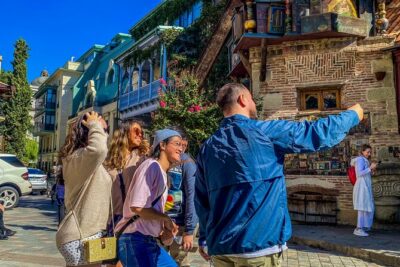
Tbilisi Walking Tour Including Cable Car and Traditional Bakery
Read our review →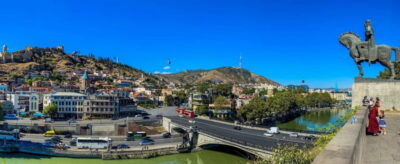
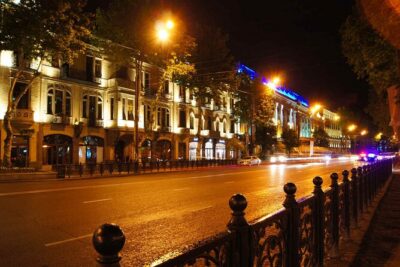
Evening Walking & Talking Tour with Wine & Boat Ride
Read our review →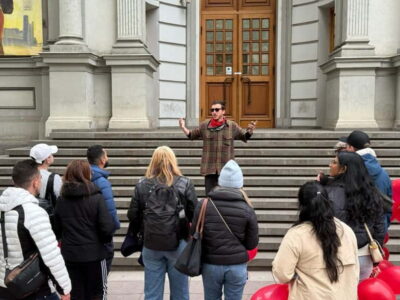
Evening Walking Tour with Wine & Boat Ride Options
Read our review →
Old Tbilisi Highlights walking tour with wine & 10 tastings
Read our review →
Old Tbilisi Tour: Private Walking Tour With Wine Tasting
Read our review →

Private Tbilisi Food Tour: 9 Tastings Walk in Bohemian District
Read our review →Browse the lists this tour appears in