
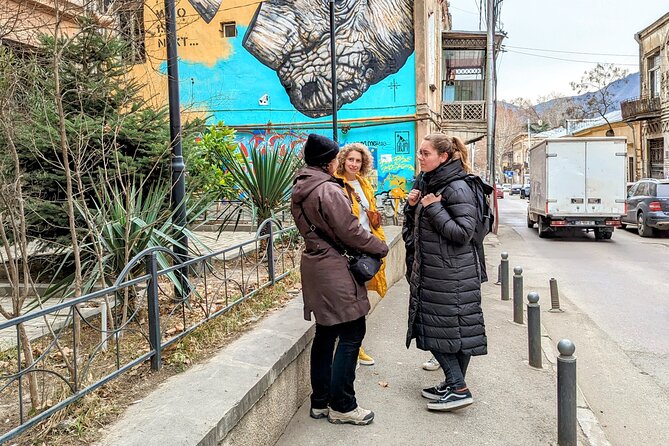
Reviewed · WALKING TOURS
Alternative walking tour New Tiflis and backstreets
Tbilisi rewards walkers who leave the postcard route. This three-hour walk links New Tiflis with colorful markets, old theatres, street art, and everyday neighborhood corners. I like the route’s clear sense of place, and I like that the guide service includes a complimentary wine tasting. The main catch is simple: you will walk about 3 kilometers, often beside busy streets, so comfortable shoes matter.
The tour begins at Liberty Square and ends near Marjanishvili Metro Station. That makes it useful on your first day, when you want to understand the city’s layout, or later in your stay, when you are ready for something beyond the Old Town. Guides such as Oksana have earned especially warm praise for explaining history, art, daily life, and practical recommendations in an easy, friendly way.
In This Review
- Five things to know before you book
- Starting beneath St. George at Liberty Square
- Orbeliani Square and its flower market
- Dry Bridge Market: Soviet objects and handmade work
- Agmashenebeli Avenue and the theatrical side of Tbilisi
- Roses Park and a quieter neighborhood pause
- Fabrika and Tbilisi’s creative present
- St. Peter and St. Paul Church
- Kote Marjanishvili Theatre and Georgian performance
- Finishing at Marjanishvili Square
- What the $30 price really gets you
- Pace, weather, and who will enjoy it most
- Booking details worth noting
- Should you book the New Tiflis walk?
- FAQ
- Is this an Old Town walking tour?
- How long is the walking tour?
- Where does the tour start and finish?
- Is wine included?
- What is the maximum group size?
- Is hotel pickup included?
Five things to know before you book
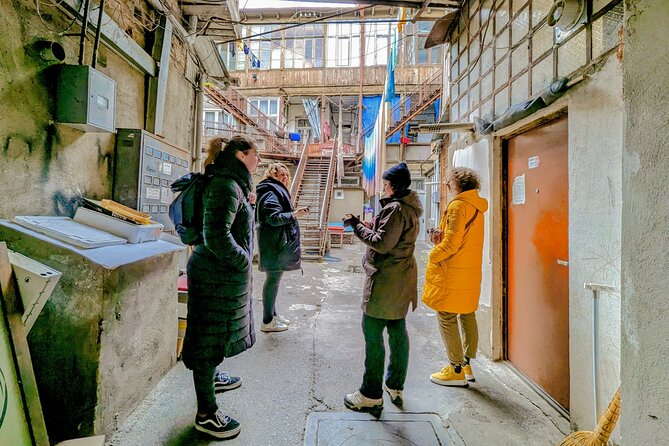
- New Tiflis, not the Old Town: The route focuses on Agmashenebeli Avenue, Marjanishvili, Fabrika, markets, parks, and side streets.
- A small group of up to 10: This is a more personal format than a large city walk.
- A useful three-hour route: You see nine stops without paying admission fees at each one.
- A guide-led look at daily life: Roses Park, Dry Bridge Market, and Fabrika show sides of Tbilisi that can be easy to miss alone.
- Wine is included: A complimentary tasting adds a distinctly Georgian touch.
- Plan for the weather: Summer heat and winter rain or wind can make the walk harder than the relaxed pace suggests.
Starting beneath St. George at Liberty Square
Your meeting point is outside the Burberry shop at Liberty Square, also called Tavisuplebis Moedani. The square is easy to reach because it has a metro station, and it is one of central Tbilisi’s main gathering places.
Take a few minutes to look around before the group sets off. The statue of St. George defeating the dragon rises in the middle, while the Georgian National Museum and City Hall help frame the square. This is also a place linked with public demonstrations, national celebrations, New Year events, and Independence Day gatherings, so your guide has plenty of context to share before the walk gets moving.
The meeting instructions are precise, but punctuality matters. The guide waits up to 10 minutes after the scheduled start. After that, you may need to rebook, so allow time to find the Burberry entrance and reach the square.
Liberty Square is a sensible starting point, though it is not the most atmospheric stop on the route. Its value is practical and civic rather than intimate. You begin in the city center, then quickly move toward streets with a different pace and texture.
More Walking Tours in Tbilisi:
- Tbilisi Walking Tour Including Cable Car and Traditional Bakery
★ 5.0 · 1,310 reviews - Tbilisi: City Highlights Guided Walking Tour
★ 4.9 · 1,114 reviews - Tbilisi:Evening Walking & Talking Tour with Wine & Boat Ride
★ 5.0 · 572 reviews
Orbeliani Square and its flower market
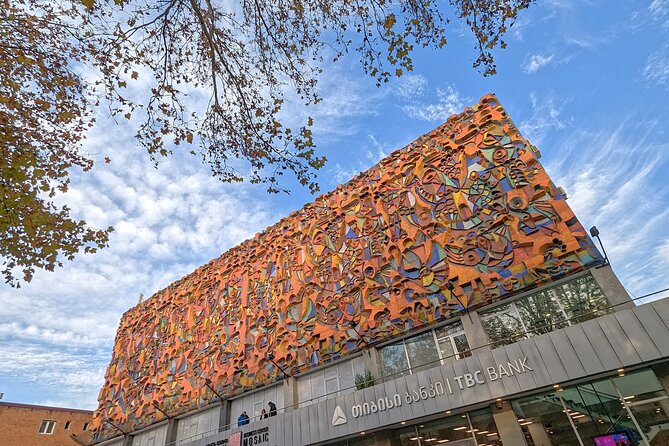
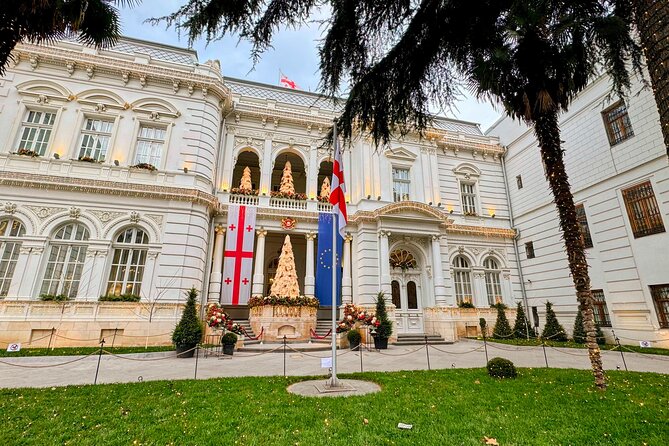
The next stop is Orbeliani Square, a pleasant place to pause for around 25 minutes. The square is associated with Orbeliani Palace, the official residence of Georgia’s president. You do not go inside, but the exterior gives the guide a chance to explain the building’s place in Georgian public life and architecture.
The square also has cafes, restaurants, and a flower market. The market is the more engaging part for many people. Flowers, herbs, colors, and smells make this a good place for photographs, and it gives you a quick look at ordinary commerce rather than another grand monument.
I would not plan a full meal here because the scheduled stop is short. Instead, use it to get your bearings, enjoy the market, and note places you might return to after the tour. The guide can also point out options for Georgian food or coffee later in the day.
Dry Bridge Market: Soviet objects and handmade work
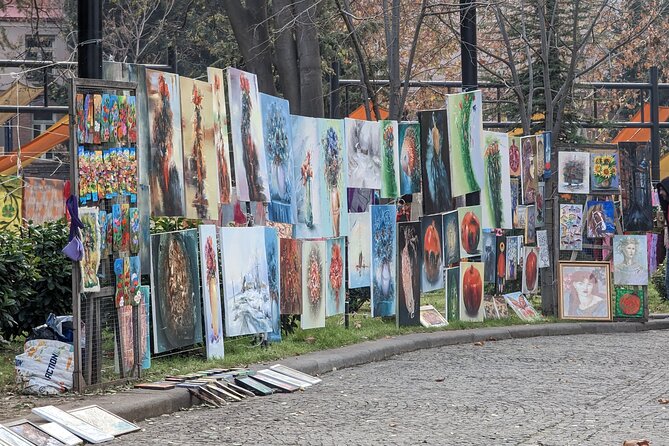
Dry Bridge Flea Market gets about 30 minutes, making it one of the more substantial stops. Stalls offer antique furniture, vintage clothing, jewelry, Soviet-era objects, and handmade pieces. Some sellers are artists or craftspeople, so the market is not only a place to shop for old items.
The pleasure here is the uncertainty of what you might find. One stall may suggest Soviet domestic life, another may reveal Georgian decorative traditions, and another may simply offer an unusual souvenir with a story attached. Vendors can often explain the background of their goods, which makes browsing more rewarding than walking through a standard souvenir shop.
Keep your expectations practical. Thirty minutes is enough for a first look, but not enough for a slow, serious search through every stall. If something catches your eye, ask questions and decide carefully. The tour is not built around shopping, and any purchase is your own responsibility.
Dry Bridge also helps explain why this route works. You are not simply ticking off famous buildings. You are seeing how objects, art, memory, and commerce meet in modern Tbilisi.
Agmashenebeli Avenue and the theatrical side of Tbilisi

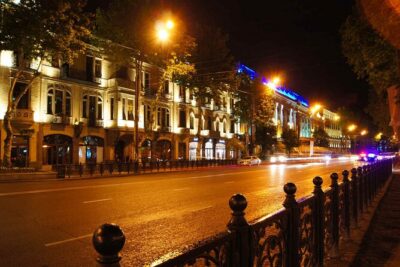
Agmashenebeli Avenue brings a change of scale. Its late 19th and early 20th-century buildings feature detailed facades linked with Art Nouveau and Neo-Renaissance design. The avenue is a good place to look upward, since much of its character is found in balconies, trim, arches, and decorative fronts.
The route allows around 25 minutes here. That is enough for a guided architectural walk, though not enough to study every building at length. Listen for the contrast between restored facades and the lived-in feel of the surrounding streets.
The Marjanishvili Theatre is one of the avenue’s key cultural landmarks. The city’s theatrical tradition is also represented by the Tbilisi Opera and Ballet Theatre at the northern end of the avenue. This section will suit you if you enjoy architecture with a cultural story attached, rather than architecture treated as a series of pretty facades.
The avenue can be busy. Traffic noise is part of the urban setting, and people sensitive to crowded streets should know this before booking. Still, the movement is part of the experience. You are seeing a working city, not a preserved outdoor museum.
More things to do in Tbilisi:
- Tbilisi: Day Trip to Kazbegi, Gudauri, Gergeti, and Ananuri
★ 4.9 · 3,203 reviews - Day Trip to Kakheti Wine Region Including 9 Wine Tastings
★ 5.0 · 2,774 reviews - Highlights of Caucasus Mountains-Jinvali,Ananuri,Gudauri,Kazbegi(Group tour)
★ 5.0 · 2,682 reviews - From Tbilisi: Kakheti Wine Region Tour with 9 Wine Tastings
★ 4.9 · 2,541 reviews
Roses Park and a quieter neighborhood pause
Roses Park is a welcome change after the avenue. Tucked into the backstreets, it offers a look at residential Tbilisi and a slower part of the walk. The garden contains more than 200 varieties of roses, with the strongest display during the summer months.
The planned visit lasts about 20 minutes. That is enough for a gentle walk among the flowers and a short rest, but the garden’s appeal depends on the season. In summer, the colors and scent should be at their best. Outside the flowering period, expect the stop to be more about the neighborhood setting than a full rose display.
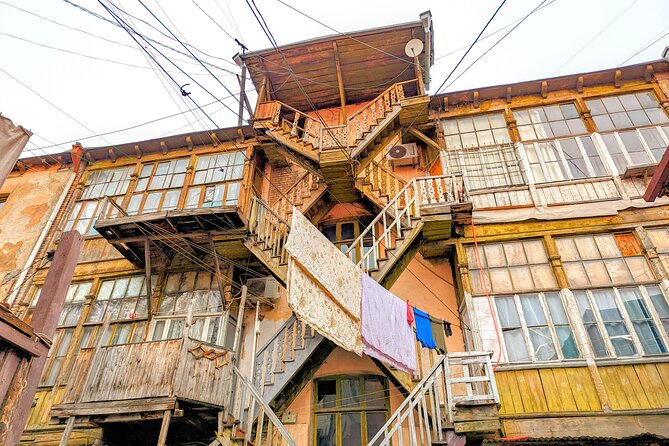
I like this part of the route because it connects sightseeing with ordinary city life. You get a break from major avenues and formal buildings, while the guide can point out details of how people use the area. It is also a useful reminder that Tbilisi is not only churches, fortresses, and grand public squares.
Fabrika and Tbilisi’s creative present
Fabrika occupies a former Soviet sewing factory that has been converted into a mixed-use cultural and social space. The stop lasts about 25 minutes and gives you time to see how an old industrial building now serves creative work, art, and entertainment.
Street art is central here. Murals cover parts of the building and nearby walls, reflecting Tbilisi’s growing reputation for public art. The guide can give the artwork a local frame, which is helpful because street art can look random when you encounter it alone.
Fabrika is one of the route’s strongest stops for people interested in urban renewal. The building’s past remains visible, but its current use shows a younger, more experimental side of the city. You may want extra time for photographs, coffee, or simply sitting in the courtyard, but the tour keeps moving after roughly 25 minutes.
That time limit is both useful and restrictive. You get a focused introduction without losing the rest of the route, but you will not have time to explore every corner. If Fabrika interests you, mark it for a return visit.
St. Peter and St. Paul Church
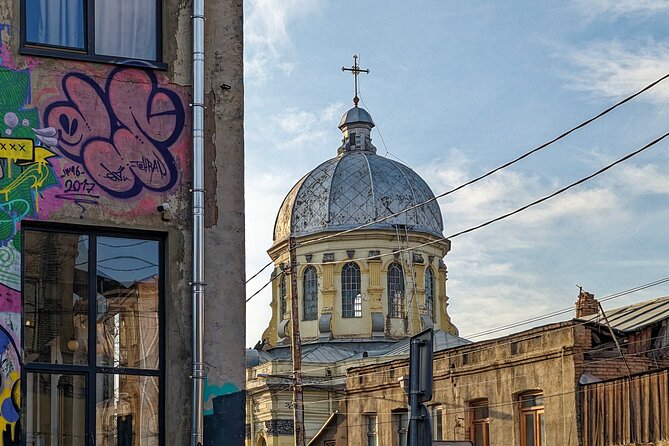
The Roman Catholic Church of St. Peter and St. Paul provides a more formal architectural stop. Built between 1870 and 1877, it was commissioned through Georgia’s Catholic community and designed by Albert Zaltsman. Its strong Baroque style gives the building a look quite different from the surrounding streets.
Allow about 15 minutes here. The yellow facade is divided by pilasters and arches in a deeper shade, while the rose window above the entrance has floral decoration and a dove. The window was added after 2000, and the church was later painted yellow, details that show how old buildings continue to change.
Pope John Paul II celebrated Mass here during his October 1999 visit to Georgia. That connection adds modern religious significance to the building, while the design offers a useful reminder that Tbilisi’s religious life has never been limited to one tradition.
The church may appeal most to visitors who enjoy architectural detail and the city’s Catholic story. It is a brief stop, not a full interior visit, so do not expect an extended church service or museum-style presentation.
Kote Marjanishvili Theatre and Georgian performance
The Kote Marjanishvili State Drama Theatre is another short stop, with around 15 minutes devoted to it. It began in Kutaisi in 1928 under the direction of Kote Marjanishvili, moved to Tbilisi in 1930, and has continued in the same building.
The theatre occupies an Art Nouveau building that was renovated and reopened in 2006. Its reopening featured Bertolt Brecht’s The Threepenny Opera. Today, its program includes plays, musicals, and operas, making it a possible evening stop if you want to add a performance to your Tbilisi plans.
You will not attend a show as part of this walk. The value lies in seeing the building and understanding why Marjanishvili remains important to Georgian theatre. Your guide can connect the theatre with the avenue and square named after its founder, giving this part of the route a satisfying thread.
Finishing at Marjanishvili Square
The walk ends at Marjanishvili Square, surrounded by cafes, restaurants, and shops. This is a practical finish because you can stop for food or continue exploring without needing a separate transfer.
Marjanishvili Metro Station is nearby. Opened in 1966, it was designed by O. Melia and G. Melkadze. Look for the high-relief bust of Kote Marjanishvili at the station, a small but fitting final detail after visiting his theatre.
The ending is flexible. You can use the metro to reach another part of Tbilisi, settle into a restaurant, or continue on foot. Because the tour finishes in an active part of the city rather than at a remote landmark, it fits well into a full sightseeing day.
What the $30 price really gets you
At $30 per person, this tour offers fair value if you want a guide to connect several neighborhoods and explain what you are seeing. There are no separate admission charges at the listed stops, and the price includes guide service plus a complimentary wine tasting.
The real value is the route design. You could reach many of these places alone, but you would spend time working out the order and missing the links between Soviet architecture, theatre, public art, markets, religion, and everyday streets. The guide also adds recommendations for food, art, and local life, which can be useful beyond the three-hour walk.
The value is weaker if you want a private tour, extensive time inside monuments, or a slow photography walk. A group of up to 10 is small enough for questions, but it is still a group. You also pay for a walking experience, not hotel transport. Pickup and drop-off are not included.
Wine tasting is a pleasant bonus, but it should not be the reason you book. The tour’s main strength is the guided route through New Tiflis.
Pace, weather, and who will enjoy it most
The walk covers about 3 kilometers at a relaxed pace. Most people who can comfortably walk that distance should manage it, but significant mobility limitations, recent injuries, or difficulty walking long distances may make the experience unsuitable.
Wear non-slip walking shoes. Tbilisi’s winter weather can be cold, windy, and rainy, while summer midday conditions can be hot. Bring sun protection and water in summer, and warm layers in winter. The route includes busy streets, so anyone sensitive to traffic noise should take that into account.
I would recommend this tour to:
- First-time visitors who already have, or plan to have, a separate Old Town visit
- People interested in architecture, theatre, street art, and local markets
- Visitors who prefer a small group and a guide-led route
- Anyone wanting practical food and neighborhood suggestions
- Curious walkers who want a more modern and local side of Tbilisi
I would choose something else if your main goal is the traditional Old Town, Narikala Fortress, sulfur baths, or a long interior visit at major landmarks. This experience clearly avoids that familiar route.
Booking details worth noting
The tour is offered in English and accepts mobile tickets. It is generally booked well ahead, with an average booking time of about 58 days, so reserve early if your dates are fixed.
Free cancellation is available up to 24 hours before the start time. Changes or cancellations inside that window are not refunded, and the tour can be moved or refunded if poor weather or an insufficient number of bookings causes cancellation.
The guide service has received a very high overall rating, with particular praise for Oksana. The strongest theme is her ability to explain Tbilisi’s past, art, and daily life while answering questions and offering useful recommendations. That personal guidance matters here because several stops, especially the market and backstreets, are more interesting when someone explains what you are seeing.
Should you book the New Tiflis walk?
Book it if you want to see Tbilisi beyond the Old Town and you are happy to spend three hours on foot. The combination of Dry Bridge Market, Agmashenebeli Avenue, Roses Park, Fabrika, theatres, and Marjanishvili gives you a broad look at the city for $30.
Skip it if you need hotel transport, dislike urban noise, or have limited walking ability. Also avoid treating it as a complete introduction to Tbilisi, since the famous Old Town is not part of the route.
For the right visitor, this is a smart early-stay choice. You finish near a metro station, learn where several useful neighborhoods are, and leave with a better sense of how Tbilisi mixes old buildings, Soviet-era spaces, creative culture, and ordinary city life.
FAQ
Is this an Old Town walking tour?
No. The route focuses on New Tiflis, backstreets, Agmashenebeli Avenue, Fabrika, Marjanishvili, and other less touristy areas.
How long is the walking tour?
The experience lasts approximately three hours and covers about 3 kilometers at a relaxed pace.
Where does the tour start and finish?
It starts at the entrance of the Burberry shop at Liberty Square. It ends at Marjanishvili Square, close to Marjanishvili Metro Station.
Is wine included?
Yes. Guide service and a complimentary wine tasting are included in the price.
What is the maximum group size?
The tour has a maximum of 10 travelers.
Is hotel pickup included?
No. Hotel pickup and drop-off are not included.
Just added in Tbilisi
- Wine Tasting feel the Difference of Qvevri or Classical Wine★ 4.4 · 10 reviews
- From Tbilisi: Kakheti and Kazbegi 2-Day 4X4 Jeep Tour pack★ 5.0 · 6 reviews
- Walking Tour in Old Tbilisi – Group Tour★ 4.5 · 8 reviews
- Uforgatable Kakheti Tour with wine tasting – in Georgia★ 4.9 · 5 reviews
- From Tbilisi: Uplistsikhe Caves and Mtskheta Town Day tour★ 5.0 · 2 reviews
- Tbilisi: Vintage Fashion and Secondhand Thrifting Tour★ 5.0 · 11 reviews
- Private Adorable City Tour of Tbilisi★ 5.0 · 3 reviews
- Tbilisi Airport to Gudauri, Bakuriani, Batumi, Tbilisi★ 5.0 · 3 reviews
Walking Tours, compared.
Tbilisi Walking Tour Including Cable Car and Traditional Bakery
Read our review →
Evening Walking & Talking Tour with Wine & Boat Ride
Read our review →
Evening Walking Tour with Wine & Boat Ride Options
Read our review →
Old Tbilisi Highlights walking tour with wine & 10 tastings
Read our review →
Old Tbilisi Tour: Private Walking Tour With Wine Tasting
Read our review →

Private Tbilisi Food Tour: 9 Tastings Walk in Bohemian District
Read our review →Browse the lists this tour appears in