
Reviewed · WINE TOURS IN TBILISI
Very Friendly Tbilisi Walking Tour (wine tasting & cable car)
Tbilisi rewards slow feet. This four-hour walk links the city’s oldest churches, fortress ruins, sulfur baths, markets, and riverfront sights in one well-planned route. I especially like the cable car ride to Narikala Fortress and the chance to hear local stories while moving through real neighborhoods rather than viewing the city from a bus. I also like the personal tone suggested by guide Anastasia de Fellini Travels, whose warm Spanish-English reply shows genuine enthusiasm for meeting people.
The price is $27.24 per person, a fair deal for a local guide and included cable car ticket. The main point to clarify before booking is the wine tasting: it appears in the tour title, but no tasting stop or wine allowance is listed in the detailed schedule. Hotel pickup is also described differently in the information, so confirm the meeting arrangement in advance.
In This Review
- Key points before you book
- Starting at Pushkin Square and finding old city walls
- Shavteli Street and Tbilisi’s oldest church
- Patriarchate buildings and the modern Peace Bridge
- Rike Park to Narikala by cable car
- Narikala Fortress and the story of Tbilisi
- The mosque, waterfall, and sulfur baths
- Meidan Bazaar, Shardeni Street, and Sioni Cathedral
- What the pace, group size, and price mean
- Who should choose this Tbilisi walk?
- Should you book the Very Friendly Tbilisi Walking Tour?
- FAQ
- How long does the Tbilisi walking tour last?
- How much does the tour cost?
- Where does the tour begin?
- Where does the tour end?
- Is the cable car ticket included?
- Is hotel pickup included?
- Is wine tasting included?
- Can I cancel for a full refund?
Key points before you book
- Old Tbilisi in one four-hour route: The walk covers walls, churches, river crossings, fortress views, sulfur baths, markets, and pedestrian streets.
- The cable car ticket is included: You ride from Rike Park toward Narikala Fortress, saving you one extra transport purchase.
- A small-group format is intended: The main tour description gives a maximum of 15 people, though the booking information also lists an overall maximum of 100. Ask for the expected group size.
- Guide personality matters here: Anastasia de Fellini Travels is praised for being friendly, close, and clearly fond of her work.
- The route ends near Orbeliani Bazaar: You finish at Orbeliani Square, not back at the starting point.
- Wine tasting needs confirmation: It is named in the tour title, but the schedule does not identify a winery, tasting room, or included pour.
Starting at Pushkin Square and finding old city walls

The tour begins at Tbilisi Pushkin Square, a useful central point for starting an Old Town walk. From there, you head toward remnants of Tbilisi’s 11th-century city wall and an old customs gate. This is a short stop, about 15 minutes, but it gives you an immediate sense of how compact and layered the old capital is.
Do not expect a large restored fortification. These are ruins and underground heritage, so the value comes from the explanation. A guide can help you picture the gates, defenses, and commercial life that once shaped this part of the city. Without context, you might simply see old stone beside newer streets.
This opening also sets the tone for the tour. Tbilisi is not a city where every important sight announces itself with a grand entrance. Small remains, odd corners, and buildings reused over many periods are part of its appeal.
More Wine Tours in Tbilisi
- Day Trip to Kakheti Wine Region Including 9 Wine Tastings
★ 5.0 · 2,774 reviews - From Tbilisi: Kakheti Wine Region Tour with 9 Wine Tastings
★ 4.9 · 2,541 reviews - Tbilisi: Kakheti Wine Region Tour with 10 Wine Tastings
★ 5.0 · 2,160 reviews
Shavteli Street and Tbilisi’s oldest church
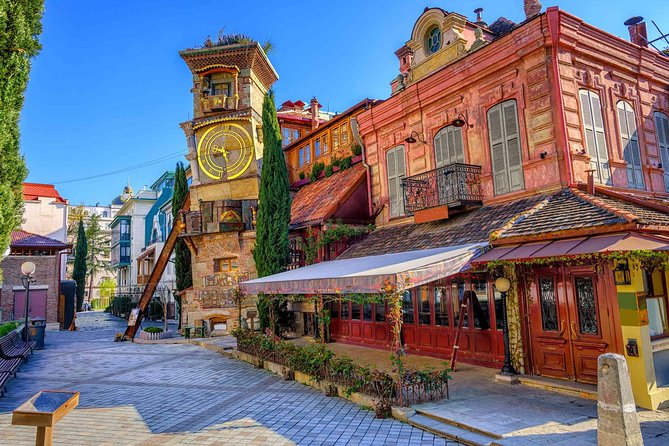
The Rezo Gabriadze Marionette Theater is one of the city’s most distinctive stops. Built in 1981 by artist Rezo Gabriadze, the theater has an unusual design, and its clock tower has become one of Tbilisi’s familiar symbols. Once an hour, a golden angel appears from a painted doorway and rings a bell with a small hammer.
The stop lasts around 15 minutes, so your guide will likely focus on the building and the clock rather than a performance. The theater is a good reminder that Tbilisi’s character is not only medieval. Contemporary Georgian art sits right beside ancient churches and old streets.
A few minutes away, Anchiskhati Basilica brings you back to the city’s early Christian past. This three-nave basilica dates to the sixth century and is regarded as the oldest church building in Tbilisi. Its name is linked to the Anchi icon, which arrived from the Anchi Monastery in southern Georgia in 1664. The original icon is now held by the Georgian National Museum.
You get about 10 minutes here. That is enough for an introduction and perhaps a quick look inside if conditions allow, but not a long architectural study. Dress and behave respectfully in the church, especially if services are taking place.
Patriarchate buildings and the modern Peace Bridge

The route continues to the Georgian Patriarchate area on Erekle II Square. The building occupies the site of a former palace associated with King Rostom. Construction of the present structure began in 1809, and it later became connected with the Russian Orthodox Church administration and its exarch.
This is a short stop, about 10 minutes, and it works best as part of the city’s political and religious story. Tbilisi has changed hands and identities many times, and its buildings often carry several layers of authority.
Then the mood shifts at the Bridge of Peace. Opened in 2010, this curved glass-and-steel bridge crosses the Mtkvari River between Erekle II Street and Rike. Its modern design contrasts sharply with the old churches, balconies, and fortress walls nearby.
I like this pairing because it shows two Tbilisis in a single glance. The bridge is not ancient, and some visitors may find its design too polished beside the older city. Still, it has become one of the symbols of renewed Tbilisi, and the river views make it a worthwhile crossing.
Rike Park follows the bridge. The park is designed from above to suggest a map of Georgia, with pathways representing different regions. You will spend about 15 minutes here, enough to look at the layout and prepare for the cable car.
Rike Park to Narikala by cable car

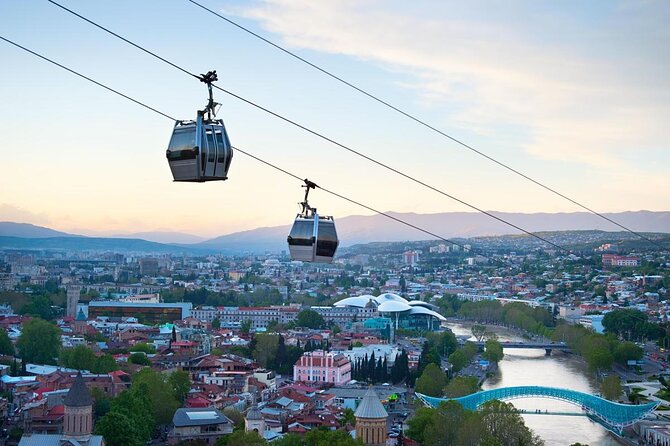
The aerial tramway connects Rike Park, or more precisely Europe Square, with the Narikala Fortress area. The ride itself takes only about 10 minutes within the tour schedule, but it delivers one of the clearest changes in viewpoint of the day.
From above, you can see the Mtkvari River, the old districts, the Peace Bridge, and the spread of Tbilisi below the hills. This is one reason the $27.24 price feels reasonable. The cable car ticket is included, and your guide helps connect the view to the places you have just walked through.
The ride may also be the tour’s easiest break from the pavement. Most of the route is on foot, with several short stops. Wear shoes you can walk in comfortably, since the fortress and hillside sections are more important than polished footwear.
At the top, you see Kartlis Deda, the Mother of Kartli statue. She holds a wine cup in one hand for friends and a sword in the other for enemies. It is a simple image with a strong message, and it connects neatly with Georgia’s long tradition of welcoming visitors while defending its independence.
A completely different kind of day:
- Tbilisi: Day Trip to Kazbegi, Gudauri, Gergeti, and Ananuri
★ 4.9 · 3,203 reviews - Highlights of Caucasus Mountains-Jinvali,Ananuri,Gudauri,Kazbegi(Group tour)
★ 5.0 · 2,682 reviews - Tbilisi: Mtskheta, Jvari, Gori and Uplistsikhe Day Tour
★ 4.9 · 2,396 reviews - From Tbilisi to Kazbegi, Ananuri, Gudauri & Gergeti
★ 4.9 · 2,278 reviews
Narikala Fortress and the story of Tbilisi
Narikala occupies the Holy Mountain above the old city. Its earliest construction dates to the fourth century, around the beginning of Tbilisi itself, though Arabs expanded the fortress in the seventh and eighth centuries. The remaining walls are a mix of periods, with a distinctly Arab fortification character.
The stop lasts about 20 minutes. That is enough for views, photographs, and a guide’s explanation, but not enough to explore every fragment. The fortress also contains the Church of St. Nicholas, dated to the 12th century.
Nearby, the Monument of King Vakhtang Gorgasali honors the king traditionally linked with the city’s early development. Vakhtang ruled Iberia, known locally as Kartli, during the late fifth and early sixth centuries. His reign involved a long struggle against Sasanian Iranian power, supported at times by the Byzantine Empire, and ended with defeat and a weakened kingdom.
The monument stop is only about five minutes. Think of it as a quick historical marker rather than a full museum visit. The guide’s explanation is especially useful here because the political names and old kingdoms can be hard to place on your own.
The mosque, waterfall, and sulfur baths

The route then descends toward the Tbilisi Mosque, also called the Juma Mosque, below Narikala. It is currently the only Muslim shrine in the city. The first Sunni mosque on this site was built by the Ottomans between 1723 and 1735, destroyed by the Persians in the 1740s, and rebuilt in the 19th century.
The building was renovated again in 1895 by the Baku-based philanthropist Hajizinelabdin Tagiyev. This stop gives you a useful reminder that Tbilisi’s identity has never been only Georgian Orthodox. Religious communities have lived close together in the old city for centuries.
Next comes Leghvtakhevi Waterfall, a 22-meter fall in the Abanotubani area. Its name comes from the Georgian word leghvi, meaning fig, because fig trees once grew around the gorge. The waterfall stop is short, about 10 minutes, but it is one of the route’s more surprising scenes. A narrow urban canyon suddenly opens onto falling water.
Abanotubani is the old sulfur-bath district at the foot of Narikala. Hot sulfur springs made the area important, and the baths were built at different times, mostly between the 17th and 19th centuries. The oldest mentioned here is Irakli Bath, which was once the subject of ownership disputes involving the imperial family and Georgian princes.
You will also pass Chreli Abano, a sulfur bath with a colorful exterior that can resemble a mosque. It is a bathhouse, not a religious building. The tour does not include a bathing session, so do not arrive expecting one. The 30-minute Abanotubani stop is mainly for the district, architecture, and the story of how Tbilisi grew around its hot springs.
Meidan Bazaar, Shardeni Street, and Sioni Cathedral

Meidan Bazaar has served as a commercial square for centuries. French traveler Jean Chardin wrote about the area in the 18th century, and the square has carried several names, including Shaitan Bazaar and Tatris Moedani.
Today, this is a practical place to browse Georgian wine, handmade accessories, souvenirs, and local foods. The tour title includes wine tasting, but the schedule only confirms time at the bazaar, not a formal tasting. If wine is a major reason you are booking, ask whether a tasting is included, where it takes place, and whether there is an extra charge.
You have about 20 minutes here. That is enough to look around, but probably not enough for serious shopping. If you see something you want, note the shop and return later, since the tour continues.
Jan Shardeni Street comes next. This pedestrian lane, along with Bambis Rigi, Rkinis Rigi, and nearby Erekle II Street, is lined with galleries and cafes. It is one of the city’s social centers, and its name honors French traveler Jean Chardin.
The atmosphere here can feel more commercial and polished than the quieter church lanes. That is not necessarily a weakness. It gives you a look at the part of Old Tbilisi aimed at dining, shopping, and evening walks.
The final major sight is Sioni Cathedral, a cross-domed church on the right bank of the Mtkvari. It has served as Tbilisi’s cathedral since the fifth century and became the Patriarchal Cathedral in 1920. The present structure reflects the rebuilding and changes that affected many Georgian churches over time.
The scheduled stop is about 10 minutes. Again, this is an introduction rather than a full visit. If you want to study the cathedral, return independently when you have more time.
What the pace, group size, and price mean

Four hours is a sensible length for this route. You see a large number of places without committing to a full day, but the schedule is brisk. Many stops last only 5 to 15 minutes, while Abanotubani receives about 30 minutes.
The tour is best for getting your bearings on a first stay. You will learn which areas deserve a longer return visit, where the baths are, how the river divides the city, and how the cable car connects the low streets with Narikala.
The tour is described as a small-group experience with a maximum of 15 people. That is the right size for narrow lanes and questions. However, the additional booking information gives a maximum activity size of 100. Those figures do not match, so I would contact Fellini Travels and ask how many people are normally placed with one guide.
Hotel pickup is also unclear. One part of the information says hassle-free hotel pickup is available, while the included services list only bottled water and a local guide, and the meeting point is Pushkin Square. Treat Pushkin Square as the confirmed starting point unless pickup is arranged in writing.
The $27.24 cost includes the guide, bottled water, and cable car admission. Food, drinks, and any possible wine tasting are not clearly included. For a four-hour route with transport and a guide, it is a good value if you want orientation and local context rather than museum entry or a long sit-down tasting.
Free cancellation is available if you cancel at least 24 hours before the start time. The tour requires a minimum number of people, so a cancellation by the operator can result in another date, another experience, or a full refund.
Who should choose this Tbilisi walk?
I would choose this tour if you have limited time in Tbilisi, want a first look at Old Town, or prefer a guide to explain what you are seeing. It suits people who enjoy churches, viewpoints, old walls, city legends, and a mix of historic and modern architecture.
It also suits anyone who likes a friendly guide. Anastasia de Fellini Travels received especially warm praise for being approachable and for making the walk pleasant. Her reply to a Spanish-language message was personal and encouraging, which suggests the company values direct contact rather than treating the tour as a simple transaction.
You may want something else if you dislike short stops, have difficulty with a long urban walk, or want in-depth time inside each church and fortress. The route covers a lot, but it cannot provide a full tour of every site in four hours.
The strongest praise centers on the guide’s warmth and the relaxed human tone. That matters in Tbilisi, where a few local explanations can make an old wall, a sulfur bath, or a statue much easier to understand.
Should you book the Very Friendly Tbilisi Walking Tour?
Book it if you want an efficient first introduction to Tbilisi, especially with the cable car and Narikala included. The route gives you the city’s essential shape: river, hill, fortress, baths, churches, markets, and modern public spaces.
Before paying, confirm three details: the actual group size, whether hotel pickup is available, and what the advertised wine tasting includes. If those points are clear and you value a personable guide more than lengthy site visits, this is a sound, fairly priced way to meet Tbilisi.
FAQ
How long does the Tbilisi walking tour last?
The tour lasts approximately four hours.
How much does the tour cost?
The listed price is $27.24 per person.
Where does the tour begin?
The stated starting point is Tbilisi Pushkin Square in Tbilisi, Georgia.
Where does the tour end?
The tour ends at Orbeliani Square, near Orbeliani Bazaar.
Is the cable car ticket included?
Yes. The aerial tramway stop lists admission as included.
Is hotel pickup included?
The information says hassle-free hotel pickup is available, but the included services list does not include hotel pickup and gives Pushkin Square as the meeting point. Confirm this directly before booking.
Is wine tasting included?
Wine tasting appears in the tour name, but no specific tasting stop or inclusion is identified in the detailed tour information. Confirm the details with Fellini Travels.
Can I cancel for a full refund?
Yes, if you cancel at least 24 hours before the experience start time. Cancellations made less than 24 hours in advance are not refunded.
More Walking Tours in Tbilisi
- Tbilisi Walking Tour Including Cable Car and Traditional Bakery
★ 5.0 · 1,310 reviews - Tbilisi: City Highlights Guided Walking Tour
★ 4.9 · 1,114 reviews - Tbilisi:Evening Walking & Talking Tour with Wine & Boat Ride
★ 5.0 · 572 reviews - Tbilisi: Evening Walking Tour with Wine & Boat Ride Options
★ 5.0 · 407 reviews
Just added in Tbilisi
- Wine Tasting feel the Difference of Qvevri or Classical Wine★ 4.4 · 10 reviews
- From Tbilisi: Kakheti and Kazbegi 2-Day 4X4 Jeep Tour pack★ 5.0 · 6 reviews
- Walking Tour in Old Tbilisi – Group Tour★ 4.5 · 8 reviews
- Uforgatable Kakheti Tour with wine tasting – in Georgia★ 4.9 · 5 reviews
- From Tbilisi: Uplistsikhe Caves and Mtskheta Town Day tour★ 5.0 · 2 reviews
- Tbilisi: Vintage Fashion and Secondhand Thrifting Tour★ 5.0 · 11 reviews
- Tbilisi Airport to Gudauri, Bakuriani, Batumi, Tbilisi★ 5.0 · 3 reviews
- Private Adorable City Tour of Tbilisi★ 5.0 · 3 reviews
Wine Tours in Tbilisi, compared.
Day Trip to Kakheti Wine Region Including 9 Wine Tastings
Read our review →
Kakheti Wine Region Tour with 9 Wine Tastings
Read our review →
Kakheti Wine Region Tour with 10 Wine Tastings
Read our review →
Mtskheta Jvari Bazaar, Chronicles of Georgia & Wine
Read our review →
Mtskheta,Jvari,Bazaar,wine tasting,Chronicles of Georgia
Read our review →
Evening Walking & Talking Tour with Wine & Boat Ride
Read our review →
Evening Walking Tour with Wine & Boat Ride Options
Read our review →
Kakheti;City of Love Sighnaghi, Bodbe. KTW. Wine House Group tour
Read our review →Browse the lists this tour appears in