
Reviewed · BORJOMI AND BAKURIANI TOURS
Uplistsikhe-Borjomi-Gori-Mtskheta
Four historic stops, one long Georgian day. This private trip from Tbilisi packs monasteries, mineral springs, Soviet history, and a rock-cut town into roughly seven to nine hours. I like the air-conditioned private vehicle, which gives your group a more relaxed ride than a large coach, and I like the mix of places: this is not just a church tour or a museum outing.
I also like that the driver-guide handles the route while sharing local context, with WiFi available in the vehicle and homemade Georgian wine included as part of the experience. The main drawback is the pace. Five stops in one day leave limited time at each site, and Borjomi’s cable car or paid attractions are not included in the stated $76.93 price.
In This Review
- Key points to know before booking
- Why this private route works well from Tbilisi
- Jvari Church and the meeting of two rivers
- Borjomi Central Park and Georgia’s famous mineral water
- Gori and the Stalin Museum
- Uplistsikhe Cave Town and Georgia before Christianity
- Svetitskhoveli Cathedral in old Mtskheta
- What the driver-guide adds to the day
- The pace, transport, and practical tradeoffs
- Who will get the most from this tour
- Booking value and the cancellation window
- Should you book this Georgia day tour?
- FAQ
- How long does the tour last?
- Where does the tour begin?
- Where does the tour end?
- Is this a private tour?
- Is transportation provided?
- Are entrance fees included?
- Can I cancel for a full refund?
Key points to know before booking
- Five major stops from Tbilisi: See Jvari Church, Borjomi Central Park, the Stalin Museum, Uplistsikhe Cave Town, and Svetitskhoveli Cathedral in one day.
- A private tour for your group: You will not be combined with other parties, so the pace and conversation can feel more personal.
- A driver-guide named Mamuka may make the difference: One particularly warm review praised Mamuka’s passion for Georgia, route planning, car, and country knowledge.
- Borjomi costs extra: The park visit is included in the route, but admission is not included, and the cable car is an optional added expense.
- The day covers varied terrain and interests: Expect religious monuments, mountain views, mineral water, a Soviet-era museum, and ancient stone chambers.
- Best for efficient sightseeing: This suits you if you want a broad introduction to central Georgia rather than a slow visit to one or two places.
Why this private route works well from Tbilisi
Tbilisi is a good base for exploring Georgia, but the capital cannot show you the whole country. This outing gives you a quick look at several very different sides of Georgian identity: ancient Christianity at Jvari and Mtskheta, healing springs at Borjomi, Soviet power in Gori, and pre-Christian settlement at Uplistsikhe.
The private format matters. Your group has the vehicle to itself, and the driver-guide can speak directly with you rather than addressing a busload of people. If your group has a shared interest in religious art, Stalin, archaeology, or Georgian food and wine, that personal setup can make the day more useful.
The vehicle is air-conditioned, an important comfort point during a long day on the road. WiFi is also listed as available, so you can stay connected between stops. Still, do not mistake the WiFi for a reason to spend the day on your phone. The best part of this route is watching the countryside change as you leave Tbilisi.
At $76.93 per person, the value depends on your group size and what you want from the day. You are paying for private transport, hotel pickup, a driver-guide, and several destinations in one outing. The price is easier to justify if you are traveling with friends or family and would otherwise need to arrange separate transport.
The cost does not cover every admission. Borjomi Central Park and the Stalin Museum list admission as not included, and Uplistsikhe also has a separate admission charge. The route description also mentions the cable car in Borjomi, but that is an optional activity with its own cost. Budget a little extra rather than assuming the tour price covers every ticket.
More things to do in Tbilisi:
- Tbilisi: Day Trip to Kazbegi, Gudauri, Gergeti, and Ananuri
★ 4.9 · 3,203 reviews - Day Trip to Kakheti Wine Region Including 9 Wine Tastings
★ 5.0 · 2,774 reviews - Highlights of Caucasus Mountains-Jinvali,Ananuri,Gudauri,Kazbegi(Group tour)
★ 5.0 · 2,682 reviews
Jvari Church and the meeting of two rivers
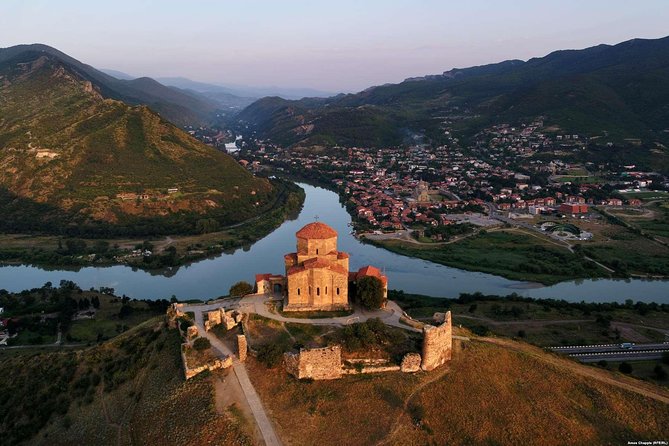
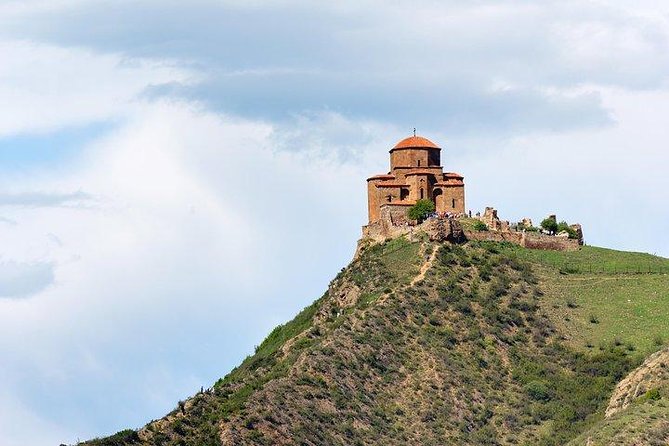
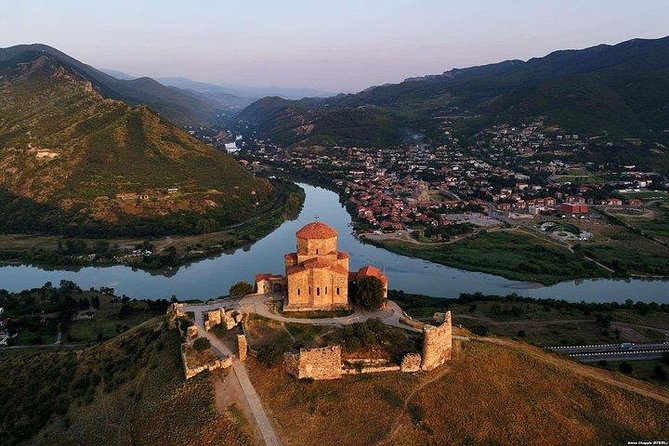
The day begins with Jvari Church, high above Mtskheta. The setting is the reason to pay attention here. From the monastery, you can look over Mtskheta and see the Aragvi and Kura, also called the Mtkvari, meet below.
The view includes wave-like mountains and the old city spread beneath the hill. It is a fine first stop because it gives you a sense of Georgia’s geography before you spend hours on the road. You are not simply entering a church and leaving again. You are looking down on a place where rivers, roads, and religious history come together.
The monastery’s story reaches back to the fourth century, soon after Georgia accepted Christianity. The main large church was built later, in the eleventh century. That layered timeline helps explain why this small stop carries so much importance.
You have about 30 minutes here, with admission listed as free. That is enough for the panorama and a short look around, but not for a long, quiet visit. If photography matters to you, have your camera ready before leaving the vehicle. The stop is brief, and the view is the main reward.
Borjomi Central Park and Georgia’s famous mineral water
Borjomi changes the mood of the day. After the hilltop monastery, you arrive at a park known for natural mineral water. The town sits around 800 to 900 meters above sea level, and the surrounding area gives you a taste of Georgia’s wooded mountain country.
You can drink Borjomi mineral water in the park, walk through the grounds, and see a waterfall. The route also allows time for the cable car, which rises to a plateau and a lake above the town. From there, you can look back over Borjomi from a higher point.
The scheduled visit is about 45 minutes. That is a useful break in a road-heavy day, but it forces a choice. You probably cannot linger over the water, take a long walk, visit the waterfall, and enjoy the cable car at a leisurely pace within that window. Ask your driver-guide how to use the time when the tour begins, especially if the cable car is your priority.
Admission is not included here. The same applies to the cable car, so keep some spending money available. The listing does not give current ticket prices, and those costs may change, but you should treat Borjomi as a stop with possible extras.
I like this part of the route because it adds nature without requiring a full hike. You get fresh air, a park, and a local product in one short visit. The compromise is that this is a sample, not a full Borjomi excursion. If your main goal is the national park, springs, or mountain walking, you may want a separate visit with more time.
Gori and the Stalin Museum
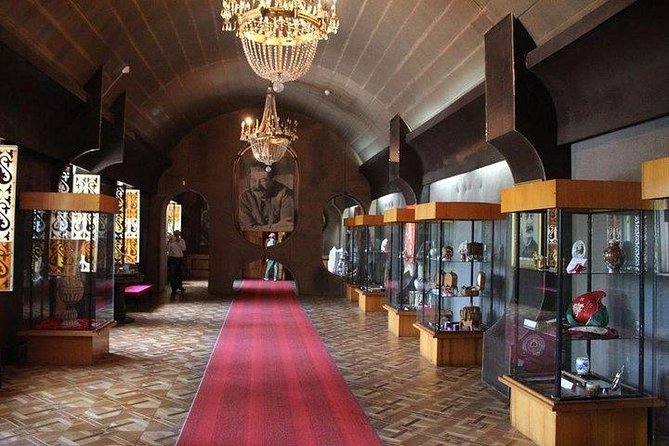
Gori is best known as the birthplace of Joseph Stalin, who was born Joseph Dzhugashvili. The city lies where the Kura and Liakhi meet, in the Kartlia valley, with mountains around it.
The Stalin Museum is a sharp change from the religious and natural stops. It focuses on one of the twentieth century’s most powerful and controversial political figures. You can expect the visit to raise questions about how a birthplace museum presents its subject, particularly when that subject ruled the Soviet Union from 1925 to 1953.
You have about 40 minutes, and museum admission is not included. That time should give you a focused introduction, but it will not allow for a slow examination of every display. If you have a strong interest in Soviet history, you may find the stop too short. If you prefer a broad day with several subjects, the compact visit fits the route.
The museum is valuable because it gives context that you cannot get from churches and archaeological ruins alone. Georgia’s story did not end in the medieval period. Gori brings the twentieth century into the day and shows how one Georgian birthplace became tied to a much larger political story.
More Mtskheta and Gori trips:
- Tbilisi: Mtskheta, Jvari, Gori and Uplistsikhe Day Tour
★ 4.9 · 2,396 reviews - Day Trip to Mtskheta Gori and Uplistsikhe
★ 5.0 · 1,801 reviews - Tbilisi: Mtskheta Jvari Bazaar, Chronicles of Georgia & Wine
★ 5.0 · 1,088 reviews - Tbilisi:Mtskheta,Jvari,Bazaar,wine tasting,Chronicles of Georgia
★ 5.0 · 730 reviews
Uplistsikhe Cave Town and Georgia before Christianity
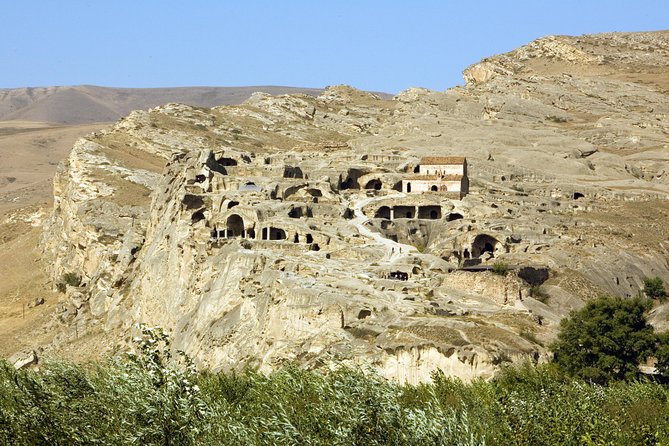
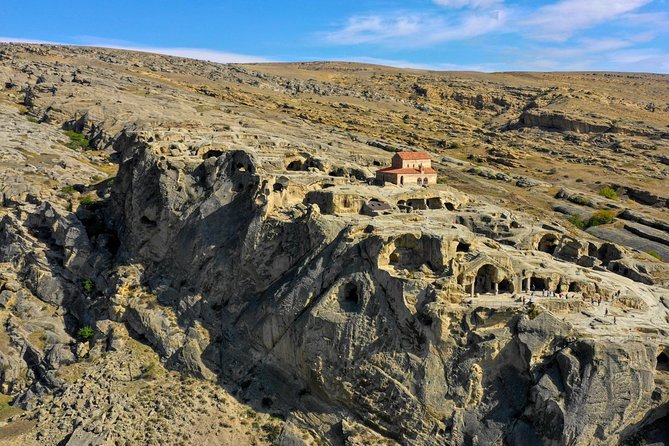
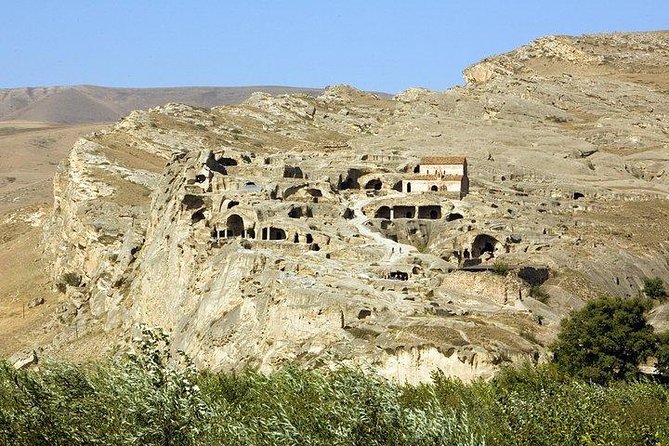
Uplistsikhe, meaning Lord’s Fortress, is the most unusual stop on the route. This abandoned rock-hewn town was founded around 1000 BC and remained inhabited until the thirteenth century AD. At its height, it housed about 20,000 people.
Between the sixth century BC and the eleventh century AD, Uplistsikhe served as an important political and religious center of pre-Christian Kartli. The settlement covers about 40,000 square meters, though your visit will focus on the surviving carved spaces and paths rather than every part of the former town.
This is where sturdy footwear and careful steps matter. The site is cut into rock, and you will be moving through an old settlement rather than a polished museum. The information provided does not specify the exact walking conditions, so ask the guide what route is practical on the day.
The planned visit lasts about 40 minutes, with admission not included. That is enough to see the character of the site, but not enough to study every chamber or understand every phase of its long occupation. I would treat this as a strong introduction to Uplistsikhe, not a complete archaeological visit.
The contrast with the Christian monuments is the point. At Jvari and Svetitskhoveli, you see Georgia’s strong Orthodox tradition. At Uplistsikhe, you encounter an older world of carved spaces and pre-Christian power. Put together, the stops show that Georgia’s identity was built in layers rather than in a single era.
Svetitskhoveli Cathedral in old Mtskheta
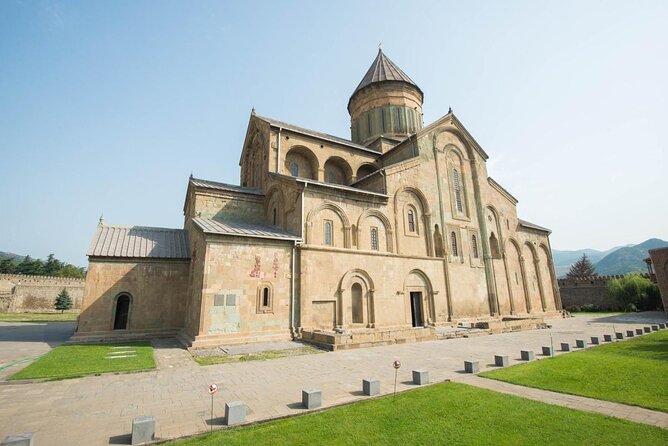
The final listed stop is Svetitskhoveli Cathedral in Mtskheta, Georgia’s old capital. Construction began in 1010 and ended in 1029. The cathedral remains one of the country’s most important religious sites.
The description identifies four major sacred items associated with the Orthodox world: the mantle of the prophet Isaiah, the robe of Jesus Christ, a particle of the Apostle Andrew, and pieces of the cross on which Jesus was crucified. The cathedral is therefore more than an old building. For Georgian Orthodox believers, it is a place of serious spiritual importance.
You have around 30 minutes here, with admission listed as free. That is enough for a respectful visit and a look at the building, but the short stop may feel rushed if you want to study the carvings or sit quietly inside.
Ending in Mtskheta makes sense. The town connects the religious view from Jvari with the cathedral below, giving the day a clear arc. You first see Mtskheta from above, then return to its historic center and enter one of its key monuments.
What the driver-guide adds to the day
A private route is only as good as the person driving it. The strongest praise attached to this experience centers on the guide, Mamuka. One account describes him as deeply passionate about Georgia and credits him with making the whole trip memorable, including the car, route, and information about the country.
That matters because the route itself is ambitious. You need someone who can keep the day moving while explaining why each place deserves attention. A driver-guide can also help you decide how to divide limited time between the Borjomi park, cable car, museum, and archaeological site.
The tour also includes homemade Georgian wine sampling. That gives the day a local food-and-drink element, though the supplied details do not specify where or when the tasting takes place. Ask about the timing if wine is important to you, especially since you will still be on a full-day drive.
Since this is a private activity, your group can ask questions without worrying about a larger audience. That is useful at the Stalin Museum and Uplistsikhe, where a short explanation can help connect the site to the wider story of Georgia.
The pace, transport, and practical tradeoffs
The advertised duration is approximately seven to nine hours. That is a long day, but the route covers a lot. Five stops, road time, hotel pickup, and the return to the meeting point leave little spare time.
Pickup is offered from your accommodation in Tbilisi, which removes one common nuisance. You do not need to find a separate departure point, and the tour ends back at the meeting point. Confirmation is received at booking, and group discounts are available.
Most people can participate, according to the supplied information. Still, the day includes a hilltop monastery, a rock-cut archaeological site, a park walk, and several entries and exits from the vehicle. If you have mobility concerns, contact Georgian Paradise before booking and ask about the exact walking conditions.
The private vehicle is a major advantage for families and small groups. You can keep your own belongings with you, use the available WiFi, and speak directly with the driver-guide. The tradeoff is that a private day does not make the distances shorter. You will still spend a substantial part of the outing on the road.
This tour is also listed as being booked about seven days ahead on average. That is a useful planning clue. It does not mean you must reserve exactly a week ahead, but booking early is sensible if you want a particular date or guide.
Who will get the most from this tour
I would recommend this outing to someone visiting Tbilisi who wants a broad first look at Georgia without planning several separate day trips. It is especially suitable for:
- First-time visitors with limited time
- Small groups who value private transport
- People interested in both religious sites and Soviet history
- Families who prefer a driver-guide to public transport
- Anyone who wants to combine nature, archaeology, and wine in one day
I would be more cautious if you dislike rushed sightseeing. Thirty to 45 minutes at a stop can feel short, especially at Uplistsikhe and Borjomi. You may also want a different plan if your main interest is hiking, because the Borjomi visit offers only a short park stop rather than a full day in the national park.
The route also works best if you enjoy variety. One hour you may be looking over two rivers from a monastery, and later you may be examining rock-cut rooms or reading about Stalin. That changing subject matter is the appeal, but it can feel scattered if you prefer one clear theme.
Booking value and the cancellation window
At $76.93 per person, the tour offers reasonable value for a private, full-day outing that includes hotel pickup, an air-conditioned vehicle, a driver-guide, WiFi, and several destinations. The value improves when the cost is shared among a small group.
Remember to add the separate admissions for Borjomi Central Park, the Stalin Museum, and Uplistsikhe. The cable car is another possible extra. Homemade wine is included in the experience description, but the details do not state whether any other food or drink is provided.
Free cancellation is available if you cancel at least 24 hours before the start time. Cancellations made less than 24 hours before departure are not refunded, and changes inside that same window are not accepted. The cut-off follows local time in Georgia.
Should you book this Georgia day tour?
Book it if you want a private and efficient sampler of Georgia’s cultural landmarks outside Tbilisi. The combination of Jvari, Borjomi, Gori, Uplistsikhe, and Mtskheta is unusually varied, and the strongest praise points to the personal touch of guide Mamuka.
Skip it if you want long visits, serious hiking, or an unhurried museum and archaeological experience. For everyone else, the tour offers a practical way to see five important places in one day, provided you accept the brisk pace and budget for extra admission fees.
FAQ
How long does the tour last?
The tour lasts approximately seven to nine hours.
Where does the tour begin?
It begins in Tbilisi, with pickup offered from your accommodation.
Where does the tour end?
The activity ends back at the meeting point in Tbilisi.
Is this a private tour?
Yes. Only your group participates in the private tour or activity.
Is transportation provided?
Yes. You travel in an air-conditioned vehicle with a driver-guide. WiFi is available in the vehicle.
Are entrance fees included?
Not all entrance fees are included. Admission is listed as not included for Borjomi Central Park, the Stalin Museum, and Uplistsikhe Cave Town. Admission for Jvari Church and Svetitskhoveli Cathedral is listed as free.
Can I cancel for a full refund?
Yes, if you cancel at least 24 hours before the experience start time. Cancellations made less than 24 hours before the start time are not refunded.
Just added in Tbilisi
- Wine Tasting feel the Difference of Qvevri or Classical Wine★ 4.4 · 10 reviews
- From Tbilisi: Kakheti and Kazbegi 2-Day 4X4 Jeep Tour pack★ 5.0 · 6 reviews
- Walking Tour in Old Tbilisi – Group Tour★ 4.5 · 8 reviews
- Uforgatable Kakheti Tour with wine tasting – in Georgia★ 4.9 · 5 reviews
- From Tbilisi: Uplistsikhe Caves and Mtskheta Town Day tour★ 5.0 · 2 reviews
- Tbilisi: Vintage Fashion and Secondhand Thrifting Tour★ 5.0 · 11 reviews
- Tbilisi Airport to Gudauri, Bakuriani, Batumi, Tbilisi★ 5.0 · 3 reviews
- Private Adorable City Tour of Tbilisi★ 5.0 · 3 reviews
Borjomi and Bakuriani Tours, compared.
Borjomi, Rabati & Vardzia Adventure Guided Tour
Read our review →
Borjomi, Rabati & Vardzia – one day group tour from Kutaisi
Read our review →
BORJOMI, RABATI & VARDZIA – Group Tour from Kutaisi
Read our review →
Vardzia, Rabati, and Borjomi Ancient Georgia Group Tour
Read our review →
LEGENDARY PLACES OF GEORGIA: VARDZIA, BORJOMI, RABAT.( Group Tour)
Read our review →
Browse the lists this tour appears in