Reviewed · 2-DAY EXPERIENCES
Tskaltubo and Chiatura: 2-days urbex tour
Soviet Georgia still has stories to tell. This two-day private tour links the abandoned sanatoriums of Tskaltubo with Chiatura’s old cable cars, Gori’s Stalin Museum, and Kutaisi’s markets and historic center. I like the easy hotel pickup and private vehicle, which make a long route much less tiring. I also like the careful mix of architecture, local life, and history. The main drawback is the price, $266.67 per person, which feels strongest for a small group that values a private guide and transport.
The schedule is full but sensibly paced. You get two hours in Chiatura, two hours among Tskaltubo’s former spa buildings on the first day, then four hours for Tskaltubo’s baths and abandoned sites on day two. Expect long road time, uneven old structures, and meals at your own cost. This is not a polished sightseeing circuit. It is an atmospheric look at places left behind by the collapse of the Soviet system.
In This Review
- Key points before you book
- Why this two-day route works
- The Chronicle of Georgia begins the morning near Tbilisi
- Gori’s Stalin Museum presents a controlled Soviet portrait
- Chiatura’s cableways reveal an industrial town’s strange solution
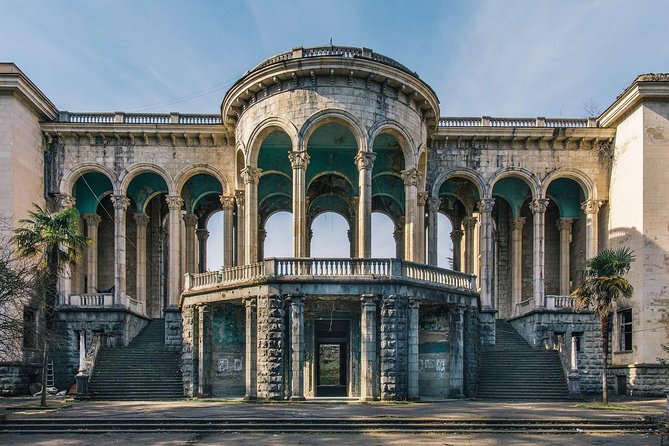
- Tskaltubo’s abandoned sanatoriums are the tour’s centerpiece
- A four-hour second morning in Tskaltubo
- Kutaisi adds markets, a railway station, and a final old town walk
- What the $266.67 price really covers
- Who should book this tour?
- Should you book the Tskaltubo and Chiatura tour?
- FAQ
- What is the starting time for the tour?
- Is hotel pickup and drop-off included?
- Is this a private tour?
- Are meals included?
- Is admission to the Stalin Museum included?
- Can the tour end in Kutaisi?
- Can I cancel for a full refund?
Key points before you book
- Chiatura’s cable cars are still part of local life: You may ride an old cableway and see the steep gorges that made these machines necessary.
- Tskaltubo gets the most time: The tour gives you two separate visits, including four hours for the radon baths, park, and abandoned sanatoriums.
- The Stalin Museum uses a Soviet-era viewpoint: It opened in 1957 and presents Stalin’s life through a heavily controlled version of the past.
- The Chronicle of Georgia sets the tone: Giant stone panels near the Tbilisi Sea offer a short visit with broad views.
- Your transport is private: Pickup, drop-off, parking, and road travel are covered, while lunch and dinner are not.
- The tour can end in Kutaisi: If you want more time there or have a flight from Kutaisi Airport, you may be left in the city instead of returning to Tbilisi.
Why this two-day route works
At 8:00 in the morning, the tour leaves Tbilisi and heads west through several very different parts of Georgia. The private vehicle matters here. Chiatura and Tskaltubo are not quick side trips from Tbilisi, and public transport would make this route harder to manage in two days.
You are not simply moving from one attraction to the next. The route traces several chapters of modern Georgian history: national monuments built in the late Soviet period, Stalin’s carefully managed public image, industrial mining towns, Soviet resort culture, and the disorder that followed the Soviet Union’s collapse.
I also appreciate that the route does not treat the abandoned buildings as mere photo backdrops. The old sanatoriums and cableways make more sense when you know what they were built to do. Chiatura’s cable cars served mine workers in a town shaped by manganese. Tskaltubo’s grand spa buildings served a very different purpose, drawing people to mineral springs and organized Soviet resort life.
The private format is best for couples, families, or a small group with a shared interest in architecture and difficult history. You can settle into the vehicle between stops, avoid changing buses, and ask for adjustments within the day’s plan. The trade-off is that you are paying for exclusivity rather than the lowest possible price.
More things to do in Tbilisi:
- Tbilisi: Day Trip to Kazbegi, Gudauri, Gergeti, and Ananuri
★ 4.9 · 3,203 reviews - Day Trip to Kakheti Wine Region Including 9 Wine Tastings
★ 5.0 · 2,774 reviews - Highlights of Caucasus Mountains-Jinvali,Ananuri,Gudauri,Kazbegi(Group tour)
★ 5.0 · 2,682 reviews
The Chronicle of Georgia begins the morning near Tbilisi
The first stop is the Chronicle of Georgia, also called the History Memorial of Georgia, near the Tbilisi Sea. The name Tbilisi Sea can mislead you slightly. It is a water reservoir, not an open sea, but it gives the monument a striking setting.
Allow about 30 minutes. Admission is free, and the short visit works well as an opening stop before the longer drive west. The monument is known for its enormous stone columns and carved scenes connected with Georgian history and identity. Its scale is the main surprise. You may spend as much time looking upward at the structure as studying the individual panels.
The site also gives you wide views over the surrounding area. Since it is not among Tbilisi’s most visited sights, the stop feels separate from the city’s usual route of churches, baths, and old streets. I like it as a visual introduction to the tour: monumental, political, and a little remote.
Do not expect a long guided visit here. Thirty minutes is enough for photographs, a walk around the monument, and a look toward the reservoir. The value is in the setting and size rather than a large number of formal exhibits.
Gori’s Stalin Museum presents a controlled Soviet portrait
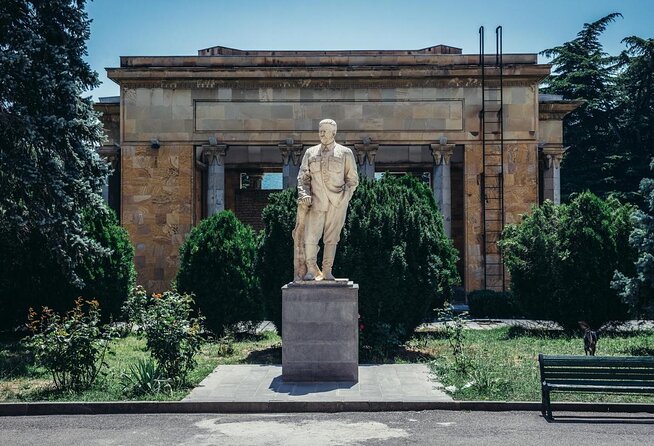
The drive then continues to Gori, Stalin’s hometown, for a one-hour visit to the Stalin Museum. The admission fee is not included, so keep that extra cost in mind.
The museum opened in 1957 and has changed little since then. That detail is important. You are not entering a modern museum designed to challenge every part of Stalin’s rule. Instead, you see a presentation shaped by the Soviet period, with his life told through a strongly censored lens.
This makes the museum useful, but you need to read it carefully. It can show you how Stalin was presented to the public, not simply provide a neutral account of his crimes and policies. The gap between the polished official story and what is left unsaid is part of the experience.
The one-hour stop is enough for a focused visit. I would not treat it as a complete study of Stalin. Think of it as a period piece, one that helps explain how memory and power worked in the Soviet Union. If you have a serious interest in twentieth-century politics, you will likely want to spend your time noticing the tone and omissions as much as the objects on display.
Chiatura’s cableways reveal an industrial town’s strange solution
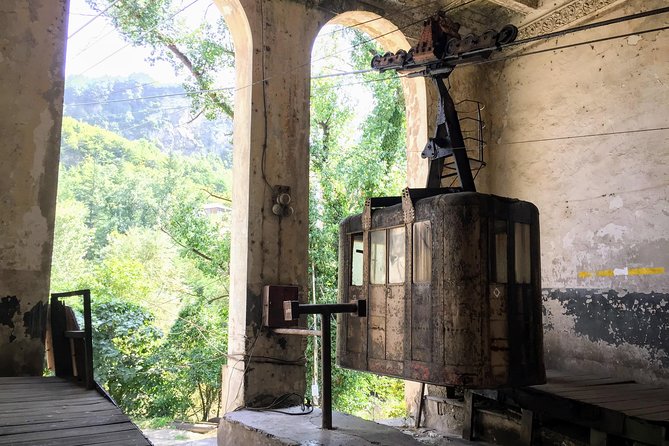
Chiatura is the tour’s most unusual stop. The town sits among steep valleys and deep gorges, with its development tied to manganese mining. Getting mine workers across this difficult terrain on foot was slow and inefficient, so the Soviet government built a network of cable cars.
Several of these cableways are old, and maintenance has been a concern. Yet they remain part of the town’s identity and, according to the planned visit, may still be used. One of the most memorable parts of the tour is the chance to ride an old cable car. The experience is not polished or theme-park neat. That is exactly why it matters.
The scheduled cableway visit lasts about an hour, followed by two hours walking around Chiatura. You will see the local market, abandoned houses, and Soviet architecture. The town gives you a better sense of everyday life than a single preserved monument could. Its buildings and transport system grew from work, industry, and difficult terrain.
Lunch is planned at a Soviet-style restaurant, but lunch is not included in the tour price. This is a useful point to remember when comparing the cost with other tours. You pay for the vehicle, parking, pickup, and private arrangement, but your meals remain separate.
The cable cars also require a practical caution. The supplied information describes a troublesome lack of maintenance, so you should be prepared for an old and basic ride. Anyone uncomfortable with aging infrastructure may prefer to view the cableways from below. The appeal here comes with a little uncertainty.
A completely different kind of day:
- From Tbilisi: Kakheti Wine Region Tour with 9 Wine Tastings
★ 4.9 · 2,541 reviews - Tbilisi: Mtskheta, Jvari, Gori and Uplistsikhe Day Tour
★ 4.9 · 2,396 reviews - From Tbilisi to Kazbegi, Ananuri, Gudauri & Gergeti
★ 4.9 · 2,278 reviews - Tbilisi: Kakheti Wine Region Tour with 10 Wine Tastings
★ 5.0 · 2,160 reviews
Tskaltubo’s abandoned sanatoriums are the tour’s centerpiece
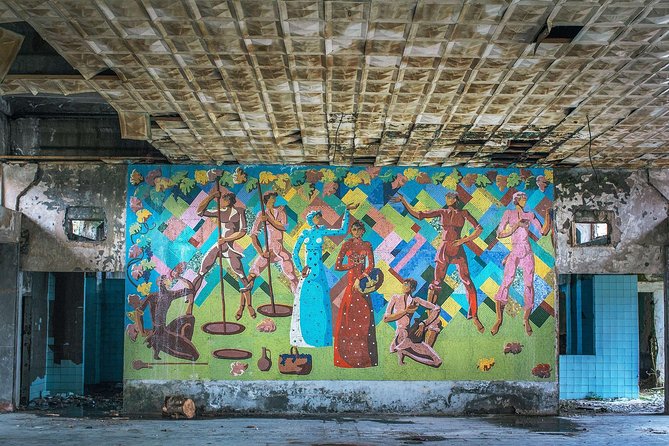
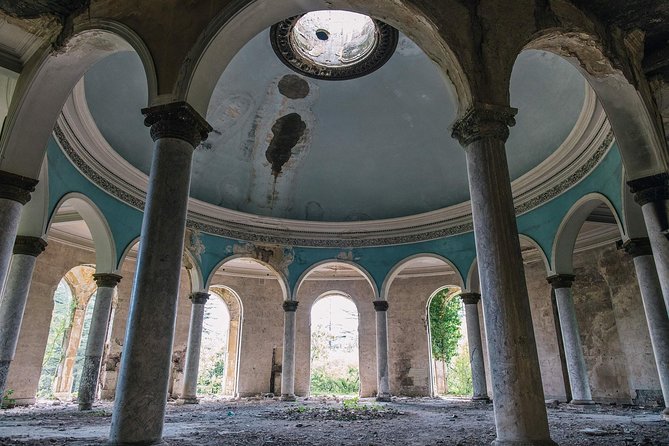
After Chiatura, the route reaches Tskaltubo, a former spa town in western Georgia. Its springs rise from limestone formations below the ground, and during the Soviet period the town became a major health resort.
The old sanatoriums once offered organized spa stays, large halls, gardens, and bathing facilities. After the Soviet Union collapsed, the town lost much of its former purpose. Later, the 1992 conflict in Abkhazia brought displaced people into some of the buildings, adding another layer to the story of decline and change.
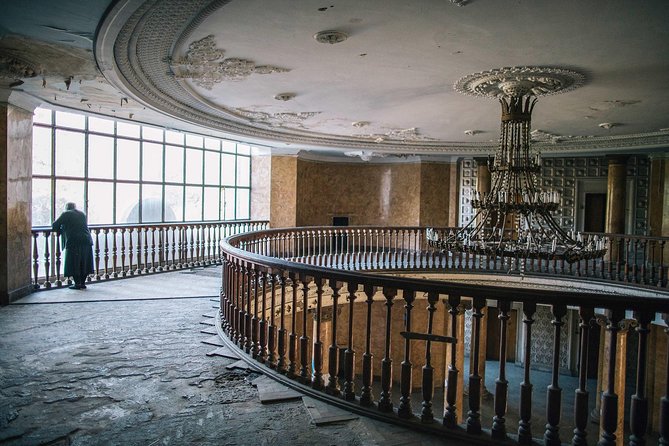
The first Tskaltubo visit lasts about two hours. You may see abandoned sanatoriums where vegetation has pushed through corridors, courtyards, and bathing rooms. Pillared halls and empty interiors make clear how grand the resort system once aimed to be. The contrast is striking: a place designed for health and leisure now marked by neglect.
You should treat the buildings with care. The tour description emphasizes abandoned structures, but it does not promise restored interiors or formal museum conditions. Expect an exploratory visit rather than a tidy attraction with signs at every corner. Wear practical footwear and stay alert around old surfaces, though the supplied details do not specify particular safety equipment or access rules.
The private vehicle and overnight stay make Tskaltubo easier to appreciate. Instead of rushing in for a few photographs and leaving, you return the next day for a longer four-hour visit. That extra time is valuable because the town is not a single building. Its atmosphere comes from the relationship between the park, baths, streets, and several former sanatoriums.
A four-hour second morning in Tskaltubo
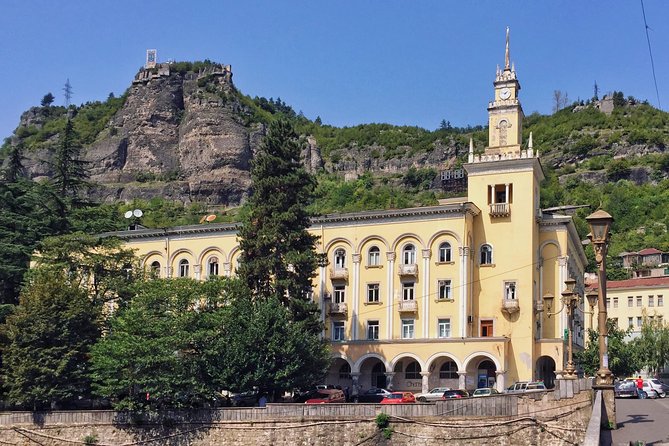
Day two gives Tskaltubo the longest block of time. You can visit the radon baths, walk through the park, and climb into abandoned sanatoriums. Admission is listed as free, although the tour does not provide a detailed breakdown of any possible local charges connected with bathing.
The radon baths are an important part of the town’s identity. Even if you do not use the baths, seeing them helps explain why Tskaltubo became a resort rather than simply another Georgian town. The park provides a change of pace after the empty buildings, while the sanatoriums return you to the tour’s main theme of Soviet architecture and decline.
I like this second visit because it keeps the tour from reducing Tskaltubo to a quick stop for dramatic pictures. You have time to walk, look closely, and connect the old spa system with the town around it. Four hours may feel long to someone interested only in photography, but it suits anyone who enjoys architecture, urban exploration, and historical context.
You spend the night at a local guesthouse in Tskaltubo. The information provided calls it a comfortable local guesthouse, but it does not give the name, room details, or meal arrangements. Dinner is not included, so confirm the evening plan before departure. The overnight stay is a practical part of the route rather than a luxury feature. It breaks up the distance between Tbilisi and western Georgia.
Kutaisi adds markets, a railway station, and a final old town walk
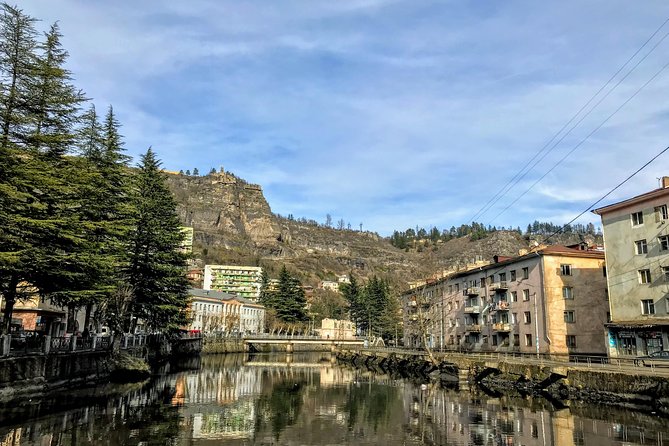
The route continues to Kutaisi, where the first stop is the market. The visit lasts about 30 minutes and is free. You can buy local goods, get a sense of the city’s everyday trade, or take photographs.
Half an hour is enough for a quick look, not a long shopping session. If you want to purchase anything, have an idea of what you want before entering. The market is included for local flavor, but it is not presented as a major food tour or extended shopping experience.
Next comes the Car Factory Railway Station, where another old cable car may be used. The visit lasts around 30 minutes, and admission is included. This stop echoes Chiatura’s transport story while offering a different setting. The tour’s appeal is partly the chance to see infrastructure that still has a connection to daily movement rather than sitting behind glass.
The final stop is Kutaisi’s old town. You get about an hour for a short walk and lunch, with lunch at your own cost. This is a compact introduction, not enough to cover all of Kutaisi. If you have a flight from Kutaisi Airport or want to spend more time in the city, the tour can leave you there instead of taking you back to Tbilisi.
That option can improve the value considerably. A return to Tbilisi makes the day longer, while ending in Kutaisi lets you combine the tour with onward plans. Confirm the drop-off arrangement when booking if your schedule depends on it.
What the $266.67 price really covers
At $266.67 per person, this is not a budget day trip. The price makes more sense when you use the private format: hotel pickup and drop-off, private transportation for two days, parking fees, and a local guesthouse overnight stay are built into the arrangement.
You still pay for lunch and dinner, and the Stalin Museum admission is not included. The tour also does not list a separate fee for the cable car at the Car Factory Railway Station, since that admission is included. These small exclusions matter when you set your total budget.
For one person, the price may feel high. For a private group splitting the vehicle and guide costs, it becomes easier to justify. Group discounts are offered, though no discount amount is specified. Ask for the exact group price before booking.
The strongest value is time and access. You avoid arranging separate transport between Tbilisi, Gori, Chiatura, Tskaltubo, and Kutaisi. You also get a route that would be awkward to assemble independently in only two days. If your main aim is cheap transportation, this is the wrong product. If you want a focused Soviet-era route with private logistics, the cost is more reasonable.
Who should book this tour?
I would recommend it to you if you like abandoned architecture, Soviet history, unusual public transport, and places that still show the marks of political change. It is especially suitable for a small private group that wants to travel at its own pace rather than join a large coach.
You should also enjoy long road journeys and imperfect sites. Tskaltubo’s sanatoriums are abandoned, Chiatura’s cableways are old, and the Stalin Museum offers a controlled historical viewpoint. None of these stops is designed as a polished modern attraction.
The tour may not suit you if you want Georgia’s vineyards, mountain scenery, or a relaxed food-focused holiday. Meals are not included, and the schedule is built around urban exploration rather than extended time in restaurants or nature.
Pickup is offered, the start time is 8:00 a.m., and confirmation arrives at booking. Most people can participate, and only your group joins the private activity. Free cancellation is available if you cancel at least 24 hours before the local start time. Inside that window, refunds and changes are not accepted.
Should you book the Tskaltubo and Chiatura tour?
Book it if you want a well-planned two-day route through Georgia’s Soviet past and prefer a private vehicle to a complicated series of local connections. The best parts are the time in Tskaltubo, the unusual cableway ride in Chiatura, and the chance to see how Soviet industrial and resort towns have changed.
Think carefully if you are uneasy around abandoned buildings or aging cable cars. Also check the total price for your group, meals, Stalin Museum admission, and any plans to end in Kutaisi.
For the right audience, this is a strong specialist tour. It offers more than dramatic ruins. It connects architecture, mining, spa culture, dictatorship, and post-Soviet change in one compact journey.
FAQ
What is the starting time for the tour?
The tour starts at 8:00 a.m.
Is hotel pickup and drop-off included?
Yes. Hotel pickup and drop-off are included, along with private transportation and parking fees.
Is this a private tour?
Yes. Only your group participates in the private tour or activity.
Are meals included?
No. Lunch and dinner are not included in the tour price.
Is admission to the Stalin Museum included?
No. Admission to the Stalin Museum is not included.
Can the tour end in Kutaisi?
Yes. You can be left in Kutaisi if you want to explore more of the city or have a flight from Kutaisi Airport.
Can I cancel for a full refund?
Yes, if you cancel at least 24 hours before the experience start time. Cancellations or changes made less than 24 hours before the start are not accepted for a refund.
Just added in Tbilisi
- Wine Tasting feel the Difference of Qvevri or Classical Wine★ 4.4 · 10 reviews
- From Tbilisi: Kakheti and Kazbegi 2-Day 4X4 Jeep Tour pack★ 5.0 · 6 reviews
- Walking Tour in Old Tbilisi – Group Tour★ 4.5 · 8 reviews
- Uforgatable Kakheti Tour with wine tasting – in Georgia★ 4.9 · 5 reviews
- From Tbilisi: Uplistsikhe Caves and Mtskheta Town Day tour★ 5.0 · 2 reviews
- Tbilisi: Vintage Fashion and Secondhand Thrifting Tour★ 5.0 · 11 reviews
- Private Adorable City Tour of Tbilisi★ 5.0 · 3 reviews
- Tbilisi Airport to Gudauri, Bakuriani, Batumi, Tbilisi★ 5.0 · 3 reviews
2-Day Experiences, compared.
2-Day Gudauri and Kazbegi Tour with Hotel Pickup
Read our review →

2 Days Trip to West Georgia (Caves, Canyons, Waterfalls)
Read our review →
2-Day Kutaisi Tour: Caves, Canyons & Soviet Sanatoriums
Read our review →
Tour to Yerevan Sevan Dilijan Armenia from Tbilisi 2 days
Read our review →