Reviewed · TOURS
Tour to Katskhi Pillar&Chiatura from Tbilisi (Mghvimevi,Cableway, Ubisa,Tsitska)
Georgia keeps a few wonders off the main road. This private day trip from Tbilisi reaches the Katskhi Pillar, the old mining town of Chiatura, and several medieval churches in about 12 hours. I especially like the mix of dramatic sights and quiet religious art, plus the comfort of hotel pickup and onboard Wi-Fi.
I also like that the tour includes local Tsitska wine and warm khachapuri, rather than offering only sightseeing from the van. The main drawback is the long day and the high price of $197.50 per person, though the value improves if you are sharing the private vehicle with a larger group or qualify for a group discount.
In This Review
- Key points to know before booking
- Why this western Georgia day trip is worth your time
- Mgvimevi, a church built into the rock
- Chiatura and the cable cars of a mining valley
- Didi Katskhi and a church with an unusual shape
- Katskhi Pillar, the dramatic centerpiece
- Ubisa Monastery and Georgia’s remarkable frescoes
- Tsitska wine and khachapuri on a long road day
- What the $197.50 price really gives you
- Who will enjoy this private tour most
- Practical advice for a smoother day
- Should you book the Katskhi Pillar and Chiatura tour?
- FAQ
- Where does the tour begin?
- How long does the experience last?
- Is this a private tour?
- Is transportation included?
- Is lunch included?
- What clothing is required at the churches?
- Can I cancel for a full refund?
Key points to know before booking
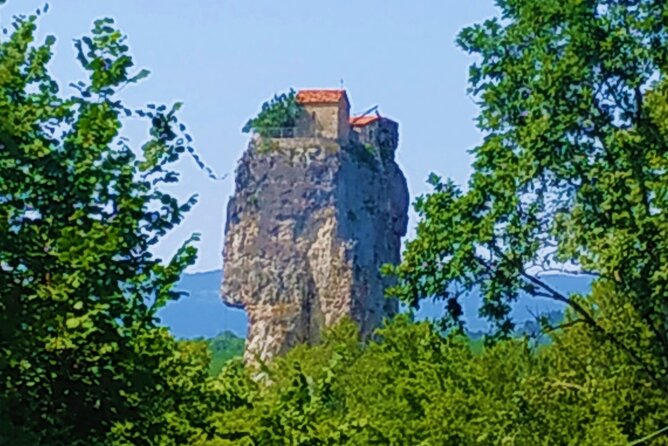
- Katskhi Pillar is the star attraction: See the 40-meter limestone monolith and its church complex from below.
- Chiatura offers unusual industrial history: Old Soviet-era cable cars once carried miners up the steep valley.
- Ubisa has exceptional medieval frescoes: The 14th-century Last Supper scene is the artistic highlight.
- Mgvimevi is partly carved into rock: Its cave monastery and wartime refuge caves add a rare physical dimension.
- The day is private and practical: Hotel pickup, air-conditioning, bottled water, and Wi-Fi are included.
- Church dress rules matter: Women need a head covering and dress, while men cannot enter in short trousers.
Why this western Georgia day trip is worth your time
Most visitors based in Tbilisi first look toward Kakheti, Mtskheta, or the mountain roads leading north. This outing sends you west instead, into a part of Georgia where medieval churches share the stage with manganese mines, rusting cable cars, and a stone pillar topped by a tiny church.
That contrast gives the day its appeal. You are not simply moving from one pretty church to another. You see how faith, mining, mountain geography, and local food have shaped the region.
The private format matters here. You get pickup and drop-off anywhere in Tbilisi, and only your own group joins the vehicle. That makes a 12-hour schedule easier to handle, since you can travel without waiting for a large group at every stop. The air-conditioned vehicle, free Wi-Fi, and bottled water are useful extras on a long road day.
Your guide may be Giorgi, whose help and local knowledge received particularly strong praise. A good guide makes a difference at places such as Chiatura and the Katskhi sites, where the meaning of what you see is not always obvious from the roadside.
More things to do in Tbilisi:
- Tbilisi: Day Trip to Kazbegi, Gudauri, Gergeti, and Ananuri
★ 4.9 · 3,203 reviews - Day Trip to Kakheti Wine Region Including 9 Wine Tastings
★ 5.0 · 2,774 reviews - Highlights of Caucasus Mountains-Jinvali,Ananuri,Gudauri,Kazbegi(Group tour)
★ 5.0 · 2,682 reviews
Mgvimevi, a church built into the rock
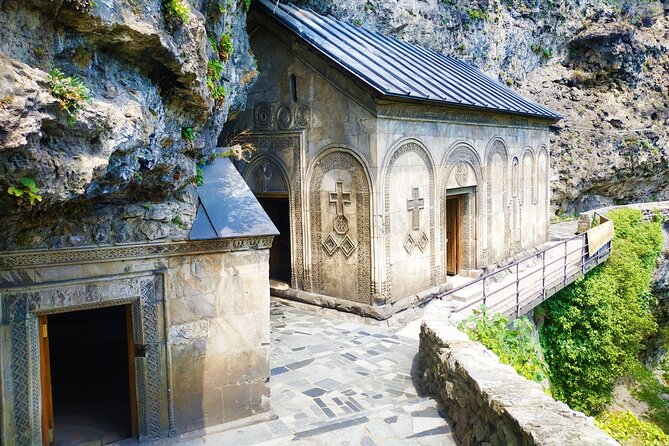
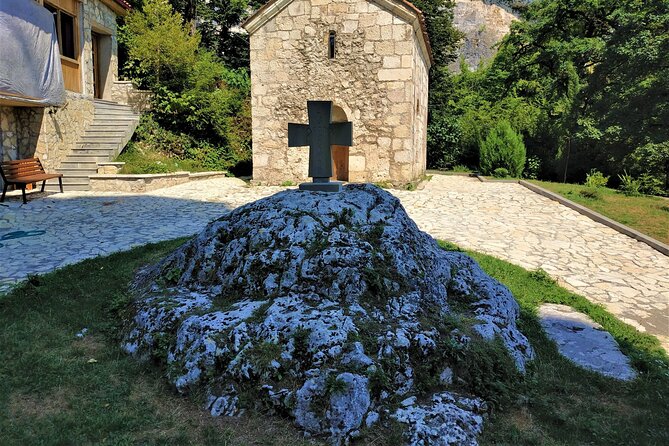
The first stop is Mgvimevi, also called the Mothers’ Monastery. The name connects to its cave setting, and the site feels different from a normal freestanding church because part of the 13th-century two-nave basilica is cut into the rock.
You have about 30 minutes here. That is enough for a focused visit, but not for a slow study of every detail. Look for the carvings around the windows, the large crosses, the interlocking diamond shapes, and the cornice decoration on the facade.
The complex also includes a small hall church, a bell tower, and a circuit wall. Small caves around the monastery served as refuges during wartime, giving the site a practical story as well as a religious one. You can picture how the surrounding rock offered protection when the region was under threat.
Inside, the wooden iconostasis dates from the 18th century. It shows Christ, the Twelve Apostles, and scenes from the life of Jesus. The combination of rough stone, old wood, and carved ornament makes this a good opening stop because it introduces the region’s mix of defensive and devotional architecture.
You should dress properly from the start of the day. Georgian Orthodox churches require modest clothing, and scarves and dresses are available near church entrances if needed. Men cannot enter in short trousers.
Chiatura and the cable cars of a mining valley
Chiatura is the most unusual urban stop. The town follows the steep Qvirila River valley, with hills rising sharply on both sides. That terrain created a serious problem for the manganese mines: workers had to spend a long time walking uphill, which reduced working efficiency.
The answer came in 1954, when cable cars were installed to carry miners between the town and the mines. The system became part of daily life, and 17 cable car routes still exist in some form. The central hub, which once had four lines, is being rebuilt with modern cable car equipment.
You have about 30 minutes in Chiatura, so this is a quick look rather than a full town tour. The value lies in understanding what the cable cars meant. They were not built as a scenic attraction. They were working transport, designed around the hard facts of a mining town squeezed into a narrow valley.
The town’s mining story reaches back to 1879, when the Georgian poet Akaki Tsereteli discovered manganese in the area. Chiatura later grew as a mining colony, became a city in 1921, and developed around manganese and iron production.
I would keep your expectations realistic. The appeal is atmospheric and historical, not polished sightseeing. The condition of old industrial infrastructure can change, and the central cable car area is being modernized. Still, the stop adds a human scale to the day. You see how local workers once moved through the valley, rather than only visiting monuments built for kings or monks.
Didi Katskhi and a church with an unusual shape
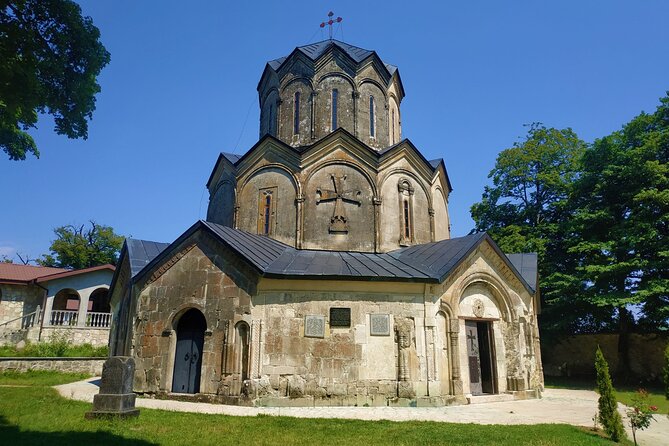
The Didi Katskhi stop takes you to the Katskhi Monastery of the Nativity of the Savior. This medieval church was built by the Baguashi family between 988 and 1014, placing it among the older religious sites on the route.
Allow about 30 minutes. The church is known for its hexagonal design and elaborate ornament. Its exterior originally had three narrowing cylindrical levels, though the decoration on the upper two levels was lost during an 1854 restoration.
That loss is worth keeping in mind. You are seeing an important medieval building, but not every part of its original design survives. The site still has plenty to inspect, including the relief at the southern vestibule. It shows the Exaltation of the Holy Cross, with four angels supporting the cross.
A pentagonal wall surrounds the church, and a free-standing bell tower was added in the 17th or 18th century. The layout gives the place a compact, fortified feel. It is a rewarding stop for anyone who likes church architecture, especially because the design differs from the more familiar cross-shaped Georgian churches.
The short visit works well here. You can see the building, study its unusual exterior, and hear the basic story without spending the afternoon on one monument.
A completely different kind of day:
- From Tbilisi: Kakheti Wine Region Tour with 9 Wine Tastings
★ 4.9 · 2,541 reviews - Tbilisi: Mtskheta, Jvari, Gori and Uplistsikhe Day Tour
★ 4.9 · 2,396 reviews - From Tbilisi to Kazbegi, Ananuri, Gudauri & Gergeti
★ 4.9 · 2,278 reviews - Tbilisi: Kakheti Wine Region Tour with 10 Wine Tastings
★ 5.0 · 2,160 reviews
Katskhi Pillar, the dramatic centerpiece
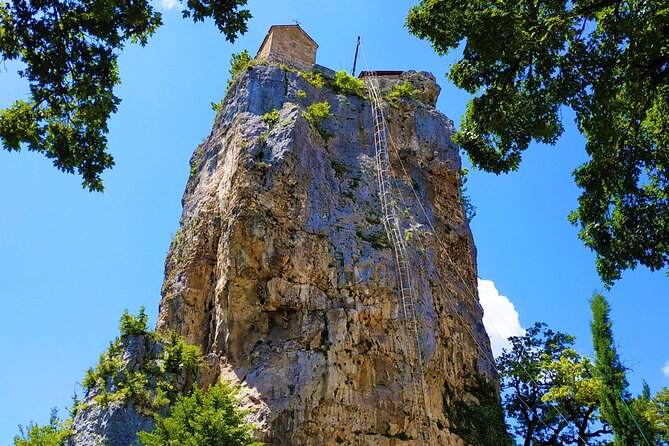
The Katskhi Pillar is the reason many people choose this tour. This natural limestone monolith rises about 40 meters above the Katskhura River valley, with a small church complex on top.
The pillar is linked to the 9th or 10th century. At the summit are a church dedicated to Maximus the Confessor, a burial vault, three hermit cells, a wine cellar, and a curtain wall. From below, the scale is striking. The religious complex seems almost impossibly placed on the rock.
At the base, you can see the newer Church of Simeon Stylites, ruins of an older wall and belfry, and a relief of a Bolnisi cross. The upper buildings are the visual focus, but the lower complex helps explain how the site functioned as a religious center.
The pillar also carries local legends. One story claims that a long iron chain once connected the top of the rock to the dome of the Katskhi church 1.5 kilometers away. Treat this as folklore, not a verified engineering fact, but it adds to the character of the place.
You have about 30 minutes here. That gives you time for photographs and a close look at the base, though you should not expect a long climb or an extended visit to the upper church. The tour description presents Katskhi as a chance to see the pillar and its clifftop religious complex, not as a summit-access excursion.
This is also a stop where weather matters. The tour requires good conditions, and poor weather can lead to a new date or a full refund. That policy makes sense because the pillar is an outdoor viewpoint, and the full day involves substantial road travel.
Ubisa Monastery and Georgia’s remarkable frescoes
Ubisa is the artistic high point of the route. The medieval monastic complex was founded by Grigol Khandzteli in the 9th century and renewed by Simon Chkondideli in 1141.
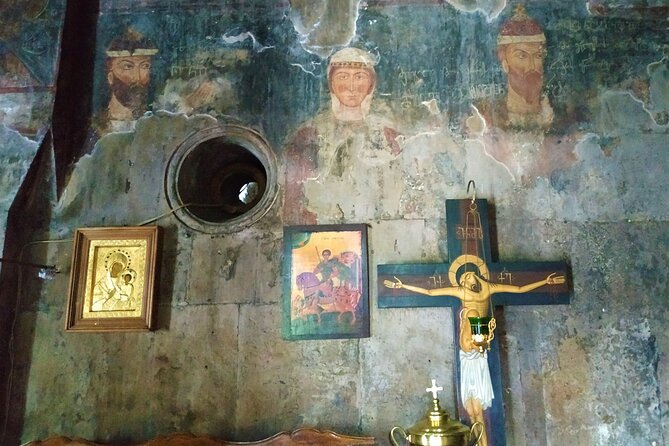
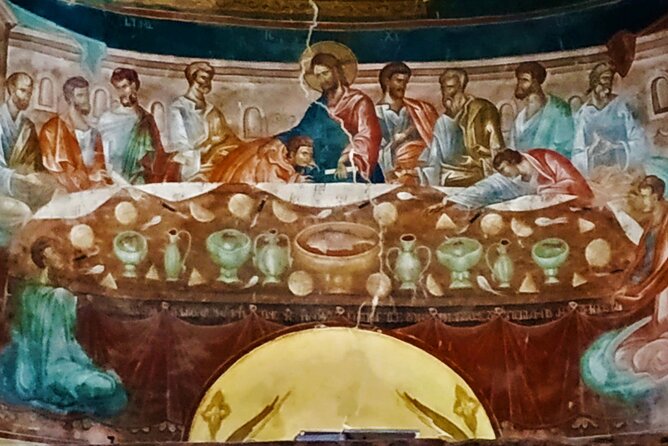
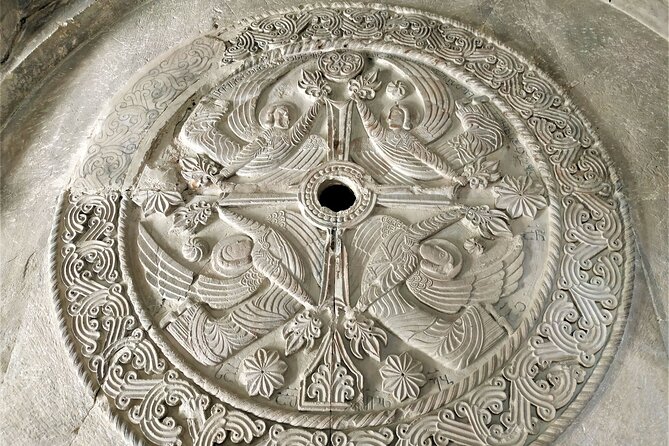
The main temple was decorated with frescoes in the 14th century, during the reign of George the Magnificent. The work is linked to the artist Damian and his student Gerasim, and the paintings offer a direct look at Georgian religious art before the Italian Renaissance reached its best-known period.
Pay close attention to the Last Supper fresco. A fish appears on the table, and the figures show human gestures and facial expressions rather than remaining stiff and purely symbolic. These details give the scene a more natural quality and help explain why Ubisa is considered one of the important artistic stops in western Georgia.
You get about 30 minutes, so listen closely and use your time well. Frescoes can be easy to miss if you only glance around the room. The value of this stop comes from noticing faces, hand movements, and small objects in the scene.
Ubisa also makes a useful counterpoint to Katskhi Pillar. Katskhi impresses you from the outside with height and isolation. Ubisa asks you to slow down and look inward, at painted walls made by medieval artists.
Tsitska wine and khachapuri on a long road day
Food and drink help break up the sightseeing. The experience includes a tasting of local Tsitska wine paired with khachapuri, Georgia’s warm cheese bread. Bottled water is also provided.
Tsitska is a local white grape variety, and tasting it in the region gives the stop more meaning than ordering a generic Georgian wine in the capital. The khachapuri is practical as well as enjoyable. Warm cheese bread is the sort of food that fits a long day on the road.
Lunch is not included, so you need to plan for that distinction. The included khachapuri is a tasting and snack, not a full lunch. Ask your provider about the day’s meal arrangements before departure, since the information supplied for the tour does not name a specific lunch restaurant or meal schedule.
I like that the food element is connected to the route rather than added as a separate luxury. You get a taste of local produce and cooking while visiting places that are harder to reach from Tbilisi.
What the $197.50 price really gives you
At $197.50 per person, this is not a budget excursion. The price needs to be judged against the private format and the amount of driving involved.
You are paying for a full-day trip of about 12 hours, hotel pickup and drop-off in Tbilisi, private transportation, an air-conditioned vehicle, onboard Wi-Fi, bottled water, khachapuri, and wine tasting. Admission is listed as free at each stop, so the main value comes from transport, time, and the guide rather than entry tickets.
The cost makes more sense for a small group that wants a private day without arranging several separate transfers. A group discount may also be available. If you are alone or traveling as a pair, the per-person price is harder to justify unless Katskhi Pillar and Chiatura are top priorities.
The free Wi-Fi is a useful touch. You avoid roaming charges while on the road, and you can stay connected during a long day outside the capital. It does not change the sightseeing itself, but it makes the transport portion less tiring.
Who will enjoy this private tour most
I would recommend this trip to you if you want unusual sights rather than Georgia’s most famous postcard stops. Katskhi Pillar is especially suited to people who enjoy remote religious architecture, while Chiatura appeals to anyone interested in industrial history and old transport systems.
The route also suits photographers. You get the vertical form of Katskhi Pillar, the steep valley of Chiatura, rock-cut architecture at Mgvimevi, and painted interiors at Ubisa. The short stop lengths keep the day moving, but you will want to have your camera ready.
This is less suitable if you prefer a slow, single-site visit. Each stop lasts roughly 30 minutes, and the total day is long. The schedule gives you a strong introduction to several places, but not an exhaustive study of any one monastery.
The private vehicle is a good choice for families and small groups who value control over their day. It also helps if you want a pickup from your own Tbilisi hotel instead of making your way to a central meeting point.
Practical advice for a smoother day
The start time is 8:00 am, so prepare for a full day away from Tbilisi. Wear comfortable clothes suitable for church visits, and bring layers because much of the attraction lies outdoors.
Women should bring a head scarf and a dress or other modest covering. Men should avoid short trousers. Scarves and dresses may be available at church entrances, but carrying your own is simpler.
Keep lunch in mind. Khachapuri and wine tasting are included, but lunch is not. Since no specific lunch stop is provided in the tour details, confirm the plan before setting off.
Do not book this outing casually the night before if your schedule is tight. Free cancellation is available up to 24 hours before the start time for a full refund, while later cancellations and changes are not accepted. Poor weather can also affect the trip, with a different date or full refund offered if the operator cancels.
Should you book the Katskhi Pillar and Chiatura tour?
Book it if you want a private, long-distance day focused on Georgia’s less familiar western sights. The strongest reasons are the unusual Katskhi Pillar, the old cable car system in Chiatura, the 14th-century frescoes at Ubisa, and the rock-cut setting of Mgvimevi.
The tour earns extra credit for practical comfort and for the guide support associated with Giorgi. The included Tsitska wine and khachapuri make the road day feel more connected to the region.
Skip it if you want a relaxed pace, a full lunch included, or a low-cost group excursion. At $197.50 per person, it is best value when shared by a private group and when these particular sights are high on your list. For the right visitor, this is one of the more distinctive day trips you can make from Tbilisi.
FAQ
Where does the tour begin?
The tour begins in Tbilisi at 8:00 am. Hotel pickup and drop-off are offered anywhere in the capital.
How long does the experience last?
The full tour lasts approximately 12 hours.
Is this a private tour?
Yes. Only your own group participates in the activity.
Is transportation included?
Yes. Private transportation in an air-conditioned vehicle is included, along with onboard Wi-Fi and bottled water.
Is lunch included?
No. Lunch is not included. Khachapuri tasting and a Tsitska wine tasting are included.
What clothing is required at the churches?
Women need to wear head scarves and dresses in Georgian Orthodox churches. Men cannot enter in short trousers. Scarves and dresses may be available near church entrances.
Can I cancel for a full refund?
Yes. You can cancel at least 24 hours before the start time for a full refund. Poor weather cancellations may result in a different date or a full refund.
Just added in Tbilisi
- Wine Tasting feel the Difference of Qvevri or Classical Wine★ 4.4 · 10 reviews
- From Tbilisi: Kakheti and Kazbegi 2-Day 4X4 Jeep Tour pack★ 5.0 · 6 reviews
- Walking Tour in Old Tbilisi – Group Tour★ 4.5 · 8 reviews
- Uforgatable Kakheti Tour with wine tasting – in Georgia★ 4.9 · 5 reviews
- From Tbilisi: Uplistsikhe Caves and Mtskheta Town Day tour★ 5.0 · 2 reviews
- Tbilisi: Vintage Fashion and Secondhand Thrifting Tour★ 5.0 · 11 reviews
- Tbilisi Airport to Gudauri, Bakuriani, Batumi, Tbilisi★ 5.0 · 3 reviews
- Private Adorable City Tour of Tbilisi★ 5.0 · 3 reviews
Tours, compared.
Highlights of Caucasus Mountains-Jinvali,Ananuri,Gudauri,Kazbegi(Group tour)
Read our review →
Kakheti Wine Region Tour with 9 Wine Tastings
Read our review →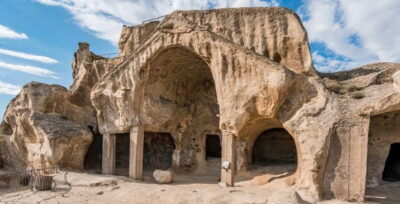
Mtskheta, Jvari, Gori and Uplistsikhe Day Tour
Read our review →
Kakheti Wine Region Tour with 10 Wine Tastings
Read our review →
Tbilisi Walking Tour Including Cable Car and Traditional Bakery
Read our review →