Reviewed · TOURS
Tbilisi: The Urbex and Soviet Tour of Tbilisi
Tbilisi keeps its Soviet secrets in plain sight. This five-hour small-group tour takes you far beyond the old-town circuit, linking Brutalist buildings, political history, local memories, and some of the city’s best unusual photo stops. I especially like the visit to the Underground Printing House Museum, and the chance to see the Skybridge houses with local context rather than just a quick exterior photograph. The main drawback is time in the vehicle: Tbilisi traffic can be slow, and several locations are viewed only from outside.
I also like the human side of the experience. Guides such as Giorgi, David, Temo, and Zezva are praised for making difficult subjects easy to follow, while conversations with people connected to the Soviet period can give the day a personal edge. At $54 per person, the tour costs more than hiring a car for sightseeing, but the guide, transport, entrance fees, and historical explanation make it a reasonable choice if you want more than a set of buildings.
In This Review
- Key things to know before you book
- Why this tour shows a different Tbilisi
- Starting at Avlabari and crossing the city
- The Underground Printing House Museum
- The Chronicle of Georgia and its giant stone panels
- The Bank of Georgia building and modern Brutalism
- The Tbilisi Skybridge houses
- The extra stop and the city beyond the postcard
- Meeting people and hearing local memories
- How much value do you get for $54?
- Who should book this Tbilisi tour?
- Practical details that affect your day
- Should you book the Urbex and Soviet Tour?
- FAQ
- How long does the Tbilisi Urbex and Soviet Tour last?
- How much does the tour cost?
- Where does the tour start?
- What transport is used during the tour?
- Is the Underground Printing House Museum available every day?
- Are all the buildings open to enter?
- Is food included?
- What language is the tour conducted in?
Key things to know before you book
- The Underground Printing House Museum reveals a secret Bolshevik press linked with Stalin and offers a rare look at underground political activity.
- The Chronicle of Georgia is one of the most dramatic photo stops, with huge carved panels and broad views beyond central Tbilisi.
- The Skybridge houses show Soviet residential planning in a practical, lived-in form, not as a polished monument.
- The tour reaches places you are unlikely to connect on foot, including the Bank of Georgia building, residential towers, museums, and lesser-known structures.
- Small groups are limited to 10 people, so it is easier to ask questions and take photographs without being lost in a crowd.
- Weekday and weekend programs differ: the printing house is available Monday through Friday, while the weekend alternative is the Car Museum.
Why this tour shows a different Tbilisi

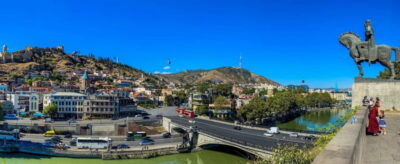
Most first visits to Tbilisi focus on the old town, sulfur baths, churches, balconies, and the fortress above the river. Those places matter, but they tell only one part of the city’s story. Tbilisi is also a city of broad Soviet housing districts, concrete public buildings, aging elevators, ambitious monuments, and structures that have been adapted to modern Georgian life.
This tour gives you a way to connect those scattered places. You are not simply driven past unusual buildings while someone names them. The guide explains how they were planned, what they were meant to represent, and how people live with them today.
That context matters with Brutalist architecture. A raw concrete building can look severe or beautiful depending on what you know about it. The tour encourages you to notice scale, shape, access, and purpose. You may begin by photographing a block of concrete and finish by thinking about the people who used its corridors, offices, lifts, and apartments.
The small group helps here. With no more than 10 participants, you can stop for questions and ask about Soviet daily life, modern Georgia, politics, or architecture. The guides are also praised for their humor and friendly manner, which keeps the subject from becoming a dry architecture lecture.
More things to do in Tbilisi:
- Tbilisi: Day Trip to Kazbegi, Gudauri, Gergeti, and Ananuri
★ 4.9 · 3,203 reviews - Day Trip to Kakheti Wine Region Including 9 Wine Tastings
★ 5.0 · 2,774 reviews - Highlights of Caucasus Mountains-Jinvali,Ananuri,Gudauri,Kazbegi(Group tour)
★ 5.0 · 2,682 reviews
Starting at Avlabari and crossing the city
The usual meeting point is outside Avlabari metro station, near the round fountain. You can reach it by metro, public bus, or taxi, and the operator offers advice if you are unsure how to get there from your accommodation.
From there, transport is provided between the stops. Depending on the group, you may ride in a clean minibus or a comfortable car. The transport is an important part of the experience because the sites are spread across Tbilisi. Trying to link them independently would take planning, several rides, and a fair amount of time.
You should allow some flexibility around the five-hour estimate. One tour extended beyond the advertised time, and traffic can be difficult. I would not schedule a flight, long lunch reservation, or another timed activity immediately afterward.
The vehicle also creates a natural pause between stops. That gives the guide time to explain what you are about to see, answer questions, and connect one part of the city with another. The trade-off is clear: this is not a walking tour, and you will spend a noticeable amount of the day sitting in traffic.
The Underground Printing House Museum
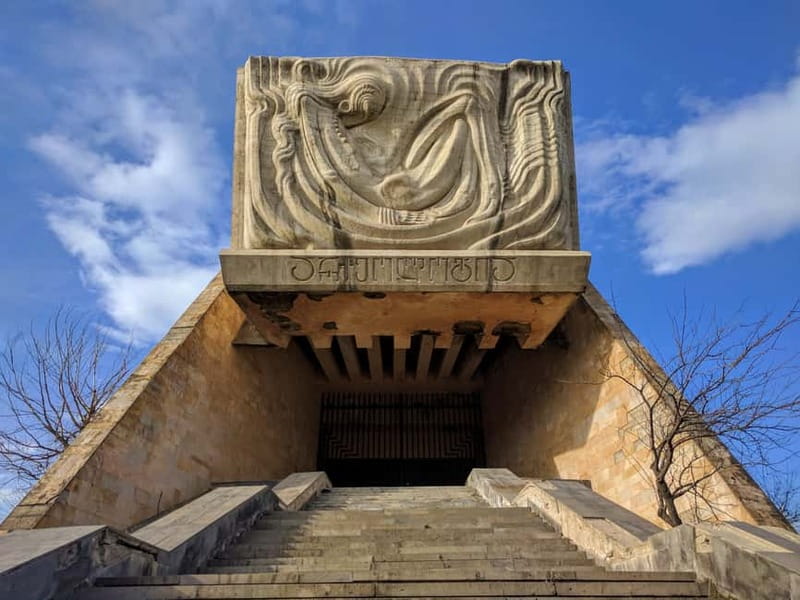
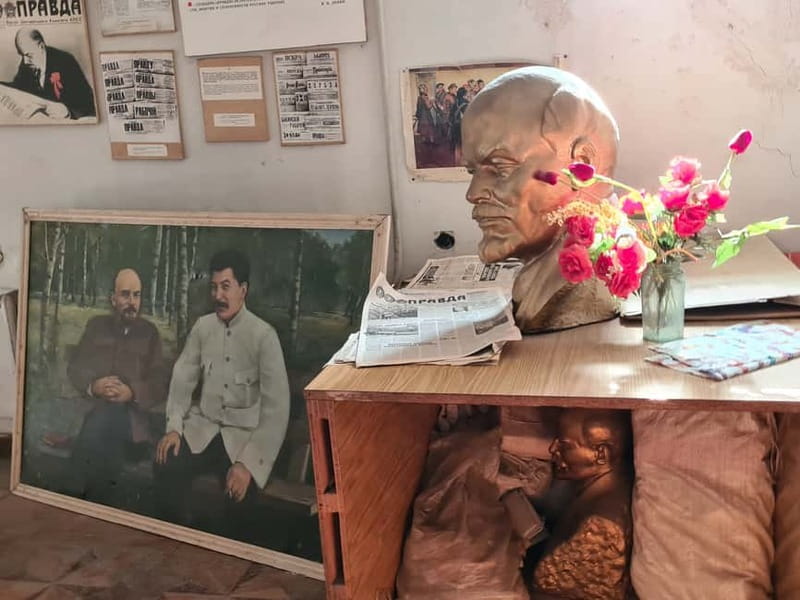
The first major stop is the Underground Printing House Museum, also known as Stalin’s Printing House. It is one of the most unusual places in the program because it connects a physical site with political work carried out in secret.
The museum recalls an underground Bolshevik printing operation, with Stalin associated with its activity. The guided visit lasts about 30 minutes. Rather than seeing another grand Soviet monument, you get a look at a concealed working space and the risks involved in producing political material under imperial rule.
This stop gives the rest of the day a useful foundation. Soviet history did not begin with monumental apartment blocks or government offices. It was shaped by underground politics, conflict, censorship, and people organizing outside official systems.
The site is included on weekday tours from Monday through Friday because of its opening hours. On weekends, the alternative is a Car Museum, usually presented as an optional replacement. If the printing house is your main reason for booking, check the operating day before you reserve.
The museum may be less visually spectacular than the Chronicle of Georgia or the Skybridge, but I would not skip it. Its value comes from the story and setting. You are looking at a place tied to political action, not simply a building designed to impress.
The Chronicle of Georgia and its giant stone panels
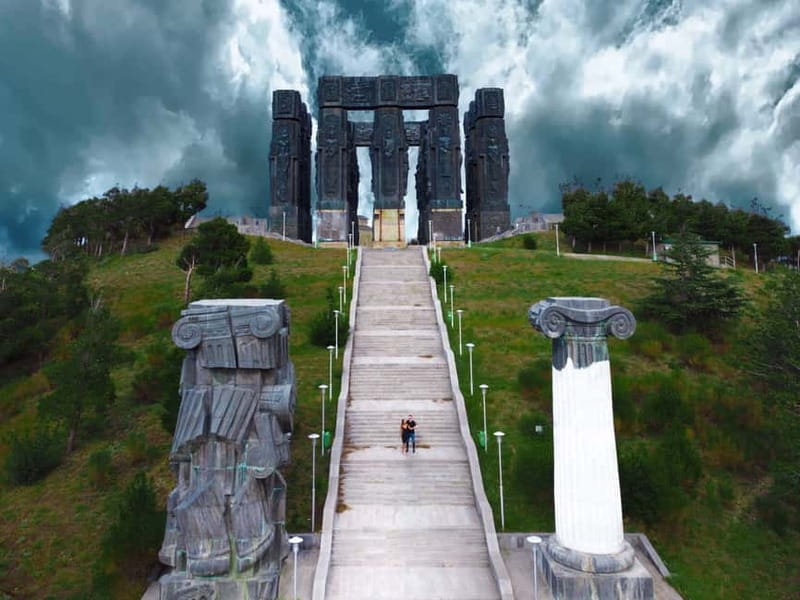
The Chronicle of Georgia is one of the most powerful visual stops. The monument sits away from the usual center and is made up of enormous columns and carved panels. It is designed for photographs, but it also carries a serious national and historical message.
You receive about 30 minutes here for a guided visit and photographs. That is enough for the guide to explain the monument and for you to work out several angles, though photographers may wish for more time.
The scale is the point. The monument can make you feel very small, and its elevated position gives you broad views across the surrounding part of Tbilisi. It is one of those places where a photograph may attract you first, then the story gives the visit weight.
This is also a good example of why a car-based tour helps. The monument is not part of the compact old town, and reaching it alongside the other stops would be awkward without private transport. Bring a lens or phone with a wide field of view if you want to capture the full scale.
A completely different kind of day:
- From Tbilisi: Kakheti Wine Region Tour with 9 Wine Tastings
★ 4.9 · 2,541 reviews - Tbilisi: Mtskheta, Jvari, Gori and Uplistsikhe Day Tour
★ 4.9 · 2,396 reviews - From Tbilisi to Kazbegi, Ananuri, Gudauri & Gergeti
★ 4.9 · 2,278 reviews - Tbilisi: Kakheti Wine Region Tour with 10 Wine Tastings
★ 5.0 · 2,160 reviews
The Bank of Georgia building and modern Brutalism
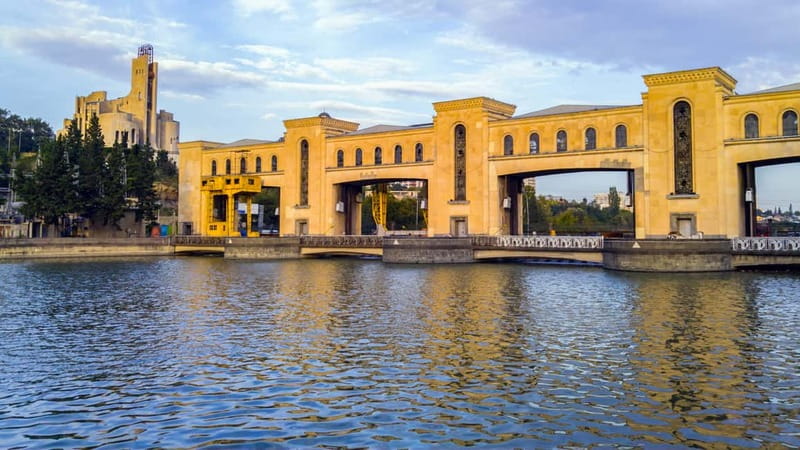
The Bank of Georgia building is a short photo stop of about 15 minutes. You see it from outside, and access to some sites on the route is restricted. Do not expect a long indoor visit or a museum-style presentation at every location.
The building is a strong example of Soviet-era architectural ambition. Its stacked, irregular forms make it one of the most recognizable concrete structures in Tbilisi. The design rewards patience because the shape changes as you move around it.
Fifteen minutes may sound brief, but that is often enough for an exterior stop. The guide can point out the structure’s key features, explain its original purpose, and suggest where to stand for photographs.
This stop also shows the limits of the tour. Some buildings are more interesting from one angle than another, and not every site will have the same emotional impact. If you want long architectural study time, a private photography outing may suit you better. If you want a broad introduction across the city, the short stop works well.
The Tbilisi Skybridge houses
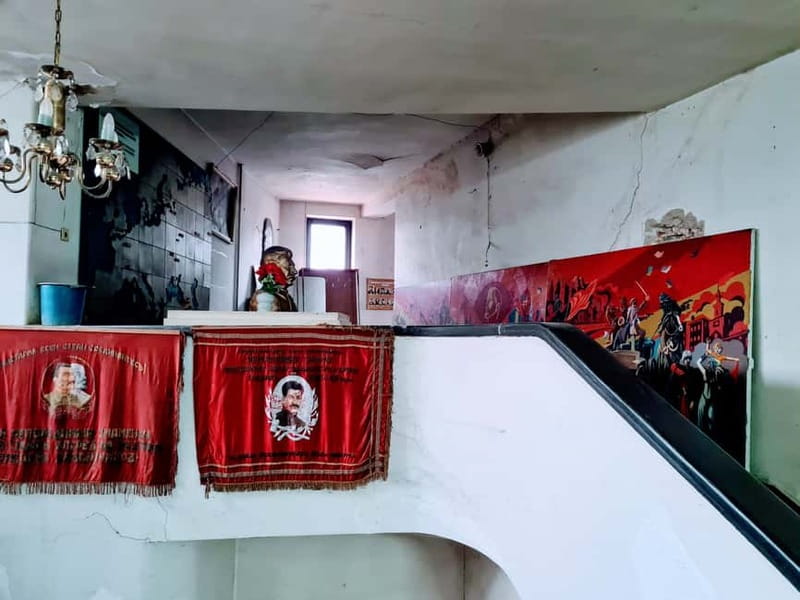
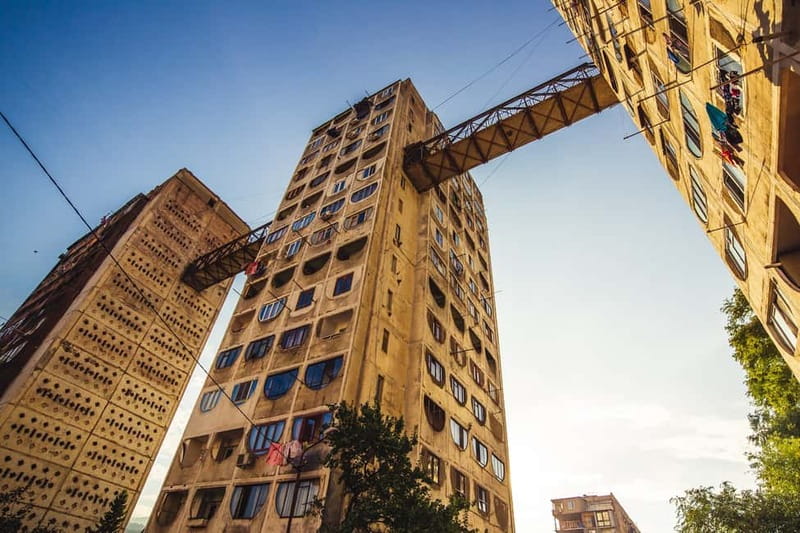
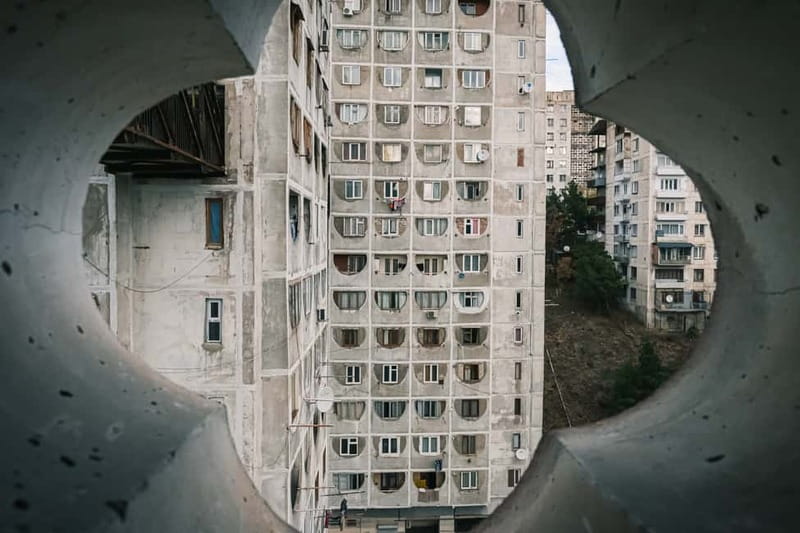
The Skybridge houses are among the most distinctive stops on the route. These residential towers are connected by a raised passage, creating a striking piece of Soviet housing design. The result is both practical and theatrical, with concrete, height, and shared circulation turned into the main visual idea.
You spend around 30 minutes here with a guided visit and photo time. The guide can explain how the buildings function and how the design relates to everyday life. This is not an abandoned ruin sealed away from the public. It is a residential place, so you should behave respectfully and avoid treating residents as part of the attraction.
One especially memorable detail from the tour experience is meeting a lift operator who showed visitors her tiny home. That kind of encounter gives the architecture a human scale. Instead of seeing only a dramatic bridge between towers, you begin to think about lifts, work, apartments, neighbors, and the routines that make a large structure function.
The Skybridge is likely to appeal even if you are not an architecture specialist. The form is easy to understand, and the stories make it easier to remember. It is also a good place to ask about how Soviet housing ideals worked in real life, including the gap between grand planning and ordinary domestic space.
The extra stop and the city beyond the postcard
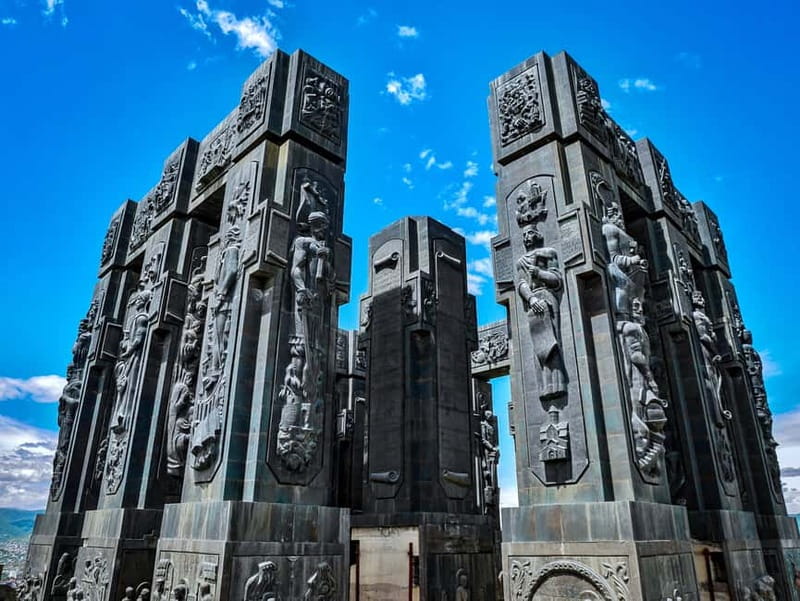
The itinerary includes another lesser-known location selected by the guide. It is used for sightseeing, explanation, and photographs, and may change with the day’s route or access conditions.
This flexible part of the tour is useful because it allows the guide to respond to the group. Guides have added unexpected stops and pointed out places that are difficult to find alone. That can make the experience feel less mechanical than a fixed list of monuments.
You should also expect a few exterior-only visits. Some parts of the locations are restricted, and a building may be visible only from the street. That is worth knowing before you book, especially if you are hoping to enter every structure.
The reward is the variety. You see restored concrete, aging Soviet architecture, monumental sculpture, residential planning, and buildings still tied to present-day city life. Tbilisi’s Soviet past is not sealed in a museum. It remains part of the roads, housing, institutions, and public spaces you pass through.
Meeting people and hearing local memories
The strongest part of the tour may be the conversation. The guides do more than recite dates. They explain how people experienced the Soviet period, how daily life worked, and how that era still affects Georgia.
Several tours included conversations with people who lived through the Soviet years, and one experience included meeting former KGB spies. These encounters depend on the day and the people available, so they should not be treated as guaranteed stops. Still, the possibility adds something a book or documentary cannot provide.
The best guides also handle these stories with care. Giorgi, David, Temo, and Zezva are repeatedly praised for being warm, funny, open-minded, and easy to talk with. Their English is described as clear, and they are willing to answer questions about Georgian history, modern life, and current events.
I would use this time well. Ask how Soviet buildings are viewed today, what has changed since independence, and how older residents remember the system. The tour is at its best when you treat it as a conversation rather than a photo safari.
How much value do you get for $54?
The listed price is $54 per person. That includes transport between sights, entrance fees listed in the program, and an English-speaking guide. Food and drinks are not included, although one tour included a stop at a local bakery for an inexpensive lunch.
You could hire a car and visit several of these places for less money. That comparison is fair, and one participant made exactly that point. The difference is the explanation, route planning, access to the printing house, and the chance to meet people connected with the city’s past.
Value depends on your interests. If you only want photographs and do not care about historical context, the price may feel high. If you want someone to explain why the buildings matter and help you reach scattered parts of Tbilisi, the cost is easier to justify.
The small group also matters. A limit of 10 keeps the day more personal than a large coach excursion. Transport received a 96 percent perfect score, and comfort and safe driving were frequent positives. At the same time, a group of two or five can feel expensive compared with a private car, so think about what kind of day you want.
Who should book this Tbilisi tour?
This is a strong match for you if you like:
- Soviet history and everyday stories
- Brutalist and experimental architecture
- Urban photography
- Places away from the old-town route
- Small groups and long conversations
- Seeing how past political systems still affect modern cities
You do not need a degree in architecture. The guides make the buildings approachable, and the variety keeps the day moving. The tour also suits first-time visitors who want a wider sense of Tbilisi, not just the historic center.
It is less suitable if you want a relaxed walking day, frequent café stops, or long visits inside each building. You will ride between districts, deal with city traffic, and sometimes view a site from outside. Photographers who need complete control over timing may prefer a private arrangement.
The tour is also a good choice for returning visitors. If you have already seen the old town, Narikala Fortress, and the main churches, this route gives you a different way to understand the city.
Practical details that affect your day
The tour lasts about five hours, but build in extra time because traffic and conversations can extend the schedule. Wear comfortable shoes for uneven areas around monuments and residential buildings, and bring water since food and drinks are not included.
A camera is useful, but do not forget the people who live in these places. Ask before photographing residents, lift operators, or private interiors. The respectful tone praised in the guiding is part of what makes the local encounters worthwhile.
The start point is outside Avlabari metro station at the round fountain. Drop-off is offered at two locations around the city, including the round fountain in Tbilisi. Confirm your exact pickup and drop-off choice when booking because the starting point depends on the selected option.
Free cancellation is available up to 24 hours before departure, and you can reserve now and pay later. English is the listed tour language.
Should you book the Urbex and Soviet Tour?
Book it if you want Tbilisi’s concrete buildings to come with stories. The Underground Printing House, Chronicle of Georgia, Bank of Georgia, and Skybridge each offer a different view of the city, while the guide adds the local setting that a taxi ride cannot provide.
I would choose a weekday if the printing house is a priority. I would also keep the rest of the day open, ask plenty of questions, and accept that traffic is part of the deal. At $54, this is not the cheapest way to see the sights, but it offers strong value for anyone interested in architecture, history, photography, or the living memory of Soviet Georgia.
If your idea of a good tour is a polished list of famous monuments, choose another route. If you want a thoughtful, sometimes surprising look at the Tbilisi beyond the postcard, this is an easy recommendation.
FAQ
How long does the Tbilisi Urbex and Soviet Tour last?
The tour is scheduled to last five hours. It can run longer, so avoid booking another time-sensitive activity immediately afterward.
How much does the tour cost?
The price is $54 per person.
Where does the tour start?
The guide waits outside Avlabari metro station, at the round fountain. You can reach the meeting point by metro, public bus, or taxi.
What transport is used during the tour?
Transport between the sights is included. Depending on the group and selected option, this may be a comfortable car or a clean minibus.
Is the Underground Printing House Museum available every day?
No. The printing house is included on weekday tours from Monday through Friday because of its working hours. On weekends, the Car Museum can be visited instead as an optional alternative.
Are all the buildings open to enter?
No. Some areas are restricted and can only be viewed from outside.
Is food included?
No. Food and drinks are not included. A local bakery stop may be offered during the day, but you should plan to pay for your own food.
What language is the tour conducted in?
The tour is conducted in English with a live English-speaking guide.
Just added in Tbilisi
- Wine Tasting feel the Difference of Qvevri or Classical Wine★ 4.4 · 10 reviews
- From Tbilisi: Kakheti and Kazbegi 2-Day 4X4 Jeep Tour pack★ 5.0 · 6 reviews
- Walking Tour in Old Tbilisi – Group Tour★ 4.5 · 8 reviews
- Uforgatable Kakheti Tour with wine tasting – in Georgia★ 4.9 · 5 reviews
- From Tbilisi: Uplistsikhe Caves and Mtskheta Town Day tour★ 5.0 · 2 reviews
- Tbilisi: Vintage Fashion and Secondhand Thrifting Tour★ 5.0 · 11 reviews
- Tbilisi Airport to Gudauri, Bakuriani, Batumi, Tbilisi★ 5.0 · 3 reviews
- Private Adorable City Tour of Tbilisi★ 5.0 · 3 reviews
Tours, compared.

Highlights of Caucasus Mountains-Jinvali,Ananuri,Gudauri,Kazbegi(Group tour)
Read our review →
Kakheti Wine Region Tour with 9 Wine Tastings
Read our review →
Mtskheta, Jvari, Gori and Uplistsikhe Day Tour
Read our review →
Kakheti Wine Region Tour with 10 Wine Tastings
Read our review →
Tbilisi Walking Tour Including Cable Car and Traditional Bakery
Read our review →