
Reviewed · MTSKHETA AND GORI TOURS
Soviet tour of Georgia – Gori, Tskaltubo, Chiatura, Enguri Dam.
Georgia keeps its Soviet past in plain sight. This private tour links Tbilisi’s Soviet buildings with Stalin’s birthplace in Gori, Chiatura’s mining relics, Tskaltubo’s abandoned sanatoriums, and the enormous Enguri Dam. I like the range: you see both grand state projects and the quieter remains of daily life. I also like the private format, which gives your group room to adjust the route and spend longer at places that catch your interest.
The main drawback is the amount of driving. Gori, Chiatura, Tskaltubo, Zugdidi, and Enguri are spread across western Georgia, so some days are long. The tour information also contains conflicting details about a four-day Soviet tour and a separate six-day Svaneti program, so you should confirm the exact route before paying.
In This Review
- Key points to know before booking
- Why this Soviet Georgia tour is different
- Day one: Tbilisi and Rustavi’s Soviet side
- Day two: Stalin, Chiatura, and a long road west
- Day three: Tskaltubo to Enguri Dam
- Day four: Tskaltubo’s abandoned sanatoriums
- What the $850 price buys you
- Transport, pace, and practical comfort
- Who should book this experience?
- Should you book the Soviet tour of Georgia?
- FAQ
- How long is the Soviet tour of Georgia?
- Where does the tour start and finish?
- What time does the tour start?
- Is an English-speaking guide included?
- Are meals included?
- Can I cancel for a full refund?
Key points to know before booking
- Stalin’s Gori museum gives the tour a strong historical starting point, with admission included.
- Chiatura offers some of Georgia’s most striking Soviet industrial scenery, set among steep hills.
- Tskaltubo’s abandoned sanatoriums are the main event for anyone interested in architecture and decay.
- Enguri Dam adds a huge working Soviet-era engineering site to the schedule.
- Private transport means only your own group participates, with pickup at Rose Revolution Square in Tbilisi.
- An English-speaking guide costs extra, though guiding can be arranged on request.
Why this Soviet Georgia tour is different
Many tours of Georgia focus on churches, wine, mountain villages, and food. This one takes a different road. It looks at the country through concrete, steel, empty resort buildings, mining infrastructure, apartment blocks, and monuments built during the Soviet period.
That gives you a more complicated picture of Georgia. You see the scale of Soviet planning, but you also see what happened when those systems lost their purpose. In Tskaltubo, once a famous spa town, grand sanatoriums now sit empty. In Chiatura, the setting reveals how industry was fitted into a dramatic mountain town. At Enguri, you see a structure that still performs its original job.
I like that mix of abandoned and active places. It keeps the tour from becoming a simple collection of ruins. Some sites are quiet and eerie. Others still matter to local life and energy production.
The tour is private, so your group does not share the vehicle with strangers. That is useful here because the subject is specialized. You may want to stop for a closer look at a façade, ask about a monument, or skip a building that feels too similar to the last one. A private vehicle gives you more freedom than a fixed group itinerary.
There is one important point to settle first. The supplied tour information describes a four-day route through Tbilisi, Gori, Chiatura, Tskaltubo, and Enguri Dam, but another section describes a six-day, five-night Svaneti trip with flights, hikes, Mestia accommodation, Ushguli, and Qoruldi Lakes. Those are two very different holidays. Contact Travelist Georgia and confirm that you are booking the Soviet architecture route, not the Svaneti program.
More things to do in Tbilisi:
- Tbilisi: Day Trip to Kazbegi, Gudauri, Gergeti, and Ananuri
★ 4.9 · 3,203 reviews - Day Trip to Kakheti Wine Region Including 9 Wine Tastings
★ 5.0 · 2,774 reviews - Highlights of Caucasus Mountains-Jinvali,Ananuri,Gudauri,Kazbegi(Group tour)
★ 5.0 · 2,682 reviews
Day one: Tbilisi and Rustavi’s Soviet side
The first day is devoted to Soviet buildings in Tbilisi and Rustavi, with about six hours of touring. The exact buildings are chosen as part of the day rather than listed in detail, so you should ask for a rough route before departure if particular types of architecture matter to you.
Tbilisi is a good place to begin because Soviet-era structures are woven into a much older city. You are not looking at an isolated open-air museum. Instead, you move through a living capital where Soviet apartment blocks, public buildings, and monumental forms sit beside older streets and later construction.
That contrast helps you read the architecture. Look for the difference between practical housing, public institutions, and buildings designed to make a political statement. The tour can also put these structures in the context of Tbilisi’s changing neighborhoods, rather than presenting them as disconnected sights.
Rustavi adds another angle. It was shaped by heavy industry and Soviet planning, so it helps show how a purpose-built industrial city differs from historic Tbilisi. The stop is particularly useful if you want to see more than central-city architecture.
The limitation is that the first day may feel broad rather than tightly focused. Since the precise stops are not specified, the quality of the day depends heavily on the route chosen and the person leading it. If you are keen on brutalist design, ask whether the schedule includes the buildings and monuments you most want to see.
One previous visitor was unable to fit Rustavi into a Tbilisi and Gori visit and planned to return. That is a useful warning: the route can contain more material than a single day comfortably allows. Confirm that Rustavi is included if it is important to you.
Day two: Stalin, Chiatura, and a long road west
Day two is the longest listed day, at about twelve hours. It combines the Stalin Museum in Gori with Chiatura, then continues to Tskaltubo for the night. Admission to the Stalin Museum is included.
Gori is Stalin’s birthplace, and the museum presents a highly specific version of his story. You can expect the visit to focus on Stalin’s early life, political career, and public image. The museum is interesting not only because of the objects on display, but also because it raises questions about how a country presents a dictator who was born there.
I would not treat this as a simple celebration or a complete account of Soviet history. Go with a critical eye. Notice what is emphasized, what is absent, and how the museum shapes your understanding of Stalin. The stop works best when you allow time afterward to discuss what you saw with your guide or driver.
Chiatura changes the mood. This former Soviet mining town is known for its industrial setting and stark architecture. The town lies in a narrow valley, and the surrounding hills give its concrete structures a powerful backdrop. Even without a formal lecture, the setting helps you understand why the town was built where it was.
The stop is one of the strongest parts of the route for people interested in industrial heritage. Chiatura is not just a collection of abandoned structures. It represents a town built around extraction and production, with Soviet transport, housing, and public systems shaped by that purpose.
The long day is the price of fitting Gori and Chiatura together. You will spend many hours on the road, and the experience will be tiring if you prefer short sightseeing days. On the other hand, this is also what makes the route efficient. You cover two very different places in one sweep instead of arranging separate trips from Tbilisi.
You stay overnight in Tskaltubo, in a former Soviet sanatorium built for the navy. That is an unusual lodging detail and part of the theme rather than a neutral hotel choice. Ask exactly what accommodation is being used and what facilities are available, since a former sanatorium may not offer the same experience as a conventional modern hotel.
Day three: Tskaltubo to Enguri Dam
The third day covers about six hours and runs from Tskaltubo toward Zugdidi and the Enguri hydropower station. Admission to the dam is included.
Enguri is a useful counterpoint to Tskaltubo’s empty resorts. The dam was built during the Soviet period and remains an important piece of infrastructure. Its dome-shaped design is among the tallest of its type, according to the tour information, which gives the visit a clear engineering focus.
You are not simply looking at a ruin here. Enguri shows the lasting scale of Soviet construction and the way major projects can continue beyond the political system that created them. It also gives the tour some variety after the abandoned buildings of Tskaltubo and the industrial remains of Chiatura.
The route toward Zugdidi adds travel time, but it also connects several parts of western Georgia that are often visited separately. If you are interested in how roads, energy, mining, and spa towns fit together, this broader route is more rewarding than visiting one abandoned site in isolation.
The practical question is how much access you receive at the hydropower station. The information confirms a visit and included admission, but it does not specify the exact viewing areas, tour length, or whether all parts of the facility are open. Ask before departure so you know if you are planning a guided technical visit or a shorter stop at the dam.
More Mtskheta and Gori trips:
- Tbilisi: Mtskheta, Jvari, Gori and Uplistsikhe Day Tour
★ 4.9 · 2,396 reviews - Day Trip to Mtskheta Gori and Uplistsikhe
★ 5.0 · 1,801 reviews - Tbilisi: Mtskheta Jvari Bazaar, Chronicles of Georgia & Wine
★ 5.0 · 1,088 reviews - Tbilisi:Mtskheta,Jvari,Bazaar,wine tasting,Chronicles of Georgia
★ 5.0 · 730 reviews
Day four: Tskaltubo’s abandoned sanatoriums
The final listed day returns to Tskaltubo for about four hours of exploring. This is likely to be the most memorable section for anyone drawn to abandoned architecture.
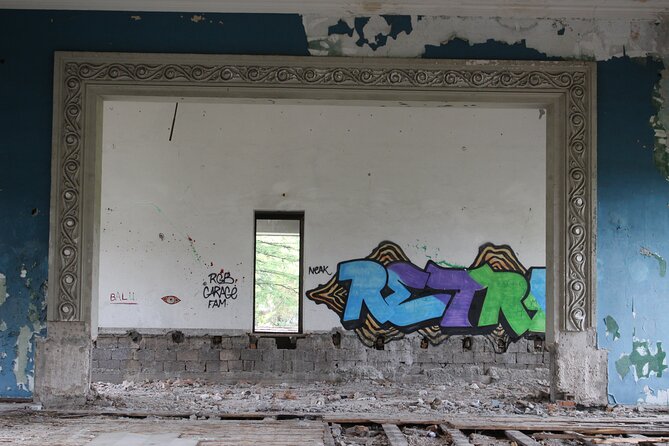
Tskaltubo was once a major spa destination, and its Soviet sanatoriums were built on a large scale. Today, empty halls, staircases, façades, and overgrown grounds show how quickly a building can change when maintenance stops. The appeal is not just visual. These buildings reveal the social world the Soviet system tried to create, with organized holidays, state-sponsored rest, and grand public facilities.
The tour does not lock in one fixed group of sanatoriums. Instead, the selection is made on site from the many available options. That flexibility is helpful because conditions can vary. Some buildings may be more intact, while others may offer stronger views or a more dramatic sense of decay.
It also means you should not expect a carefully polished museum visit. Abandoned structures can be rough, dark, unstable, or difficult to enter. The information says that most people can participate, but it does not promise that every interior is easy to access. Wear sturdy shoes, watch your footing, and follow local instructions.
I like the fact that Tskaltubo receives a full half-day rather than a quick photo stop. Four hours gives you enough time to see several buildings without turning the visit into a rushed race through corridors. It also leaves room for the guide or driver to adapt the choice of sites.
If you only want one part of the tour, Tskaltubo may be it. The abandoned sanatoriums were repeatedly singled out as a reason to take the trip, especially for people interested in Soviet architecture and the effects of time and nature on large public buildings.
What the $850 price buys you
The listed price is $850 per person. That is a serious amount for four days, so value depends on what is included and on the size of your private group.
You receive private transportation, the planned sightseeing route, admission to the Stalin Museum, admission connected with Enguri Dam, breakfast, dinner, and two lunches. Pickup and return are at Rose Revolution Square in Tbilisi, with an 8:00 a.m. start.
The private format matters most if you are traveling with friends or family. A larger group can spread the vehicle cost across several people, while a solo visitor pays much more per person for the same arrangement. Group discounts are available, so ask for the actual price based on your party size rather than assuming the advertised rate is final.
The price does not include an English-speaking guide. Guiding can be organized on request, but you should confirm the fee before booking. This is important because architecture and political history are much easier to understand with context. A driver can get you from site to site, but guiding and driving are different services.
Food is partly covered, but the details are not fully spelled out. Breakfast is included, along with one dinner and two lunches according to the inclusions. Ask which meals are provided on which days and whether drinks are extra.
For the right person, the cost can make sense. You are not paying for a standard city transfer. You are paying for a private route across western Georgia, a specialized subject, included admissions, and the convenience of linking places that would be awkward to visit independently. If you are mainly interested in Tbilisi, a shorter custom tour may offer better value.
Transport, pace, and practical comfort
This is a road-based experience with an early start. The 8:00 a.m. meeting time gives you a full day, but you should be ready for long stretches in the vehicle, especially on the Gori to Chiatura and Chiatura to Tskaltubo portions.
The private setup gives you control over the pace, but it does not remove the distances. I would book this only if you are comfortable giving up some relaxed time in Tbilisi for a wider regional route.
Pickup is offered, although the stated meeting point is Rose Revolution Square. Confirm the exact pickup arrangement when you book. The tour ends back at the meeting point, and confirmation is sent at booking.
The experience requires good weather and a minimum number of participants, despite being private for your own group. If poor weather or low bookings force cancellation, you are offered another date or a full refund. You can also cancel for a full refund up to 24 hours before the start time. Changes or cancellations inside that window are not accepted.
Service animals are allowed, and the meeting point is near public transportation. The information says most people can participate, but it does not give detailed accessibility information for abandoned buildings. Ask about stairs, uneven ground, and interior access if those issues affect you.
Who should book this experience?
I would recommend this tour to you if you enjoy:
- Soviet and brutalist architecture
- Industrial towns and large engineering projects
- Abandoned buildings and photographic subjects
- Political history, especially the complicated legacy of Stalin
- Private tours with flexible site choices
- Seeing parts of Georgia beyond the usual church and wine routes
You should think twice if you dislike long drives, prefer a polished sightseeing experience, or want a fully guided tour included in the price. The abandoned buildings are not presented as conventional attractions, and the lack of a built-in English-speaking guide may leave you wanting more explanation.
If you are especially interested in architecture, ask whether Zviad will lead your tour. His name has been associated with visits to the Tbilisi and Gori Soviet sites, and knowing who will handle the route may help you decide whether to add formal guiding.
Should you book the Soviet tour of Georgia?
Book it if Tskaltubo, Chiatura, and Enguri Dam sound more appealing to you than another standard day trip from Tbilisi. The strongest feature is the range: you move from Stalin’s carefully presented museum to Chiatura’s industrial valley, then from abandoned spa buildings to a functioning Soviet hydropower project.
I would confirm four things before booking: the exact number of days, the correct route, the accommodation, and the cost of an English-speaking guide. Once those points are clear, this is a strong private choice for a specialized look at Georgia’s Soviet past.
It is not the best pick for a gentle holiday. It is a better match for you if you want unusual places, open questions, long road days, and architecture that still shows the marks of a vanished system.
FAQ
How long is the Soviet tour of Georgia?
The stated itinerary covers approximately four days. Another description gives a six-day, five-night Svaneti program, so you should confirm the duration and route with Travelist Georgia before booking.
Where does the tour start and finish?
The stated meeting point is Rose Revolution Square in Tbilisi. The tour ends back at the meeting point.
What time does the tour start?
The scheduled start time is 8:00 a.m.
Is an English-speaking guide included?
No. An English-speaking guide is not included, but guiding can be organized on request.
Are meals included?
Breakfast, one dinner, and two lunches are listed as included. Ask for the exact meal schedule before departure.
Can I cancel for a full refund?
Yes. You can cancel at least 24 hours before the start time for a full refund. Poor weather or failure to meet the minimum number of participants may also result in a different date or a full refund.
Just added in Tbilisi
- Wine Tasting feel the Difference of Qvevri or Classical Wine★ 4.4 · 10 reviews
- From Tbilisi: Kakheti and Kazbegi 2-Day 4X4 Jeep Tour pack★ 5.0 · 6 reviews
- Walking Tour in Old Tbilisi – Group Tour★ 4.5 · 8 reviews
- From Tbilisi: Uplistsikhe Caves and Mtskheta Town Day tour★ 5.0 · 2 reviews
- Tbilisi: Vintage Fashion and Secondhand Thrifting Tour★ 5.0 · 11 reviews
- Uforgatable Kakheti Tour with wine tasting – in Georgia★ 4.9 · 5 reviews
- Tbilisi Airport to Gudauri, Bakuriani, Batumi, Tbilisi★ 5.0 · 3 reviews
- Private Adorable City Tour of Tbilisi★ 5.0 · 3 reviews
Mtskheta and Gori Tours, compared.
Mtskheta, Jvari, Gori and Uplistsikhe Day Tour
Read our review →
Mtskheta Jvari Bazaar, Chronicles of Georgia & Wine
Read our review →
Mtskheta,Jvari,Bazaar,wine tasting,Chronicles of Georgia
Read our review →
The Chronicles of Georgia, Jvari & Mtskheta Tour
Read our review →
Browse the lists this tour appears in