
Reviewed · DAY TRIPS IN TBILISI
One day tour in Mtskheta and Tbilisi
Two capitals, one memorable day. This $35.90 tour gives you a practical way to see Tbilisi and Mtskheta without arranging several taxis, routes, and guides yourself. You get hotel pickup, an air-conditioned vehicle, bottled water, snacks, and a professional guide, with a maximum group of 10 people.
I especially like the mix of old churches and city life, from Anchiskhati Basilica and Sioni Cathedral to cafés, bridges, parks, and the sulfur-bath district. I also like the high viewpoint stops at Narikala Fortress and Jvari Monastery. The main drawback is pace: eight hours covers a lot, so many stops last only 10 to 20 minutes.
The guide can make or break a history-heavy day. Daviti received especially warm praise for being friendly, respectful, well informed, and flexible about personal likes and dislikes. That kind of guide is useful here, since the tour moves between legends, religious sites, city streets, and viewpoints at a steady clip.
In This Review
- Key Points to Know Before Booking
- Why This Tour Works for a First Day in Georgia
- Freedom Square and Tbilisi’s Old City Clues
- The Clock Tower, Anchiskhati, and the Bridge of Peace
- Sioni Cathedral, Shardeni Street, and Metekhi
- Narikala Fortress and Mother of Georgia
- Abanotubani and the Leghvtakhevi Waterfall
- Jvari and the First Capital at Mtskheta
- Svetitskhoveli Cathedral and the Meaning of the Day
- Is $35.90 Good Value?
- Who Should Book This Tbilisi and Mtskheta Tour?
- FAQ
- How long does the tour last?
- What cities does the tour visit?
- Is hotel pickup included?
- How many people can join the tour?
- Is lunch included?
- What happens if the tour is canceled because of bad weather?
Key Points to Know Before Booking
- Two capitals in eight hours: See Georgia’s modern capital, Tbilisi, and its former capital, Mtskheta, in one outing.
- Small group size: The tour has a maximum of 10 people, a better setup for questions and easier movement than a large coach.
- Hotel pickup included: You start without arranging your own transport to the meeting point.
- The cable car needs checking: The route includes a ride toward Narikala Fortress, but all fees and taxes are not included, so confirm whether the aerial tram fare is extra.
- Food is limited: Bottled water and snacks are provided, but lunch is not.
- Best for first-time visitors: The route gathers many major sights quickly, making it a useful introduction to Georgia.
Why This Tour Works for a First Day in Georgia
Tbilisi can feel confusing at first. Its old lanes, steep hills, river crossings, churches, fortresses, and newer public spaces are spread across a compact but uneven city center. This tour gives you a broad first look, then adds Mtskheta, the former capital and one of Georgia’s most important religious centers.
I like this arrangement because the day has a clear story. You begin with central Tbilisi and its political heart at Freedom Square. You then move through the old city, cross the Mtkvari River, climb to the fortress and Mother of Georgia, and finish with the older spiritual center of Mtskheta.
The vehicle matters. Tbilisi has hills and some stops are separated by busy roads or steep climbs. An air-conditioned vehicle gives you a place to cool down between walks, which is welcome during warm weather. Pickup also removes one early chore, although you should make sure your hotel is covered when you book.
With a maximum of 10 people, the outing should feel more manageable than a large bus tour. It does not make the schedule leisurely, but it gives the guide a better chance to answer questions and keep the group together.
More Day Trips in Tbilisi
- Tbilisi: Day Trip to Kazbegi, Gudauri, Gergeti, and Ananuri
★ 4.9 · 3,203 reviews - Day Trip to Kakheti Wine Region Including 9 Wine Tastings
★ 5.0 · 2,774 reviews - Day Trip to Kazbegi and Gudauri
★ 5.0 · 2,009 reviews
Freedom Square and Tbilisi’s Old City Clues
The day begins at Freedom Square, a central gathering place with a long political life. The square has changed names several times over roughly 200 years and was first laid out in the early 19th century with neoclassical and Moorish touches.
Your guide may also explain its connection to a dramatic 1907 bank robbery involving Joseph Stalin. The robbery reportedly brought in the modern equivalent of about $4 million. That story gives the square more texture than a quick photo stop.
The scheduled time is only 15 minutes, so think of this as an orientation rather than a full visit. You can get your bearings, hear the main story, and understand why the square remains central to Tbilisi.
A short walk follows along Pushkin Street, named for the Russian poet and author Alexander Pushkin. The route then reaches the ruins of Tbilisi’s old city wall, uncovered in 2012. This is a small stop, about 10 minutes, but it helps you picture the fortified city beneath the modern streets.
The wall remains are not a grand monument. Their value is visual and historical. You see how old Tbilisi continues to appear in fragments as newer buildings and roads are repaired or rebuilt.
The Clock Tower, Anchiskhati, and the Bridge of Peace
The Rezo Gabriadze Marionette Theater is one of the city’s most distinctive stops. Its crooked-looking clock tower was built beside the theater in 2010. Each hour, an angel appears and strikes the bell with a hammer.
The tower also contains a small puppet theater. A show called The Circle of Life is scheduled twice daily, at noon and 7 p.m. The tour allows about 10 minutes here, so you should not assume the puppet performance will fit the schedule. If seeing it matters to you, check the timing before booking.
Nearby Anchiskhati Basilica offers a sharp change of mood. Built in the sixth century by Dachi, son of King Vakhtang Gorgasali, it is one of Tbilisi’s oldest churches. Its name comes from the Anchi Cathedral icon, which was brought here in the 17th century and is now held at Tbilisi’s Fine Arts Museum.
The visit is brief, but the church helps explain how much older Tbilisi is than its modern streets suggest. As with other religious sites, dress and behavior should be respectful.
The Bridge of Peace is the tour’s modern counterpoint. This pedestrian bridge crosses the Mtkvari River and gives you a clean view over the water and nearby parts of the old city. You get about 15 minutes for photos, a sensible amount of time for a quick crossing and a few views.
At Rike Park, you can see the city’s newer recreational side. The park has fountains, footpaths, a children’s maze, a climbing wall, and a large chess board. It is also the departure point for the aerial tramway to Narikala Fortress.
The park stop lasts about 10 minutes. That is enough to understand the layout, but not enough for a long rest or a full look at every feature. The tour description includes a tram ride toward the fortress, yet the inclusions do not list all entrance or transport fees. I would confirm the cable-car arrangement before departure.
Sioni Cathedral, Shardeni Street, and Metekhi
Sioni Cathedral sits in Old Tbilisi and has been rebuilt several times after invasions and destruction. The present building draws on a 13th-century version, with later work from the 17th through 19th centuries.
For centuries, Sioni was the main Georgian Orthodox cathedral and the seat of the Catholicos-Patriarch of All Georgia. That role moved to Holy Trinity Cathedral after its consecration in 2004.
You get about 15 minutes here. The stop is best for seeing the building and hearing its place in Georgian religious life, not for a slow architectural study.
The route then passes through Shardeni Street, now known for bars, restaurants, and nightlife. In earlier times it was a trading street, once covered by roofs and known as a dark row. It was reconstructed in 1981 and named for Jean Chardin, a French traveler who visited Georgia in the 17th century.
This is a useful reminder that Tbilisi is not only a museum of old churches. It is also a living city with evening streets and active commercial spaces. You may wish for more time here, but the tour keeps moving.
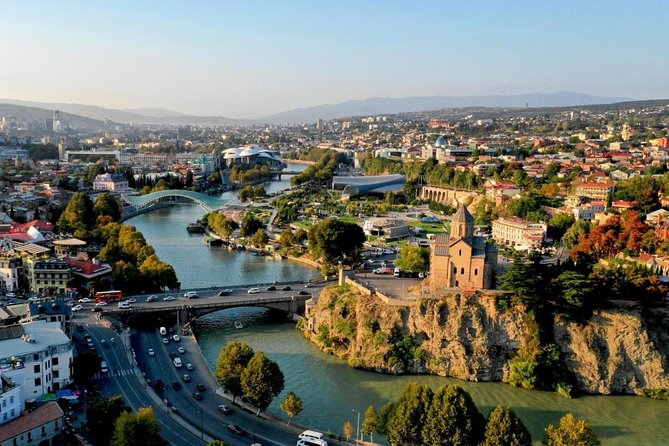
Metekhi Cathedral sits on a cliff above the Mtkvari River, in one of Tbilisi’s oldest inhabited areas. The church has been destroyed and restored many times, including after Mongol and Persian attacks. Georgian kings rebuilt it during the 16th and 17th centuries, and another restoration took place in the 19th century.
The surrounding fortifications were later removed and replaced with a prison building. That layered setting makes Metekhi especially useful for understanding how religious, royal, defensive, and prison functions have occupied the same part of the city.
The stop lasts about 15 minutes. Expect a strong river view and a compact history lesson rather than a long interior visit.
More things to do in Tbilisi:
- Highlights of Caucasus Mountains-Jinvali,Ananuri,Gudauri,Kazbegi(Group tour)
★ 5.0 · 2,682 reviews - From Tbilisi: Kakheti Wine Region Tour with 9 Wine Tastings
★ 4.9 · 2,541 reviews - Tbilisi: Mtskheta, Jvari, Gori and Uplistsikhe Day Tour
★ 4.9 · 2,396 reviews - From Tbilisi to Kazbegi, Ananuri, Gudauri & Gergeti
★ 4.9 · 2,278 reviews
Narikala Fortress and Mother of Georgia
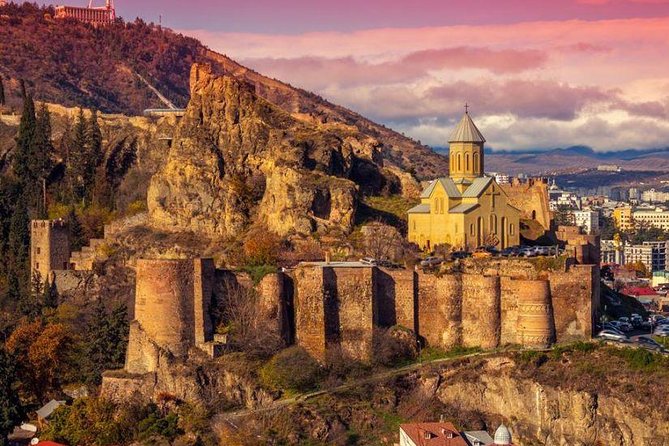
Narikala is the high point of the Tbilisi portion, both literally and visually. The fortress began in the fourth century as a Persian citadel called Shuris-tsikhe, or Invidious Fort. It grew under the Umayyads and later under King David the Builder.
The Mongols gave it the name Narin Qala, meaning Little Fortress. Much of what you see today dates from the 16th and 17th centuries. An earthquake damaged parts of the complex in 1827, and some sections were later demolished.
A restored St. Nicholas Church occupies the lower court. The current church was built in 1996 and 1997 to replace a 13th-century church destroyed by fire.
The tour allows 20 minutes at Narikala. That gives you time for the principal views and a quick look around, but the uneven terrain and open setting call for sensible shoes. The aerial tramway adds a memorable approach, with the city and river below, though the fare should be clarified because fees are not generally included.
Nearby, the 20-meter Mother of Georgia statue overlooks Tbilisi from Sololaki Hill. Elguja Amashukeli designed the aluminum figure in 1958 for the city’s 1,500th anniversary.
Her symbols are easy to read. She holds a bowl of wine in her left hand for friends and a sword in her right for enemies. The stop lasts only five minutes, but the statue works well as a quick photo point and a simple introduction to how Georgia presents its national character.
Abanotubani and the Leghvtakhevi Waterfall
The descent into Abanotubani brings you to Tbilisi’s famous sulfur-bath district. This is one of the oldest parts of the city, with a legend tied to King Vakhtang Gorgasali.
According to the story, the king’s falcon fell near hot springs. The discovery led to the decision to establish a capital here. The springs remain central to the district’s identity, and the rounded bathhouse roofs make this one of the most recognizable areas in Tbilisi.
You get around 15 minutes in Abanotubani. That is enough to see the district and hear the founding legend, but not enough for a bath experience. Lunch is also not included, so do not count on this stop as your main meal break.
A short walk leads to Leghvtakhevi Waterfall, a 22-meter cascade inside the bath district. Its name comes from the Georgian word for fig, since fig trees once grew around the area.
The waterfall stop lasts about 10 minutes. It is a welcome change from monuments and church interiors, though the short schedule means you should keep an eye on the guide and meeting time.
Jvari and the First Capital at Mtskheta
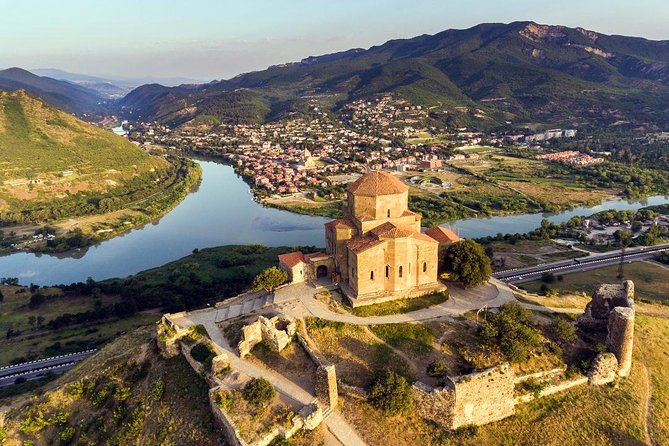
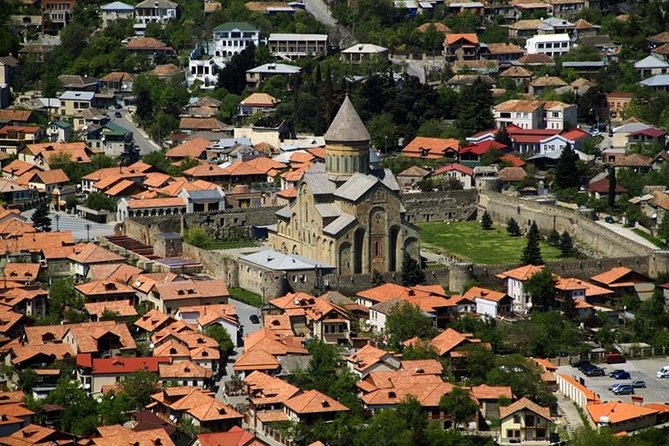
The trip to Mtskheta changes the scale of the day. Jvari Monastery sits on a rocky hill above the meeting point of the Mtkvari and Aragvi rivers. From here, you look across to Mtskheta, the former capital of the Kingdom of Iberia.
Jvari dates to the sixth century and is a UNESCO World Heritage site. Its story reaches back to the adoption of Christianity in Georgia. King Mirian III is said to have erected a large wooden cross on the hill, and a smaller church was later built beside it in the second half of the sixth century.
The setting is as important as the building. From the hilltop, the two rivers and the old capital below make the relationship between geography, power, and religion easy to understand. The scheduled visit is 20 minutes, so your time is mainly for the overlook and a concise look at the monastery.
Mtskheta itself is a city-museum reserve with cobblestone streets and traditional balconies. It remains a religious center, and its old core is also part of the UNESCO-listed heritage area.
You have about 40 minutes to explore the town. This is one of the more useful walking portions of the day because you can experience the scale of the former capital at street level. The time is not generous, but it gives you room to follow the lanes, look at the balconies, and pause for photographs.
Svetitskhoveli Cathedral and the Meaning of the Day
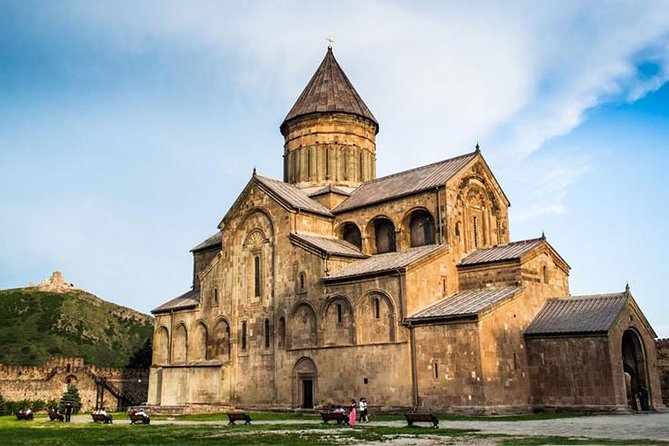
Svetitskhoveli Cathedral is the main finale in Mtskheta. It is an Early Medieval masterpiece and a UNESCO World Heritage site. It is also the second-largest church building in Georgia, after Tbilisi’s Holy Trinity Cathedral.
The cathedral is tied to a powerful Georgian religious legend. Elioz, a citizen of Mtskheta, is said to have obtained the tunic of Jesus Christ in Jerusalem. His sister Sidonia died after touching it and was buried with the tunic. A cedar tree then grew from her grave, and the site became linked to the cathedral’s origin.
You get about 30 minutes here, the longest single monument visit on the route. That extra time is welcome, since the cathedral carries architectural, religious, and national meaning all at once.
By the end of the day, you will have seen Georgia through two different lenses. Tbilisi shows a working capital shaped by Persian, Russian, religious, royal, and modern influences. Mtskheta presents an older spiritual center whose importance reaches back to Georgia’s conversion to Christianity.
Is $35.90 Good Value?
At $35.90 per person, the tour offers strong value if you want transport and a guide for both cities. The price includes hotel pickup, an air-conditioned vehicle, bottled water, snacks, and professional guiding. You would otherwise need to organize transport between Tbilisi, Jvari, and Mtskheta, then decide how to connect the scattered city stops.
The value is strongest for a first visit. You see a large share of Tbilisi’s essential sights and add two major UNESCO sites without spending a second day on logistics.
The tradeoff is personal freedom. Ten to 15 minutes is enough for a quick look, but not for lingering over a church, sitting in a café, or exploring every old lane. Lunch, alcoholic drinks, and all fees and taxes are excluded. Clarify the aerial tramway cost before you go.
Free cancellation is available up to 24 hours before the start time. The tour depends on good weather and a minimum number of participants. If poor weather or low enrollment cancels it, you are offered another date or a full refund.
Who Should Book This Tbilisi and Mtskheta Tour?
I would choose this outing if you are visiting Georgia for the first time, have only one full day, or prefer having transport and historical context handled for you. It is also a good fit if you want a small group rather than a large coach.
The tour suits people who enjoy variety: city squares, churches, bridges, a waterfall, a fortress, a statue, and a former capital all in one day. It is less suited to you if your priority is slow photography, long meals, detailed church interiors, or independent wandering.
Daviti’s friendly and flexible approach is a real advantage when available, especially for a first day in a new country. Still, ask about pickup, lunch timing, and the cable-car fare before paying.
If you want a broad, efficient introduction to Georgia’s two most important historic capitals, I would book it. If you already know Tbilisi well, choose a slower experience focused on one district or one subject instead.
FAQ
How long does the tour last?
The tour lasts approximately eight hours.
What cities does the tour visit?
It visits Tbilisi, Georgia’s current capital, and Mtskheta, the former capital.
Is hotel pickup included?
Yes. Hotel pickup is offered as part of the experience.
How many people can join the tour?
The maximum group size is 10 people.
Is lunch included?
No. Lunch is not included, although bottled water and snacks are provided.
What happens if the tour is canceled because of bad weather?
You will be offered a different date or a full refund. The same choice applies if the minimum number of participants is not met.
Just added in Tbilisi
- Wine Tasting feel the Difference of Qvevri or Classical Wine★ 4.4 · 10 reviews
- From Tbilisi: Kakheti and Kazbegi 2-Day 4X4 Jeep Tour pack★ 5.0 · 6 reviews
- Walking Tour in Old Tbilisi – Group Tour★ 4.5 · 8 reviews
- Uforgatable Kakheti Tour with wine tasting – in Georgia★ 4.9 · 5 reviews
- From Tbilisi: Uplistsikhe Caves and Mtskheta Town Day tour★ 5.0 · 2 reviews
- Tbilisi: Vintage Fashion and Secondhand Thrifting Tour★ 5.0 · 11 reviews
- Tbilisi Airport to Gudauri, Bakuriani, Batumi, Tbilisi★ 5.0 · 3 reviews
- Private Adorable City Tour of Tbilisi★ 5.0 · 3 reviews
Day Trips in Tbilisi, compared.
Day Trip to Kazbegi, Gudauri, Gergeti, and Ananuri
Read our review →
Day Trip to Kakheti Wine Region Including 9 Wine Tastings
Read our review →

Browse the lists this tour appears in