
Reviewed · MTSKHETA AND GORI TOURS
One-day tour in ancient Mtskheta, Gori and Uplistsikhe
Ancient Georgia fits into one long day. This tour links Jvari and Mtskheta, two major religious sites, with Gori’s Soviet-era story and the extraordinary rock-cut town of Uplistsikhe. I like the clear mix of churches, royal history, military ruins, and archaeology. I also like that pickup, bottled water, an air-conditioned vehicle, fuel, and a professional guide are included.
The main drawback is the pace. Ten hours is a lot, and several stops are brief, while lunch and two important admission fees cost extra. The Stalin Museum may also require extra help with interpretation, since its displays are in Georgian and Russian.
In This Review
- Key points before you book
- Why this day trip works from Tbilisi
- Jvari Monastery and the meeting of two rivers
- Mtskheta, Georgia’s former capital
- Gori Fortress above the city
- The Stalin Museum and a complicated local story
- Uplistsikhe, Georgia’s cave town
- What the $50.13 price really covers
- The guide can shape the whole day
- Timing, food, and comfort
- Who should book this tour?
- Should you book it?
- FAQ
- How long does the tour last?
- Where does the tour begin?
- What sites are included?
- Are entrance fees included?
- Is lunch included?
- How many people can join the tour?
- What is the cancellation policy?
Key points before you book
- Jvari gives you Georgia’s great river view: The sixth-century monastery sits above the meeting point of the Mtkvari and Aragvi rivers.
- Mtskheta adds two UNESCO-listed religious sites: You visit Svetitskhoveli Cathedral and the old streets of Georgia’s former capital.
- Gori offers two very different sights: You can see the medieval fortress and learn about Joseph Stalin, who was born in the city.
- Uplistsikhe is the day’s most unusual stop: This ancient cave town was carved into rock and dates back to the second or first millennium BC.
- The price covers the essentials, not everything: At $50.13 per person, transport and guiding are included, but museum and cave-town entry, plus lunch, are separate.
- The small-group limit matters: A maximum of 20 people is stated, and pickup is offered, which makes the day easier than arranging several separate trips.
Why this day trip works from Tbilisi
If you have only one free day outside Tbilisi, this route makes good use of it. The destinations are close enough to combine, yet each gives you a different view of Georgia. Mtskheta is tied to the country’s Christian identity, Gori brings in modern political history, and Uplistsikhe reaches much further back into antiquity.
The tour lasts about 10 hours. That gives you enough time to see all five main stops, but not enough time for long, unplanned wandering. You should think of this as a guided overview rather than a slow study of each place.
I find the combination especially useful because the sites do not repeat one another. Jvari is about setting and early Christianity. Svetitskhoveli is about worship, Georgian architecture, and legend. Gori Fortress gives you a military viewpoint, while the Stalin Museum offers a complicated look at twentieth-century history. Uplistsikhe then changes the mood again with its caves and rock-cut passageways.
Pickup is offered, and the group can include up to 20 people. An air-conditioned vehicle, bottled water, fuel surcharge, and guide service are included. One practical detail is worth noting: the tour is often booked well ahead, with an average booking time of 18 days before departure. If your dates are fixed, booking early is sensible.
More things to do in Tbilisi:
- Tbilisi: Day Trip to Kazbegi, Gudauri, Gergeti, and Ananuri
★ 4.9 · 3,203 reviews - Day Trip to Kakheti Wine Region Including 9 Wine Tastings
★ 5.0 · 2,774 reviews - Highlights of Caucasus Mountains-Jinvali,Ananuri,Gudauri,Kazbegi(Group tour)
★ 5.0 · 2,682 reviews
Jvari Monastery and the meeting of two rivers
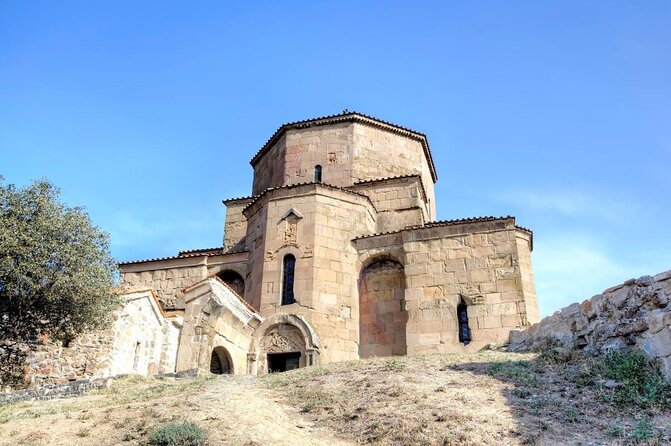
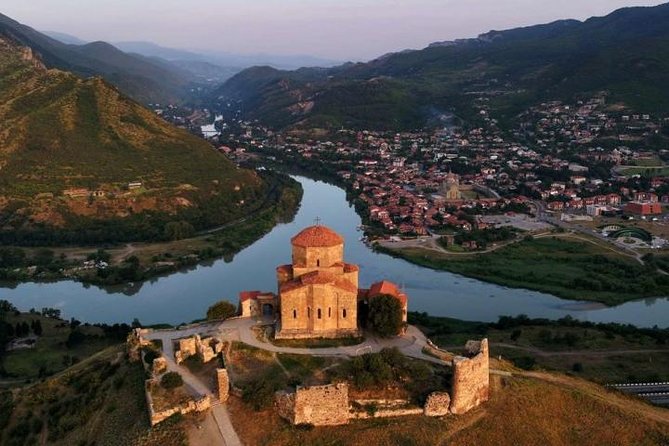
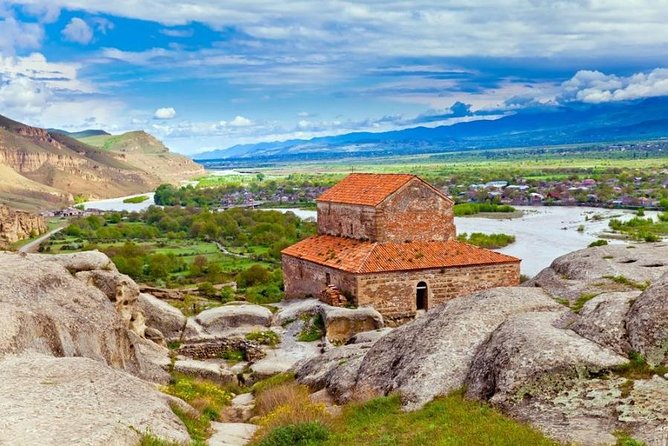
The first stop is Jvari Monastery, perched on a rocky hill above Mtskheta. From here, you look down toward the confluence of the Mtkvari and Aragvi rivers and across the old capital. The view is a major part of the visit, so take a moment outside before focusing on the church itself.
Jvari dates from the sixth century and is listed as a UNESCO World Heritage Site. Its story begins soon after Georgia adopted Christianity. King Mirian III is said to have raised a large wooden cross on this hill, marking the country’s acceptance of the new faith. Later in the sixth century, Guaram, ruler of Kartli, built a small church beside the Holy Cross.
You have about 20 minutes here, with admission included. That is enough to see the church and take in the setting, but it is not a long visit. The hilltop location can also mean exposed conditions, so comfortable shoes and a light outer layer are useful choices.
Jvari is one of those places where the setting explains its importance. You are not simply looking at an old stone building. You are seeing the site from which Mtskheta, Georgia’s former capital, spreads below you, with two rivers marking the terrain.
Mtskheta, Georgia’s former capital
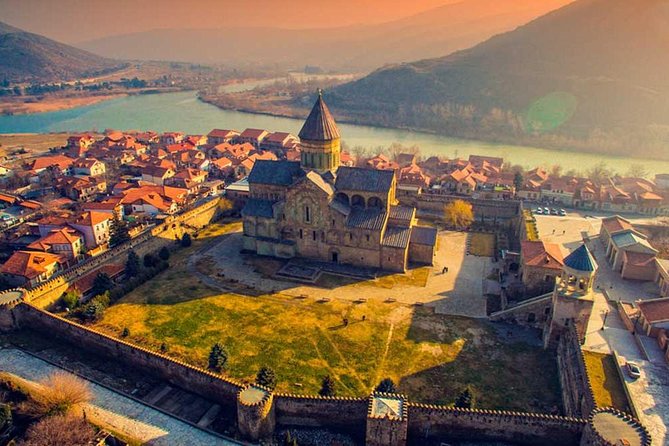
After Jvari, the tour heads into Mtskheta. This was the capital of the Kingdom of Iberia before Tbilisi took that role, and its old center is best understood on foot. You can expect streets lined with traditional balconies and historic buildings, along with the steady presence of religious monuments.
The principal visit is Svetitskhoveli Cathedral, where you have about 30 minutes. It is recognized by UNESCO and is the second-largest church building in Georgia, after Tbilisi’s Holy Trinity Cathedral. The present cathedral dates to the eleventh century and is one of the country’s most important religious buildings.
Inside, Georgian tradition connects the church with the tunic of Jesus Christ. The story says that a citizen of Mtskheta named Elioz obtained the tunic in Jerusalem and brought it home. His sister Sidonia died after touching it, and she was buried with the garment. A cedar tree later grew from her grave, and the story links that tree to the building of the church.
You do not need to treat the legend as a historical fact to appreciate its importance. It shows how strongly Mtskheta’s religious identity is tied to Christian tradition. A guide can help you separate the architecture, local belief, and documented history, which is one reason the included guide service adds value.
The half-hour stop is useful for a first look, but you may wish for more time. Mtskheta’s old streets invite a slower walk, and the tour’s tight schedule means you will need to follow the group rather than explore every corner. Still, pairing the town with Jvari gives you both the broad view and the close-up visit.
Gori Fortress above the city
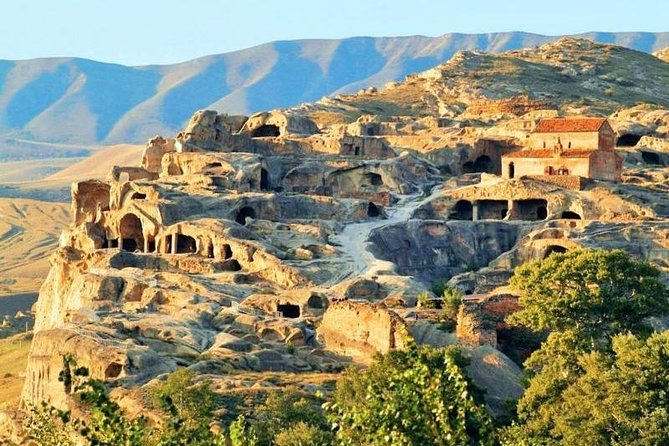
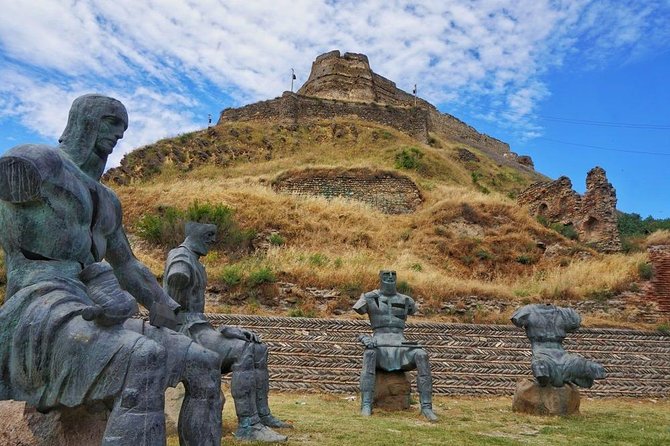
Gori changes the subject from religion to defense. Gori Fortress rises on a hill above the city and dates back to the thirteenth century. You have about 30 minutes here, with admission included.
The fortress changed hands many times. The Ottomans captured it in the sixteenth century, and Turks, Georgians, and Persians later contested control. Much of what you see today dates from the seventeenth and eighteenth centuries. A 6.2-magnitude earthquake in 1920 caused major damage, so the site should be viewed as a surviving ruin rather than a perfectly preserved castle.
The elevated position gives the fortress its purpose. From the hill, you can understand why this location mattered for control and defense. The stop also offers a useful pause between the formal interiors of Mtskheta and the more focused visit to the Stalin Museum.
Thirty minutes is enough to walk around and take in the city view, but it will not support a detailed archaeological inspection. I would treat Gori Fortress as a compact historical stop, not the main reason to choose this tour.
More Mtskheta and Gori trips:
- Tbilisi: Mtskheta, Jvari, Gori and Uplistsikhe Day Tour
★ 4.9 · 2,396 reviews - Day Trip to Mtskheta Gori and Uplistsikhe
★ 5.0 · 1,801 reviews - Tbilisi: Mtskheta Jvari Bazaar, Chronicles of Georgia & Wine
★ 5.0 · 1,088 reviews - Tbilisi:Mtskheta,Jvari,Bazaar,wine tasting,Chronicles of Georgia
★ 5.0 · 730 reviews
The Stalin Museum and a complicated local story
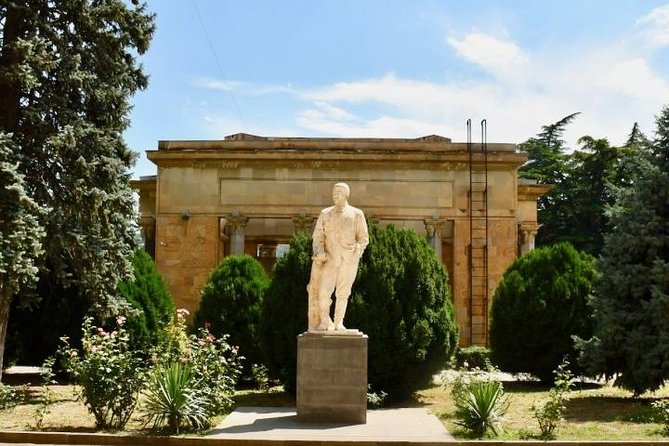
Gori is known as the birthplace of Joseph Stalin, and the museum dedicated to him is the most politically charged stop of the day. The visit lasts about 45 minutes, and the admission fee is not included.
The museum retains its Soviet-era character. That matters because the presentation is not simply a neutral biography. You are seeing how Stalin’s life and public image were framed through a Soviet lens, in the city where he was born. The collection includes his childhood home, museum displays, and a train wagon associated with him.
This is a place where context helps. Stalin led the Soviet Union, but he was also a local figure in Gori, and the museum reflects that connection. You may find the material fascinating, uncomfortable, or both. It is worth approaching with curiosity and a critical eye.
Language is an important practical issue. The displays are in Georgian and Russian. An English-speaking guide or interpreter is recommended if you want to understand the written material in detail. The tour includes professional guide service, but the exact language support should be confirmed before booking if this stop is a major reason for your trip.
The museum entry costs extra, so add that expense to the advertised price. The same applies to Uplistsikhe later in the day. If you prefer to skip the museum, the tour structure may not give you much flexibility, since the itinerary is built around this stop.
Uplistsikhe, Georgia’s cave town
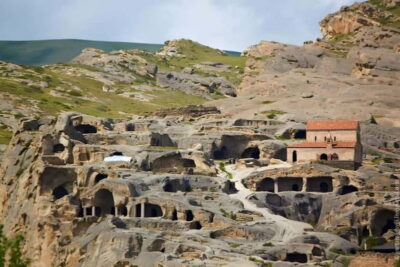
Uplistsikhe is the most distinctive stop and receives about one hour. Its name means Fortress of the Lord, and archaeologists identify it as one of Georgia’s oldest urban settlements. The earliest history of the site reaches back to the second or first millennium BC.
The town was cut into rock in the ancient kingdom of Kartli, also known to classical writers as Iberia. It became a political and religious center, and in the Middle Ages it stood along a trade route connecting Byzantium with India and China. Georgian tradition attributes its foundation to Uplos, a mythical descendant of Kartlos.
You can expect a rough, open site rather than a polished museum complex. The rock-cut rooms and paths show how people adapted a natural ridge for homes, religious spaces, storage, and public use. The setting also helps explain why this place was valuable: it combined defensible high ground with a position near important routes.
One hour gives you a useful introduction, but the terrain deserves care. The stop involves walking through an ancient rock settlement, so sturdy footwear is a wise choice. Some passages and surfaces may feel uneven, and you should stay aware of your footing rather than rushing to keep up.
Admission is not included. The separate fee is reasonable to plan for, since Uplistsikhe is one of the main reasons this day trip feels different from an ordinary city excursion. If you have already seen several churches and fortresses in Georgia, the cave town supplies a welcome change of scale and texture.
What the $50.13 price really covers
At $50.13 per person, the tour offers good value if you want transport and a guide for a full day outside Tbilisi. Hiring separate transport to Mtskheta, Gori, and Uplistsikhe could take more planning, and the included vehicle, fuel, water, and pickup reduce the small tasks that can consume a day.
The price is not all-inclusive. You must pay separately for:
- Stalin Museum admission
- Uplistsikhe admission
- Lunch
Jvari Monastery, Svetitskhoveli Cathedral, and Gori Fortress are listed with free admission. That keeps the extra costs focused on the two paid sights, but you should still budget for food and entry tickets.
The value is strongest for someone who wants a guided introduction to several important places. It is less attractive if you prefer to spend half a day at one site, linger over lunch, or choose your own order and timing. The schedule is designed for range, not leisure.
The guide can shape the whole day
A good guide matters on this route because the sites cover religion, legend, ancient settlement, military history, and Soviet politics. A bare transfer between sights would miss much of the point.
One particularly positive detail is the guide Aleko. When a booking was canceled because too few people had signed up, the company arranged a solo tour with Aleko at no additional cost. That suggests some flexibility when a departure does not reach its minimum, though you should not assume every future booking will work in exactly the same way.
Aleko was praised for making the day enjoyable as well as informative. The tour provider is Evatour, and the stated group limit is 20 people. A smaller group can make questions and short walking stops easier, while a full group may feel less personal.
For the Stalin Museum, ask about English explanations in advance. Since the displays use Georgian and Russian, the guide’s spoken explanation may be more useful than trying to read every panel yourself.
Timing, food, and comfort
Ten hours in a vehicle and at historic sites is a full day. Pickup is offered, which is helpful at the start, and the air-conditioned vehicle should make the transfers more comfortable. Bottled water is included, but lunch is not.
Because the itinerary gives only 20 to 60 minutes at each stop, bring something small to eat if you do not want to wait for a formal meal. The supplied information does not specify a lunch venue or meal break, so do not assume that food is built into the schedule.
You should also wear shoes suited to old streets, church grounds, fortress paths, and the uneven surfaces of Uplistsikhe. Modest clothing is a sensible choice for Orthodox churches, though specific dress rules are not provided here.
Most people can participate, and the tour is near public transportation. Pickup makes it easier still, but the day remains active enough that anyone with movement concerns should ask the provider for current details before booking.
Who should book this tour?
I would choose this tour if you want a broad introduction to the history around Tbilisi and prefer someone else to organize the transport. It suits first-time visitors, people with limited time in Georgia, and anyone who wants to connect famous sights in one day.
It is also a strong choice if your interests are varied. You get early Georgian Christianity, medieval architecture, a fortress, Soviet political history, and an ancient rock settlement without booking several separate outings.
I would hesitate if you dislike busy schedules or want long, quiet visits. Mtskheta and Uplistsikhe could each support more time, and the paid admissions and lunch are additional costs. The Stalin Museum also deserves advance thought if you want detailed English interpretation.
Should you book it?
Book this day trip if you value range, convenience, and a guide-led introduction more than a relaxed pace. For $50.13, the included transport, pickup, water, fuel, and guiding make the price fair, especially when you consider how many major sites are covered.
Before paying, confirm the language support at the Stalin Museum and check the extra admission costs. If those details suit you, this is a well-balanced route through Georgia’s religious roots, royal past, Soviet legacy, and ancient cave culture.
FAQ
How long does the tour last?
The tour lasts approximately 10 hours.
Where does the tour begin?
The tour is based in Tbilisi, Georgia, and pickup is offered.
What sites are included?
The route includes Jvari Monastery, Mtskheta and Svetitskhoveli Cathedral, Gori Fortress, the Stalin Museum, and Uplistsikhe Cave Town.
Are entrance fees included?
Admission is listed as free for Jvari Monastery, Svetitskhoveli Cathedral, and Gori Fortress. Stalin Museum and Uplistsikhe admission fees are not included.
Is lunch included?
No. Lunch is not included in the tour price.
How many people can join the tour?
The activity has a maximum group size of 20 people.
What is the cancellation policy?
You can cancel for a full refund up to 24 hours before the experience start time. Cancellations or changes made within 24 hours are not accepted for a refund. If the minimum number of participants is not reached and the tour is canceled, you will be offered another date or experience, or a full refund.
Just added in Tbilisi
- Wine Tasting feel the Difference of Qvevri or Classical Wine★ 4.4 · 10 reviews
- From Tbilisi: Kakheti and Kazbegi 2-Day 4X4 Jeep Tour pack★ 5.0 · 6 reviews
- Walking Tour in Old Tbilisi – Group Tour★ 4.5 · 8 reviews
- Uforgatable Kakheti Tour with wine tasting – in Georgia★ 4.9 · 5 reviews
- From Tbilisi: Uplistsikhe Caves and Mtskheta Town Day tour★ 5.0 · 2 reviews
- Tbilisi: Vintage Fashion and Secondhand Thrifting Tour★ 5.0 · 11 reviews
- Tbilisi Airport to Gudauri, Bakuriani, Batumi, Tbilisi★ 5.0 · 3 reviews
- Private Adorable City Tour of Tbilisi★ 5.0 · 3 reviews
Mtskheta and Gori Tours, compared.
Mtskheta, Jvari, Gori and Uplistsikhe Day Tour
Read our review →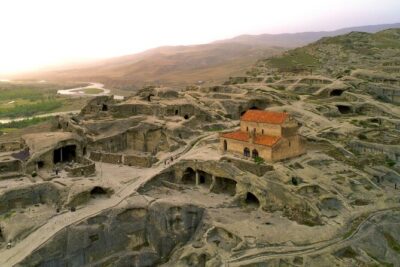
Mtskheta Jvari Bazaar, Chronicles of Georgia & Wine
Read our review →
Mtskheta,Jvari,Bazaar,wine tasting,Chronicles of Georgia
Read our review →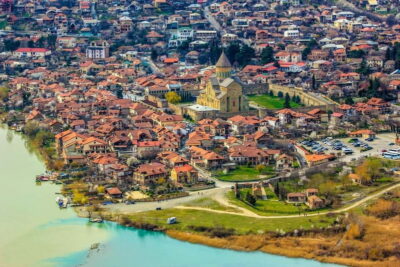
The Chronicles of Georgia, Jvari & Mtskheta Tour
Read our review →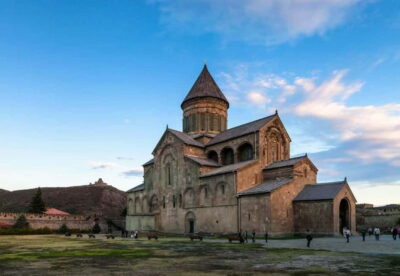
Browse the lists this tour appears in