
Reviewed · MTSKHETA AND GORI TOURS
Full Day Tour of Tbilisi and Mtskheta
Two capitals, one very full day. This tour links modern Tbilisi with ancient Mtskheta, Georgia’s former capital, so you get sweeping city views, major churches, old lanes, and local legends without arranging several separate outings. I especially like the UNESCO-listed stops at Jvari and Svetitskhoveli, plus the chance to explore Tbilisi’s historic districts with guides such as Anna, Eka, Tamara, or Maia. The main drawback is the pace: nearly eight hours with several uphill walks can feel demanding, and the advertised minimum group size needs clarification before you pay.
This is a private activity for your own group, with transportation, bottled water, a professional guide and driver, and entrance fees included. At $158 per person, it is not Georgia’s cheapest day out, but the value improves if you want a driver, an English-speaking guide, and two major destinations handled in one booking. Church-service restrictions and possible cable-car closures can change the order or shape of the day.
In This Review
- Key points at a glance
- Why this Tbilisi and Mtskheta pairing works
- Jvari Monastery and the first view of Mtskheta
- Svetitskhoveli Cathedral and Georgia’s sacred center
- Walking through Mtskheta’s old town
- Narikala Fortress and Tbilisi from above
- Abanotubani, Legtakhevi, and the old city streets
- Metekhi Cathedral and the final city view
- The guide and vehicle matter more than the ticket price
- What to know before booking
- Who should book this tour?
- Should you book the Tbilisi and Mtskheta day tour?
- FAQ
- What time and where does the tour start?
- Where does the tour end?
- How long does the tour last?
- Is the tour offered in English?
- Is this a private tour?
- Are entrance fees included?
- Are meals included?
- Can I enter the churches during services?
Key points at a glance
- Jvari Monastery gives you the postcard view: Look down on Mtskheta and the meeting point of the Aragvi and Mtkvari rivers from a sixth-century hilltop church.
- Svetitskhoveli is the spiritual centerpiece: The cathedral is one of Georgia’s most sacred places and is traditionally linked with Christ’s robe.
- You cover two historic capitals: Mtskheta brings ancient religious sites, while Tbilisi adds fortress ruins, sulfur baths, old streets, and city viewpoints.
- The guide makes a big difference: Anna, Eka, Tamara, and Maia are praised for clear English, humor, historical detail, and personal help on steep sections.
- The cable car is useful but not guaranteed: If it is closed, the route may be changed, as it was for one group that used Tbilisi’s funicular instead.
- Check the minimum group rule: One section says two people are required, while the additional information says six. Ask Georgian Holidays to confirm the current requirement.
Why this Tbilisi and Mtskheta pairing works
Mtskheta and Tbilisi are close enough to visit in one day, but they offer very different moods. Mtskheta was the ancient capital of Georgia and remains a major religious center. Tbilisi is the later capital, shaped by its river, baths, fortress, churches, trade routes, and layered old neighborhoods.
I like this pairing because you do not spend the whole day inside one city trying to tick off every sight. The morning begins in Mtskheta, where the churches feel tied to Georgia’s national story. Later, you return to Tbilisi for a more urban walk through Narikala, Abanotubani, Legtakhevi, Meidan, Shardeni, and Metekhi.
The tour begins at 10:00 am near the Giant Bicycle monument at Rose Revolution Square. It ends back at the same meeting point after about seven hours and 40 minutes. That start time is practical if you want a slower morning, though it leaves little room for adding a separate dinner or evening activity afterward.
The vehicle and driver are important here. Mtskheta’s hilltop monastery and Tbilisi’s old districts are easier to connect by car than by trying to piece together taxis and public transport. One especially positive account praised the comfortable van and pleasant driver, while another described the transport as excellent.
More things to do in Tbilisi:
- Tbilisi: Day Trip to Kazbegi, Gudauri, Gergeti, and Ananuri
★ 4.9 · 3,203 reviews - Day Trip to Kakheti Wine Region Including 9 Wine Tastings
★ 5.0 · 2,774 reviews - Highlights of Caucasus Mountains-Jinvali,Ananuri,Gudauri,Kazbegi(Group tour)
★ 5.0 · 2,682 reviews
Jvari Monastery and the first view of Mtskheta
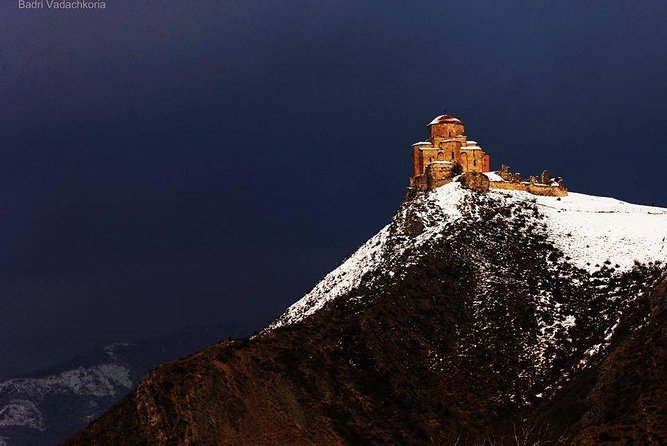
Your first stop is Jvari Monastery, dating from the sixth century. It sits above Mtskheta, and the hilltop position gives you the clearest broad view of the old capital and the rivers below.
This is a strong opening stop because the setting explains Mtskheta before you walk through it. From above, you can see why the town mattered: it lies near the meeting point of the Aragvi and Mtkvari rivers, in a position that connected important routes.
You have about an hour here, with no admission fee. The visit is more about the church, setting, and explanation than a long indoor tour. Bring shoes you trust on uneven ground, and expect some uphill walking during the day.
Clear weather matters at Jvari. One couple selected their tour date partly around the forecast and came away with better photographs. That is sound advice if you can choose your day. Gray weather will not ruin the visit, but the view is a major part of the reward.
Svetitskhoveli Cathedral and Georgia’s sacred center
After Jvari, the vehicle takes you down into Mtskheta for Svetitskhoveli Cathedral. You get about an hour here, and admission is included.
Svetitskhoveli is one of the most sacred places in Georgia. It is traditionally said to preserve Christ’s robe, a belief that helps explain the cathedral’s importance far beyond its architecture. Your guide can provide the religious and historical setting that you would miss by simply stepping inside, taking a photo, and leaving.
The church-service rule deserves attention. Entry into places of worship is not permitted during services, including Sunday mornings, Saturday evenings, and religious holidays. If your date falls at one of those times, the operator says it will switch the order and begin with Tbilisi before going to Mtskheta.
That adjustment may solve the access problem, but it does not guarantee that every interior visit will happen at your preferred time. If seeing the inside of Svetitskhoveli is central to your plans, confirm the timing before booking. One disappointed customer specifically wished this restriction had been clearer during booking.
Walking through Mtskheta’s old town
The City-Museum Reserve of Mtskheta gives you an hour to walk through the town. This is a welcome change after the two church visits because you can slow down, look at the streets, and get a sense of Mtskheta as a living place rather than only a collection of monuments.
The route includes a local wine shop where you can buy Georgian wine. Alcohol is not included, so purchases are your responsibility. The tour does not include meals either, although one account praised an excellent Georgian lunch during the day. Treat that as an occasional arrangement, not a guaranteed part of the package.
Samtavro Church follows, with about 40 minutes at the medieval monastery in Mtskheta’s historic area. It adds another important religious site without requiring a long detour.
The strength of this section is context. Jvari shows the town from above, Svetitskhoveli gives you the great cathedral, and the walk plus Samtavro fill in the smaller scale of the old capital. The possible weakness is repetition if churches are not your main interest. A good guide helps by explaining how each place differs instead of giving the same speech at every stop.
More Mtskheta and Gori trips:
- Tbilisi: Mtskheta, Jvari, Gori and Uplistsikhe Day Tour
★ 4.9 · 2,396 reviews - Day Trip to Mtskheta Gori and Uplistsikhe
★ 5.0 · 1,801 reviews - Tbilisi: Mtskheta Jvari Bazaar, Chronicles of Georgia & Wine
★ 5.0 · 1,088 reviews - Tbilisi:Mtskheta,Jvari,Bazaar,wine tasting,Chronicles of Georgia
★ 5.0 · 730 reviews
Narikala Fortress and Tbilisi from above
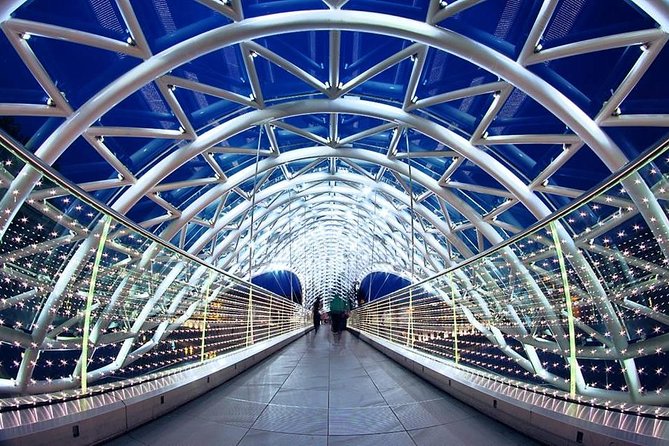
Back in Tbilisi, you take the aerial cable car to Narikala Fortress, a fourth-century fortification. The ride itself is part of the attraction, but the real payoff is the view across the city.
You have about an hour for the fortress and the surrounding area. The ruins are a reminder that Tbilisi’s position was valuable and contested, while the high viewpoint helps you understand the city’s shape around the Mtkvari River.
Cable-car service can be interrupted. One group found the cars closed and used the city funicular instead, which gave them a worthwhile substitute. That experience also shows why flexibility matters on a day with several moving parts. You should not regard the cable-car ride as an absolute guarantee, even though it is part of the planned route.
Narikala also begins a downhill walking section through the sulfur-bath district, Legtakhevi, Meidan Square, and nearby streets. This is where comfortable footwear becomes especially useful. A guide named Tamara was praised for helping an older mother on hills, a small but meaningful detail if someone in your group has trouble with slopes.
Abanotubani, Legtakhevi, and the old city streets
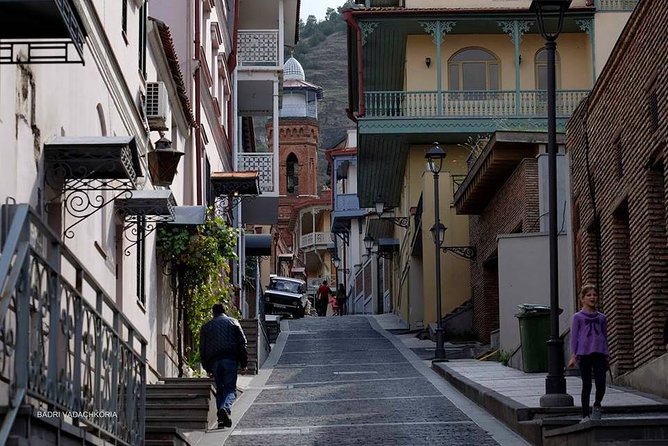
Abanotubani is Tbilisi’s ancient sulfur-bath district, located on the eastern bank of the Mtkvari beneath Narikala. The baths are central to the city’s identity, and the district is tied to the founding story of Tbilisi.
According to the legend, King Vakhtang Gorgasali’s falcon fell near the hot springs. The discovery led to the founding of the new capital. You do not need to accept every detail of the tale to appreciate how closely the baths are tied to the city’s origin story.
The tour allows about an hour here, followed by a visit to the small waterfall in Legtakhevi. That waterfall is a pleasant surprise in the middle of the old city, and the short route gives the day some variety after the larger churches and viewpoints.
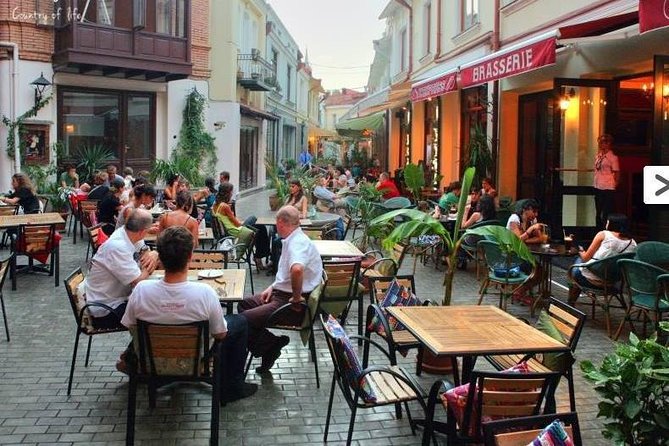
From there, you head toward Meidan Square and the nearby Meidan Bazaar, Shardeni Street, Cotton Row, and Iron Row. This is the most commercial part of the walk, with souvenir shops, art galleries, and cafes. It can be a good place to browse, but you should not expect a quiet old quarter untouched by tourism.
I like this section because it gives you several pieces of Tbilisi in one walk: bathhouses, a stream and waterfall, shopping lanes, food stops, and public squares. The guide also helps connect the physical sights to the city’s legends and past.
Metekhi Cathedral and the final city view
Metekhi Cathedral is the final listed stop. The church dates to the 13th century and sits on Metekhi Plateau, one of the important architectural points in old Tbilisi.
The visit lasts about an hour. After the more crowded streets around Meidan, Metekhi gives the day another strong viewpoint and a final look at the city’s historic core.
This stop also helps round out the religious story. Mtskheta shows Georgia’s ancient spiritual center, while Metekhi places a major church directly within Tbilisi’s urban setting. If you have already taken a separate Tbilisi walking tour, tell your guide what you have seen. Eka was praised for tailoring the city portion so a repeat visit could focus on sights missed earlier.
That flexibility is one of the better reasons to book a private activity. Guides including Eka and Anna have been praised for combining historical explanation with a relaxed manner. Maia was described as funny and helpful in making Georgian religious and cultural history easier to follow.
The guide and vehicle matter more than the ticket price
The strongest part of this experience is the human service. Anna received repeated praise for her English, historical explanations, organization, and ability to keep the day enjoyable. Eka was appreciated for personal insight into Georgian culture and for adjusting the route around sights already visited. Tamara earned special credit for assisting an older participant on the hills, and Maia was praised for humor and clear explanations.
Those details matter because this is not just a transfer between monuments. You spend a long day moving between religious sites, old districts, viewpoints, and shops. A guide who can adjust the explanations and pace will make the day feel far less mechanical.
At $158 per person, the cost is high compared with a simple group bus outing. The price makes more sense if you value a dedicated driver, a private group, an English-speaking guide, bottled water, and all stated entrance fees. It is also useful if you have only one free day and want both Mtskheta and Tbilisi handled together.
The value drops if you prefer slow independent sightseeing, long cafe breaks, or time to explore each church alone. The seven-hour-40-minute schedule is efficient, but it is still a full program. The route includes hills and walking, even though transportation covers the longer connections.
There is also a confusing group-size detail. The highlights require at least two people per booking, while the additional information says a minimum of six people is required. Since the activity is described as private, you should ask the provider to confirm the current rule for your party before finalizing plans.
What to know before booking
The tour operates in all weather, so dress for the conditions. Church visits require appropriate clothing, and the operator may change the order on service days. Bottled water and admission fees are included, but meals and alcoholic drinks are not.
Confirmation is sent within 48 hours, subject to availability. Free cancellation is allowed up to 24 hours before the start time for a full refund. Changes or cancellations inside that window are not accepted, and the local time cutoff applies.
Most people can participate, and the meeting point is near public transportation. Still, do not confuse that with a completely easy day. Jvari, Narikala, and the old-town route involve slopes, steps, or uneven surfaces. If mobility is a concern, explain it before booking and ask how the route can be adjusted.
The minimum drinking age is 18. That matters mainly if you plan to buy Georgian wine in Mtskheta, since alcohol is available for purchase but not included.
Who should book this tour?
I would choose this tour if you want a strong first look at Georgia’s two most important historic centers and prefer having the transport and explanations arranged. It suits couples, families, and small private groups that want to cover a lot without spending time negotiating taxis.
It is also a good fit if you enjoy churches, viewpoints, city stories, and short walks rather than a single long museum visit. The guide names associated with the tour have earned strong praise for English, humor, patience, and route flexibility.
I would hesitate if you want a relaxed day with plenty of unscheduled time. I would also think twice if your main goal is a long wine experience or a full meal, since neither is included. Finally, check the worship schedule and the minimum group requirement before paying.
Should you book the Tbilisi and Mtskheta day tour?
Book it if your time is limited and you want a well-organized overview of both cities, especially with a private group and a good guide. Jvari, Svetitskhoveli, Narikala, Abanotubani, and Metekhi give you a strong range of Georgia’s religious, urban, and scenic highlights.
The tour is worth the $158 when personal guiding and comfortable transport matter more than finding the lowest price. Before booking, confirm the group minimum, ask about church access on your chosen date, and be ready for hills, changing weather, and a full schedule.
FAQ
What time and where does the tour start?
It starts at 10:00 am near the Giant Bicycle monument at Rose Revolution Square in Tbilisi.
Where does the tour end?
The activity ends back at the meeting point near the Giant Bicycle monument.
How long does the tour last?
The tour lasts approximately seven hours and 40 minutes.
Is the tour offered in English?
Yes. The tour is offered in English.
Is this a private tour?
Yes. Only your group participates in the activity.
Are entrance fees included?
Yes. All entrance fees are included, including the stated admission for the Narikala cable-car section.
Are meals included?
No. Meals are not included. Alcoholic drinks are also excluded, though they can be purchased.
Can I enter the churches during services?
No. Entry is prohibited during church services, including Sunday mornings, Saturday evenings, and religious holidays. The operator may change the order and begin in Tbilisi if needed.
Just added in Tbilisi
- Wine Tasting feel the Difference of Qvevri or Classical Wine★ 4.4 · 10 reviews
- From Tbilisi: Kakheti and Kazbegi 2-Day 4X4 Jeep Tour pack★ 5.0 · 6 reviews
- Walking Tour in Old Tbilisi – Group Tour★ 4.5 · 8 reviews
- Tbilisi: Vintage Fashion and Secondhand Thrifting Tour★ 5.0 · 11 reviews
- Uforgatable Kakheti Tour with wine tasting – in Georgia★ 4.9 · 5 reviews
- From Tbilisi: Uplistsikhe Caves and Mtskheta Town Day tour★ 5.0 · 2 reviews
- Tbilisi Airport to Gudauri, Bakuriani, Batumi, Tbilisi★ 5.0 · 3 reviews
- Private Adorable City Tour of Tbilisi★ 5.0 · 3 reviews
Mtskheta and Gori Tours, compared.
Mtskheta, Jvari, Gori and Uplistsikhe Day Tour
Read our review →
Mtskheta Jvari Bazaar, Chronicles of Georgia & Wine
Read our review →
Mtskheta,Jvari,Bazaar,wine tasting,Chronicles of Georgia
Read our review →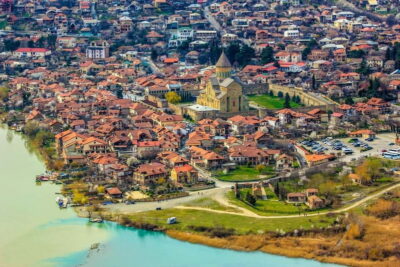
The Chronicles of Georgia, Jvari & Mtskheta Tour
Read our review →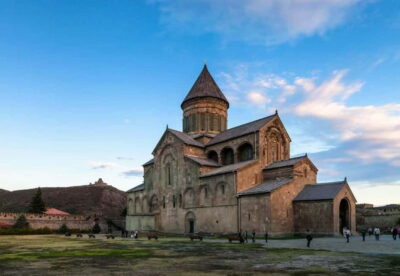
Browse the lists this tour appears in