Reviewed · TBILISI TOURS
Chiatura: Journey Through Time – Day-trip Adventure
Soviet cable cars still carry locals through a gorge. This private day trip from Tbilisi combines the Katskhi Pillar, medieval religious sites, brutalist buildings, and Chiatura’s manganese-mining past in one long, unusual day. At $104 per person, it is not a cheap outing, but the private transport, guide, cable car ride, and hotel pickup make the price fair for a full-day trip far beyond Tbilisi.
I especially like the mix of medieval Georgia and Soviet Georgia. One hour you are looking at a church perched high above a river gorge, and later you are riding an old ropeway through an industrial town. The guides also seem to make a real difference. Alex, Jonah, and Aleksi are repeatedly praised for clear explanations, personal stories, and flexibility.
The main drawback is the road time. Chiatura is far from Tbilisi, and this is a roughly 10-hour day with many stops packed into it. Some cable car lines may be closed or under repair, so you should treat the ride as an important possibility, not an absolute guarantee. The tour also involves uneven access and is not suitable for wheelchair users, people with serious back problems, or children under 120 centimeters.
In This Review
- Key points to know before booking
- Why this day trip is different from a standard Georgia excursion
- The long road from Tbilisi to Chiatura
- Katskhi Pillar and a monk’s remote home
- Mgvimevi Convent and difficult religious sites
- Entering Chiatura’s mining country
- The old cable car station and the ride itself
- Chiatura Memorial and brutalist details
- Central Cable Car Station and Temur Magradze Stadium
- Lunch at a local café
- What the $104 price gets you
- Who should book this experience?
- Should you book the Chiatura day trip?
- FAQ
- How long is the Chiatura and Katskhi Pillar tour?
- Where can pickup and drop-off take place?
- Is the tour private?
- Is the cable car ride included?
- Is lunch included?
- What languages are available?
- Can wheelchair users or people with back problems join?
Key points to know before booking
- A rare Soviet transport experience: Ride one of Chiatura’s historic passenger cable cars, if the operating lines allow it.
- Katskhi Pillar adds a spiritual contrast: See the 40-meter limestone monolith, its reconstructed eighth-century church, and the tiny monastery above.
- Chiatura is more than an abandoned industrial town: Manganese mining shaped the city, its transport system, and its place in Georgia’s modern history.
- Private touring makes the long day easier: Your guide can adjust photo stops, breaks, and the pace around your interests.
- The gorge setting is part of the attraction: Steep valleys and deep ravines frame the town and make the old industrial structures especially striking.
- Lunch costs extra: The tour includes mineral water, but you pay separately for the regional meal at a local café.
Why this day trip is different from a standard Georgia excursion
Many day trips from Tbilisi focus on churches, wine, or mountain scenery. This one takes you into Georgia’s industrial past. Chiatura grew around manganese mining in the late 19th century, and the ore shaped daily life in the town for generations.
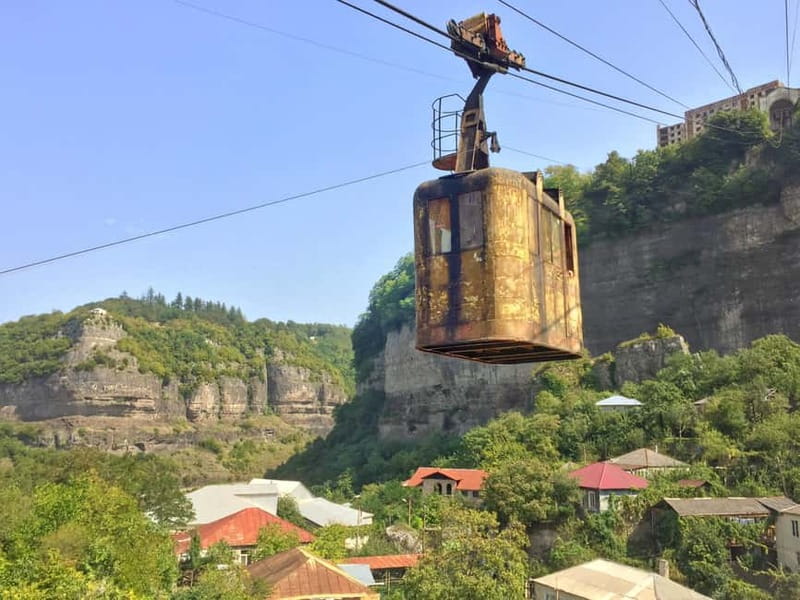
That history is not locked inside a museum. You see it in the steep streets, the concrete buildings, the cargo ropeways, and the cable cars that once gave workers a practical way to move through the gorge. The result feels more like a working town with layers of time than a polished sightseeing stop.
The private format matters here. A good guide can explain why the cable cars were built, point out Soviet-era design details, and connect Chiatura’s mining economy to the wider story of Georgia. Alex has been praised for answering questions in depth, while Jonah is known for adding personal experiences and adjusting the day to suit the group.
You should not expect a slick attraction with every structure restored. That is part of the appeal, but it also means conditions can be rough, ordinary, and occasionally disappointing. Some ropeway stations may look worn, and certain lines may not be running.
More things to do in Tbilisi:
- Tbilisi: Day Trip to Kazbegi, Gudauri, Gergeti, and Ananuri
★ 4.9 · 3,203 reviews - Day Trip to Kakheti Wine Region Including 9 Wine Tastings
★ 5.0 · 2,774 reviews - Highlights of Caucasus Mountains-Jinvali,Ananuri,Gudauri,Kazbegi(Group tour)
★ 5.0 · 2,682 reviews
The long road from Tbilisi to Chiatura
Pickup is available in Tbilisi or Gori, with return to either place. From Tbilisi, expect a full day away from your hotel, with much of it spent in the vehicle. That is worth keeping in mind if you prefer short transfers or dislike sitting in a car.
The tour begins with a local bakery stop of about 15 minutes. This is a useful start rather than a grand food experience. You can have coffee, tea, breakfast, or a local snack before the sightseeing begins. One advantage of a private tour is that the guide can help fit in practical pauses, and past groups appreciated having enough toilet stops during the day.
Your driver and English or Russian-speaking guide handle the route and hotel transport. The vehicle has received strong marks for comfort, which matters because the sites are spread out and the day covers a lot of ground.
The drive itself is part of the transition. Tbilisi gives way to smaller settlements and then to the dramatic valleys around Chiatura. You will want comfortable shoes, sunglasses, a hat, and sunscreen. These are simple items, but the day includes outdoor viewpoints and stops where shade may be limited.
Katskhi Pillar and a monk’s remote home
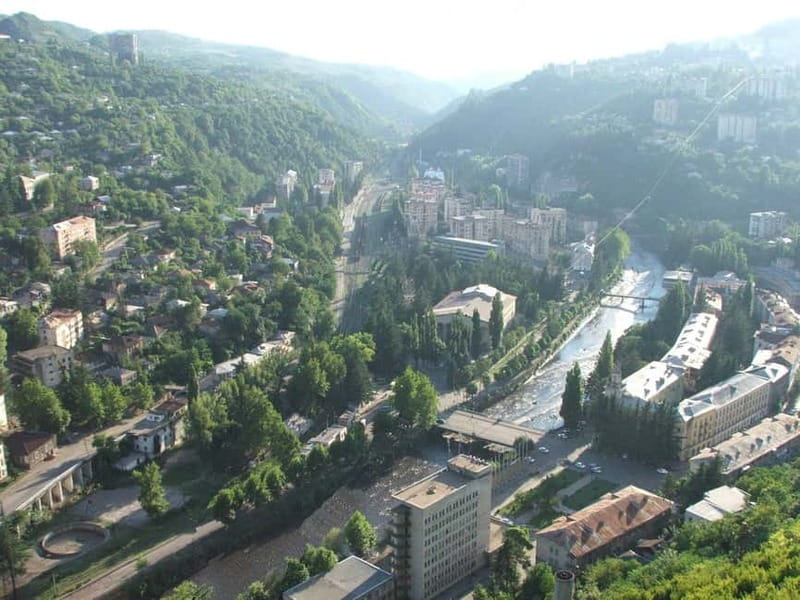
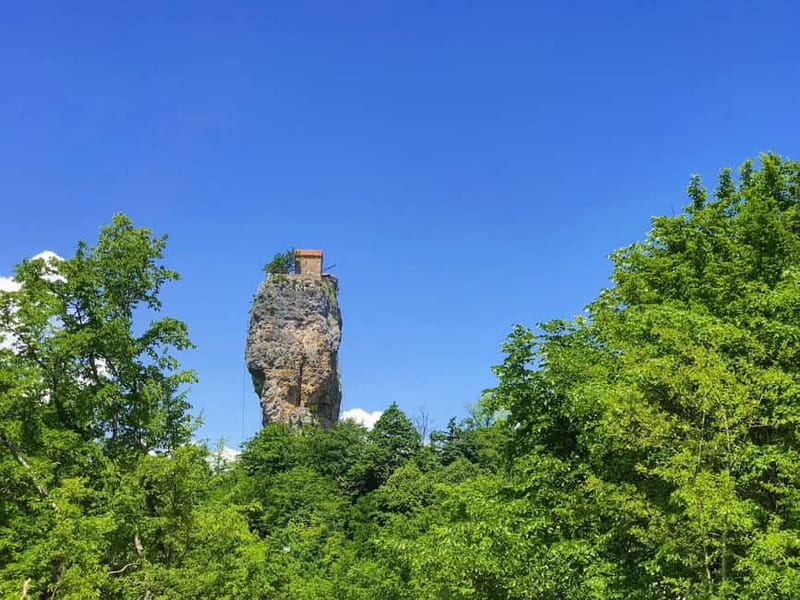
The Katskhi Pillar is one of the day’s most memorable sights. This natural limestone monolith rises about 40 meters above the Karshuna River gorge. Its narrow top holds a reconstructed eighth-century church and a small monastery.
The pillar is visually powerful because the religious buildings seem impossibly high above the surrounding ground. The site also carries a strong human story. Monk Maxime has lived there in solitude and silence for more than 25 years, making the pillar more than a dramatic photo stop.
Your visit includes a guided look at the site and scenic views. The published stop lasts around 45 minutes, so you should expect time for explanations and photos rather than a long stay inside a large complex. The pillar’s upper monastery is not presented as a normal tourist attraction that you simply walk into. Its difficult location is central to the experience.
This is a good place to listen carefully. The value comes from the link between the physical setting, Georgian religious practice, and the endurance required to live in such an isolated place. It also creates a useful contrast with Chiatura, where the next part of the day is about machinery, mines, and urban life.
Mgvimevi Convent and difficult religious sites
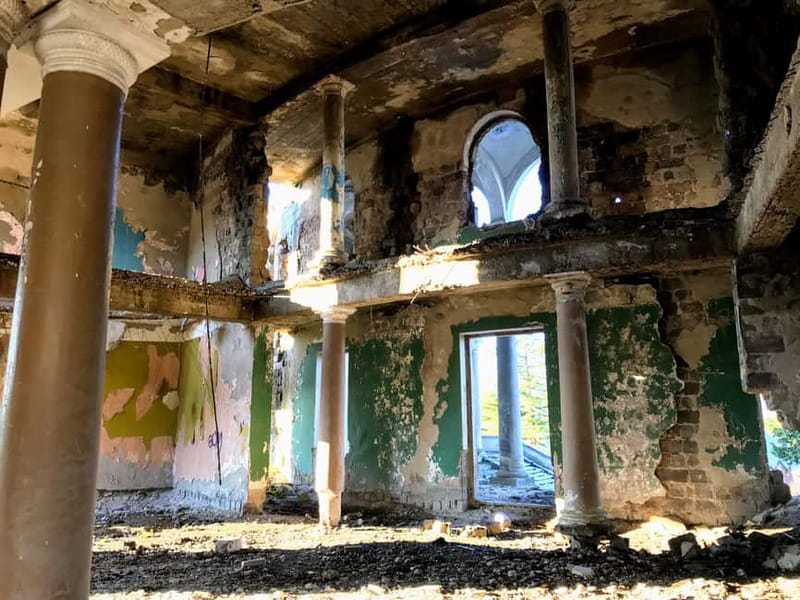
Mgvimevi Convent brings another religious stop into the program. The visit lasts about 45 minutes and includes sightseeing and scenic views along the way.
The convent is notable partly because of its hard-to-reach setting. That remote quality gives the stop more weight than a quick church photo. You are seeing religious buildings connected to the rugged terrain, not simply checking another monument off a list.
The schedule does not specify every feature inside the convent, so it is best to arrive ready for a guided visit rather than expecting a large complex with a long sequence of rooms. Modest clothing and respectful behavior are sensible at religious sites, even though a formal dress code is not listed.
A completely different kind of day:
- From Tbilisi: Kakheti Wine Region Tour with 9 Wine Tastings
★ 4.9 · 2,541 reviews - Tbilisi: Mtskheta, Jvari, Gori and Uplistsikhe Day Tour
★ 4.9 · 2,396 reviews - From Tbilisi to Kazbegi, Ananuri, Gudauri & Gergeti
★ 4.9 · 2,278 reviews - Tbilisi: Kakheti Wine Region Tour with 10 Wine Tastings
★ 5.0 · 2,160 reviews
Entering Chiatura’s mining country
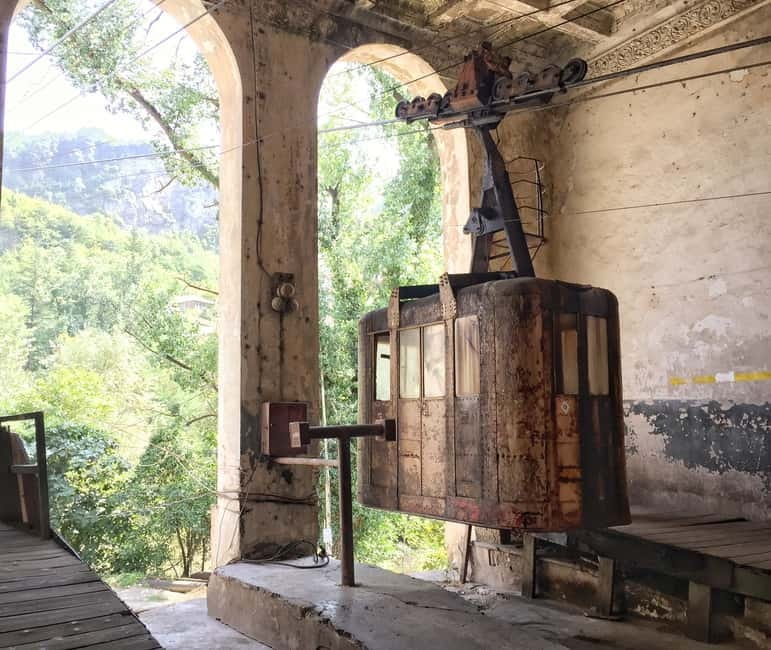
Chiatura is the heart of the excursion. Founded in the late 1800s, it became an important center for manganese mining. Manganese may sound like a dry industrial detail, but here it explains the town’s entire shape.
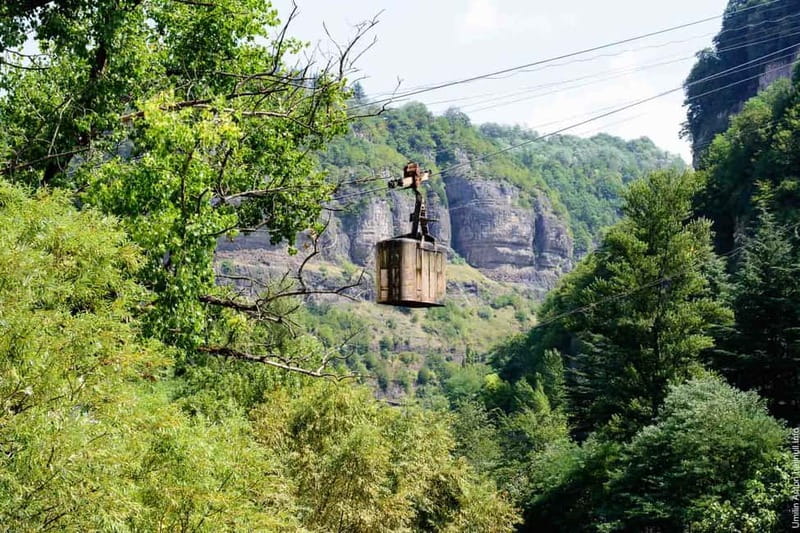
The metal helped make Chiatura economically important, while the narrow valleys made movement difficult. The response was a ropeway network that linked parts of the town and helped carry workers and materials. The passenger system once included more than a dozen operating lines, along with two cargo lines used for manganese. Altogether, the cableways extend for more than 6,000 meters.
You will see how geography and industry worked together. Chiatura sits among steep valleys and deep gorges, so the cable cars were not built as a novelty. They were practical transport across difficult ground. Riding one gives you a direct sense of how Soviet infrastructure entered ordinary life.
This is where a well-informed guide adds real value. Without context, you might see old concrete stations and rusting machinery. With someone like Alex, Jonah, or Aleksi explaining the town’s past, the structures become evidence of a particular economic and political period.
The old cable car station and the ride itself
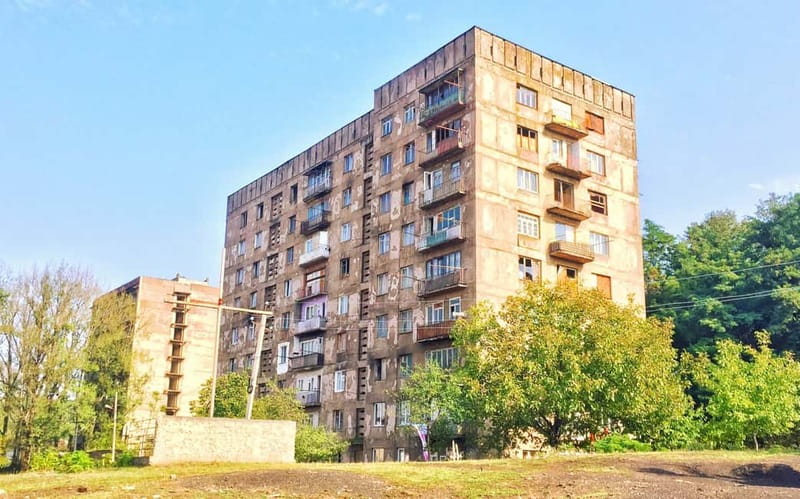
The old cable car station is scheduled as a 30-minute guided stop. It gives you time to look at the station, hear about the ropeway network, and understand how the system fit into Chiatura’s daily routine.
The actual cable car ride is included in the tour price. That is one of the strongest reasons to choose this outing over simply driving through the town. You get to experience the transport system from inside, with the gorge opening below and the old stations framing the route.
There is an important condition: some lines are closed or under repair. The provider cannot promise access to every ropeway, and your guide may need to use an operating line or change the plan. Go with the right expectation. The value is in seeing a living remnant of Soviet Georgia, not in collecting a ride on a specific numbered route.
If you have back problems, think carefully before booking. The tour is not suitable for people with back issues or wheelchair users, and the old infrastructure may not offer modern access standards. Baby carriages are also not allowed.
Chiatura Memorial and brutalist details
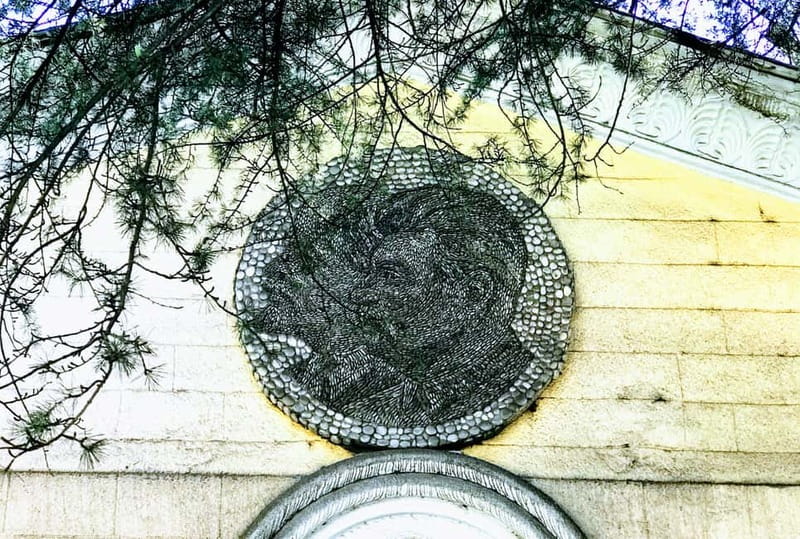
The Chiatura Memorial is a short 15-minute photo stop. It is a good pause for taking in the town from a scenic point and considering the people and industries that shaped it.
The town’s brutalist architecture is one of the pleasures of the route. Concrete forms, aging stations, and large structures set against the gorge create strong photographs, but the attraction is not only visual. These buildings reflect a period when public transport and industrial production were designed on a massive scale.
The former Palace of Students and Youth, listed locally as ყოფილი მოსწავლე-ახალგაზრდობის სასახლე, receives a brief 10-minute visit. It is another chance to see Soviet-era civic architecture and hear how the guide reads the building’s place in the town.
This stop is short, so do not expect an extended architectural tour. Still, it helps round out the visit. Chiatura is not just about cable cars. It is also about the public spaces and concrete structures built around work, education, and community life.
Central Cable Car Station and Temur Magradze Stadium
The Central Cable Car Station receives around 15 minutes. This is one of the most useful stops for understanding the ropeway network because it connects the transport story to the center of town.
You can take photos, hear more from the guide, and see how the station relates to the streets around it. The short time means the guide needs to keep the explanation focused, but a private group gives you a chance to ask questions instead of simply moving along with a large crowd.
The Temur Magradze Stadium is a 25-minute guided stop and photo opportunity. It adds another public building to the itinerary and shows how Chiatura’s civic life extended beyond mining and transport.
Together, these two stops make the town feel more complete. You are not just looking at abandoned machinery. You are seeing transport, public architecture, sport, and religious life in the same confined valley.
Lunch at a local café
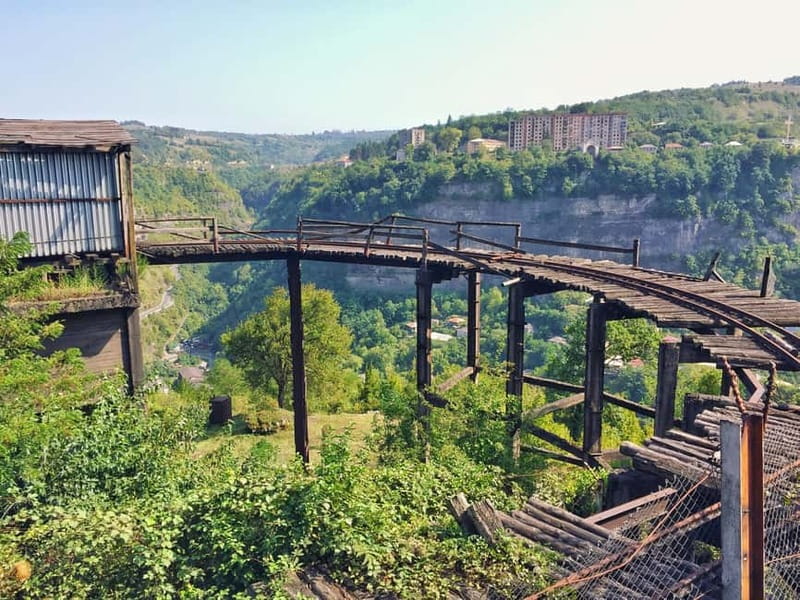
Lunch is scheduled for one hour at a local café, with regional food. It is not included in the $104 price, so plan for an additional meal cost.
A local café is a sensible choice on a day like this. You get a proper pause after the road and sightseeing, rather than relying only on snacks from the bakery stop. The private format also makes it easier to discuss dietary needs or timing with the guide, although the available information does not specify a menu or special meal options.
I would treat lunch as part of the cultural value of the day, not just fuel. Regional food gives you another way to connect with the area, and the pause prevents the schedule from becoming one long chain of roadside stops.
What the $104 price gets you
At $104 per person, this is best judged as a private full-day experience rather than a simple transport service. The price includes hotel pickup and drop-off in Tbilisi or Gori, an English or Russian-speaking guide, a driver, the sightseeing program, a cable car ride, and mineral water.
Lunch is extra. You should also remember that the price does not guarantee every cable car line, since closures and repairs can affect access.
The strongest value comes from the guide and the private format. People who toured with Alex, Jonah, Aleksi, and other team members describe guides who answered questions, shared personal experiences, stopped for unusual photographs, and adjusted breaks around the group. That flexibility is useful on a long day with distant sites.
If you are traveling alone, $104 may feel steep. For two or more people sharing a private vehicle and guide, the cost becomes easier to justify, especially if you care about history, photography, Soviet architecture, or places that are not part of the usual Georgia circuit.
Who should book this experience?
I would choose this tour if you enjoy industrial heritage, unusual transport, religious sites in remote locations, or photography. It also suits travelers who want a guide to explain Georgia from the medieval period through the Soviet era, rather than seeing isolated monuments without context.
It is a strong fit for couples, families with older children who meet the 120-centimeter minimum, and small groups with shared interests. The private setup lets you ask questions and request photo pauses without holding up a busload of strangers.
I would not choose it if your main goal is a relaxed day close to Tbilisi. The distance makes the day demanding. It is also a poor fit for anyone who needs wheelchair access, has back problems, uses a baby carriage, or expects every old cable car to be operating.
Book with comfortable shoes and a flexible attitude. The best moments may come from the working cable car, an unexpected view into the gorge, or a guide’s personal explanation of a building that looks ordinary at first glance.
Should you book the Chiatura day trip?
Yes, if you want Georgia beyond the standard church and wine route. The combination of Katskhi Pillar, Mgvimevi Convent, manganese history, Soviet cable cars, and Chiatura’s gorge gives you a day with real variety.
The tour’s biggest strength is its human side. Guides such as Alex, Jonah, and Aleksi have been praised for clear information, warmth, humor, and the ability to shape the day around their group. Its main weakness is the long drive and the uncertainty around cable car repairs.
For an offbeat private outing, $104 is reasonable, especially when shared by a small group. Book it for the story of the place, not just for one cable car ride, and you are more likely to come away satisfied.
FAQ
How long is the Chiatura and Katskhi Pillar tour?
The experience lasts 10 hours, including transportation from Tbilisi or Gori and the sightseeing stops.
Where can pickup and drop-off take place?
Pickup and drop-off are available from accommodations in Tbilisi or Gori.
Is the tour private?
Yes. The tour is arranged for a private group, with a driver and an English or Russian-speaking guide.
Is the cable car ride included?
Yes. A cable car ride is included in the tour price. Some lines may be closed or under repair, so riding a particular line cannot be guaranteed.
Is lunch included?
No. Lunch at a local café is not included, and you pay for the regional meal separately.
What languages are available?
The live guide service is available in English and Russian.
Can wheelchair users or people with back problems join?
The tour is not suitable for wheelchair users or people with back problems. It is also not suitable for children under 120 centimeters, and baby carriages are not allowed.
Just added in Tbilisi
- Wine Tasting feel the Difference of Qvevri or Classical Wine★ 4.4 · 10 reviews
- From Tbilisi: Kakheti and Kazbegi 2-Day 4X4 Jeep Tour pack★ 5.0 · 6 reviews
- Walking Tour in Old Tbilisi – Group Tour★ 4.5 · 8 reviews
- Uforgatable Kakheti Tour with wine tasting – in Georgia★ 4.9 · 5 reviews
- From Tbilisi: Uplistsikhe Caves and Mtskheta Town Day tour★ 5.0 · 2 reviews
- Tbilisi: Vintage Fashion and Secondhand Thrifting Tour★ 5.0 · 11 reviews
- Tbilisi Airport to Gudauri, Bakuriani, Batumi, Tbilisi★ 5.0 · 3 reviews
- Private Adorable City Tour of Tbilisi★ 5.0 · 3 reviews
Tbilisi Tours, compared.
Day Trip to Kazbegi, Gudauri, Gergeti, and Ananuri
Read our review →
Day Trip to Kakheti Wine Region Including 9 Wine Tastings
Read our review →
Highlights of Caucasus Mountains-Jinvali,Ananuri,Gudauri,Kazbegi(Group tour)
Read our review →
Kakheti Wine Region Tour with 9 Wine Tastings
Read our review →
Mtskheta, Jvari, Gori and Uplistsikhe Day Tour
Read our review →
From Tbilisi to Kazbegi, Ananuri, Gudauri & Gergeti
Read our review →
Kakheti Wine Region Tour with 10 Wine Tastings
Read our review →