Reviewed · TBILISI TOURS
Brutal Tbilisi: Urban exploration and untold stories
Concrete tells stories here. Brutal Tbilisi takes you far beyond the balconies and cobbled lanes of Old Tbilisi, into the city’s Soviet-era districts, monumental hills, refugee housing, abandoned buildings, and daring apartment bridges. It is part architecture tour, part modern Georgian history lesson, and part urban adventure.
I like the way the tour connects bold buildings with ordinary lives. I also like the small-group format advertised for up to six people, which should make it easier to ask questions and linger for photographs. The main consideration is the price, $75 per person, plus a possible group-size discrepancy: the highlights describe a maximum of six, while the additional information allows up to 14 people. Confirm the group size when booking if that matters to you.
The tour runs about four hours and is offered in English. It begins at the Giant Bicycle monument on Rose Revolution Square and ends there, with bottled water included. Private tours can include hotel pickup, but standard hotel pickup is not included.
In This Review
- Key details that shape the experience
- Why this is a different Tbilisi tour
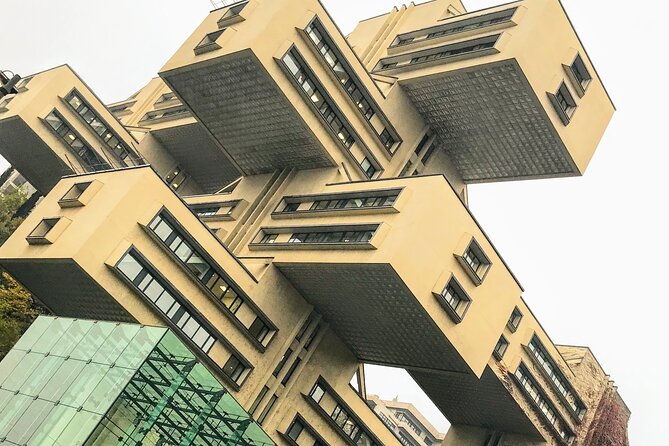
- The Ministry of Highways building and Tbilisi’s concrete icon
- The Chronicles of Georgia above the city
- The former archaeology museum, an eerie change of mood
- Maglivi Bridge and the lives behind Soviet housing
- Nutsubidze Skybridge, the tour’s high point
- What the guide adds to the buildings
- Is $75 a fair price?
- Pace, transport, and what to wear
- Who should book Brutal Tbilisi?
- FAQ
- How long does Brutal Tbilisi last?
- Where does the tour begin and end?
- Is hotel pickup included?
- What is included in the price?
- Is the tour suitable for children?
- Can I cancel for a full refund?
- Should you book it?
Key details that shape the experience
- A four-hour tour of Soviet Tbilisi: You visit five very different sites, with driving and walking between them.
- The Ministry of Highways building: This famous concrete structure is one of the city’s essential examples of Brutalist design.
- The Nutsubidze Skybridge: You may cross bridges between apartment towers about 70 meters above the ground.
- A former archaeology museum: This abandoned building provides the tour’s eeriest and most surprising stop.
- Local guides with strong reputations: Guides including Alex, Aleksi, Khatuna, Khato, Iona, and Xato are praised for clear explanations, humor, patience, and broad knowledge of Georgia.
- An adult-focused outing: Expect a moderate level of walking, stairs, uneven surfaces, and attention to the weather.
Why this is a different Tbilisi tour
Most first visits to Tbilisi focus on the old town, sulfur baths, the Narikala Fortress, and pretty wooden balconies. Those places deserve their time, but they show only one chapter of the city. This tour shifts your attention to the 20th century and to the complicated years after the Soviet Union collapsed.
You see buildings made for state power, student life, transportation, culture, and housing. Some remain in use. Some have changed purpose. Some are worn, abandoned, or only partly accessible. That contrast is the heart of the experience.
The guide supplies the meaning that concrete alone cannot provide. The strongest praise for this tour goes to the people leading it. Alex is repeatedly described as friendly, flexible, and full of information. Aleksi receives similar praise for explaining Georgian history and Soviet architecture in an easy, personable way. Khatuna and Khato are especially noted for their patience, humor, and ability to let people spend extra time taking pictures.
This matters because Brutalism can look like a collection of oversized gray blocks if nobody explains the politics, ambitions, and daily life behind it. With a good guide, the buildings become evidence of a changing society.
More things to do in Tbilisi:
- Tbilisi: Day Trip to Kazbegi, Gudauri, Gergeti, and Ananuri
★ 4.9 · 3,203 reviews - Day Trip to Kakheti Wine Region Including 9 Wine Tastings
★ 5.0 · 2,774 reviews - Highlights of Caucasus Mountains-Jinvali,Ananuri,Gudauri,Kazbegi(Group tour)
★ 5.0 · 2,682 reviews
The Ministry of Highways building and Tbilisi’s concrete icon
The first major stop is the former Ministry of Highways of the Georgian SSR, now associated with the Bank of Georgia building. It is one of Tbilisi’s best-known Brutalist structures, formed from large concrete sections stacked in a dramatic, irregular composition.
You get roughly 30 minutes here. That is enough time to look at the building from different angles, study its sharp lines, and take photographs. Your guide explains how the design balanced practical office space with a forceful public image.
This is a good opening stop because it introduces the tour’s central idea: Soviet architecture was not always plain or repetitive. Georgian architects worked within a state system, but they also produced daring forms that responded to Tbilisi’s hills, light, and steep terrain.
The drawback is that this is mainly an exterior experience. The building is impressive from outside, but do not expect a full museum-style visit with exhibits or a long indoor presentation.
The Chronicles of Georgia above the city
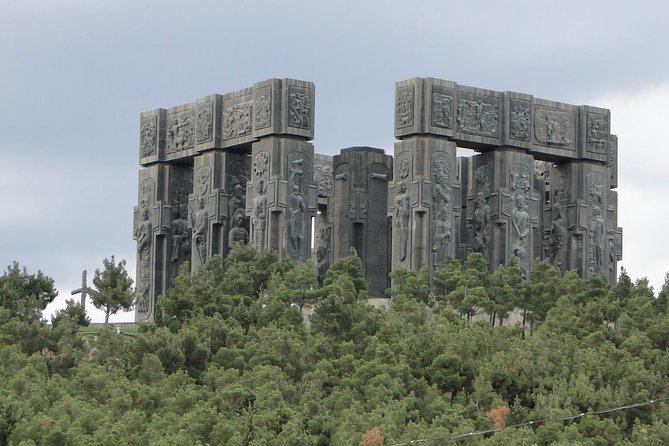
The tour then heads to the Chronicles of Georgia, also called the Memorial History of Georgia. The monument sits on a hill overlooking Tbilisi and uses enormous stone pillars carved with scenes from Georgian history and mythology.
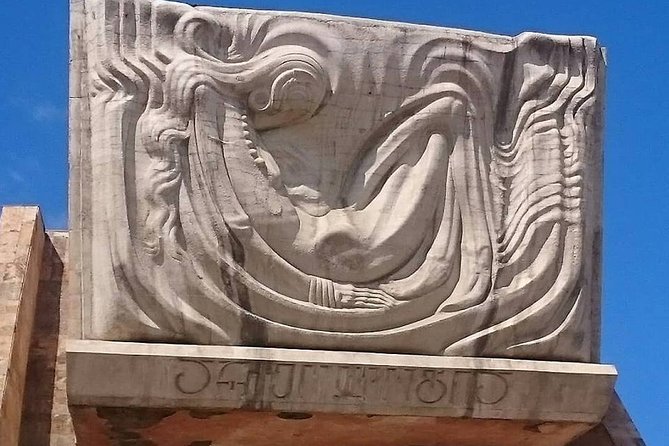
Allow about 45 minutes. This is less a Brutalist building than a monumental work of modern Georgian architecture, but it fits the tour because it shows how large-scale design was used to express national identity. The carvings refer to the founding of the Georgian state, the adoption of Christianity, ancient stories, and important figures.
I like this stop because it widens the conversation beyond Soviet concrete. You begin to see how Georgia presents its past while living with the physical remains of the Soviet period. The monument’s hilltop setting also gives you broad views over the city.
Bring a phone or camera with enough battery. The huge columns, open sky, and elevated position make this one of the tour’s best photography stops. Give yourself time to look closely at the reliefs rather than treating the monument as a quick photo backdrop.
The site can feel exposed in poor weather, so wear clothing suited to the day’s forecast. The tour’s practical advice is simple: check your weather app before leaving and choose shoes and clothing for walking outdoors.
The former archaeology museum, an eerie change of mood
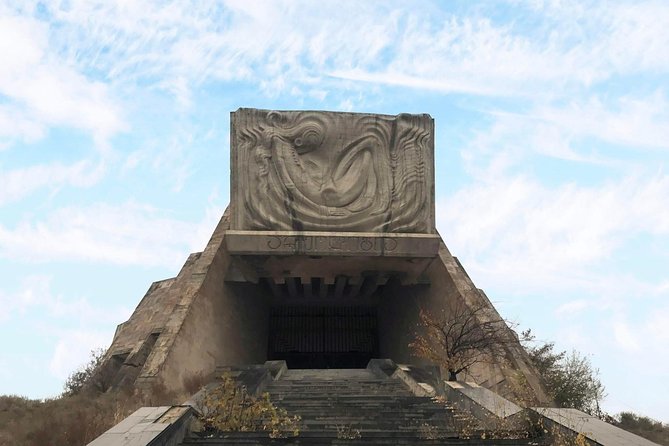
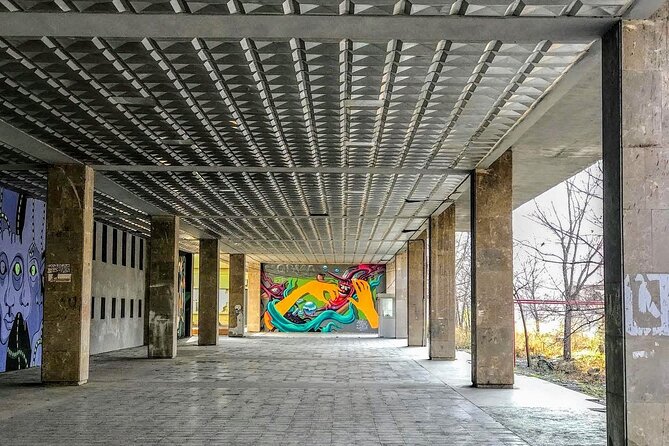
The former archaeology museum is the most unusual stop on the route. Once a grand museum, it is now abandoned and carries an eerie atmosphere that differs sharply from the open monument above the city.
The visit lasts about 30 minutes. You may see large architectural spaces and signs of the building’s former importance, along with the decay that comes when a public institution loses its purpose. The building is memorable partly because it leaves room for surprise. It does not present the polished version of Tbilisi found in a standard sightseeing program.
Several guides are praised for making this stop especially interesting. Alex’s ability to explain the building’s place in the city’s past is frequently appreciated, and one family found it easy to sit out this portion while still enjoying the rest of the tour. That is useful to know if anyone in your group dislikes abandoned places or has mobility concerns.
Access inside an abandoned building can depend on conditions at the time of the visit. Stay close to the guide, watch your footing, and do not assume every area is suitable for walking. The tour requires moderate physical fitness, and this is one reason why.
A completely different kind of day:
- From Tbilisi: Kakheti Wine Region Tour with 9 Wine Tastings
★ 4.9 · 2,541 reviews - Tbilisi: Mtskheta, Jvari, Gori and Uplistsikhe Day Tour
★ 4.9 · 2,396 reviews - From Tbilisi to Kazbegi, Ananuri, Gudauri & Gergeti
★ 4.9 · 2,278 reviews - Tbilisi: Kakheti Wine Region Tour with 10 Wine Tastings
★ 5.0 · 2,160 reviews
Maglivi Bridge and the lives behind Soviet housing
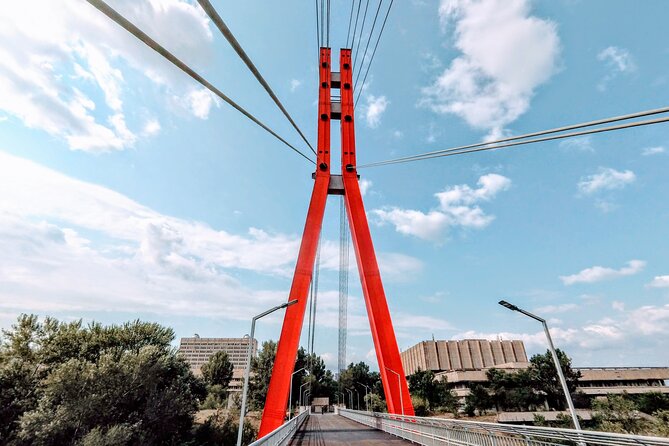
At Maglivi Bridge, the tour examines more than architecture. You look at former student dormitories that now house refugees displaced from Abkhazia. These buildings have moved from student accommodation to emergency housing, giving them a human story that is more important than their concrete design alone.
You also see the old cable car in the university district, another reminder of Soviet ideas about progress, education, and movement through the city. About 30 minutes is planned for this part of the tour.
This is where the experience gains much of its social weight. A photograph of a dormitory tells you very little by itself. Learning how the building is used today shows how Tbilisi’s housing stock has adapted to war, displacement, and economic change.
The tour handles these places best when it treats residents with care. You are visiting a real neighborhood, not a stage set. Listen to the guide, avoid intrusive photography, and remember that people live in the buildings you are examining.
The Maglivi section also helps explain why the tour is called an exploration of the true city. You are not only looking at famous architectural forms. You are seeing how the city’s residents have inherited, altered, and endured them.
Nutsubidze Skybridge, the tour’s high point
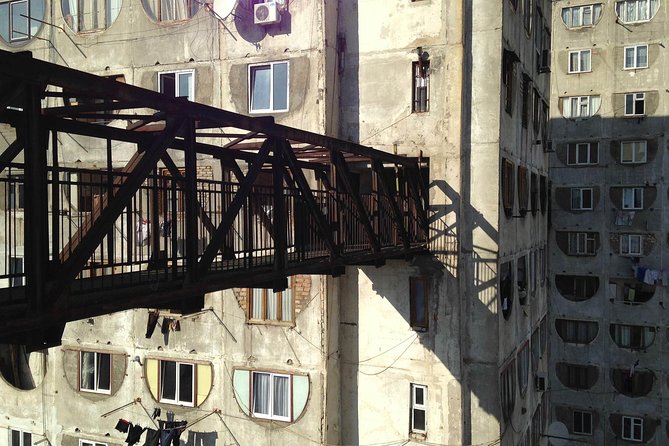
The final major stop is the Nutsubidze Skybridge, a pair of apartment towers connected by elevated bridges. The links join the buildings about 70 meters above the ground, creating one of Tbilisi’s most unusual pieces of residential design.
You spend about 45 minutes here. The chance to walk across the bridges gives the tour a physical climax. You are not simply viewing a building from the street. You are moving through it and seeing how Soviet architects used height, shared access, and connected towers to solve practical housing problems.
The views are a major attraction, but the building’s everyday character is just as interesting. This is still residential space, with people living ordinary lives inside an extraordinary structure. The tour may introduce you to the elevator operator, often called the lift lady in the tour description. Several people describe meeting her as a highlight.
That small encounter captures the spirit of the whole outing. The architecture is striking, but the human details make it memorable.
The Skybridge can be challenging for anyone uncomfortable with heights. The tour information does not promise a substitute route across the bridges, so ask the guide about the current conditions if someone in your group is uneasy. Comfortable shoes are also a sensible choice.
What the guide adds to the buildings
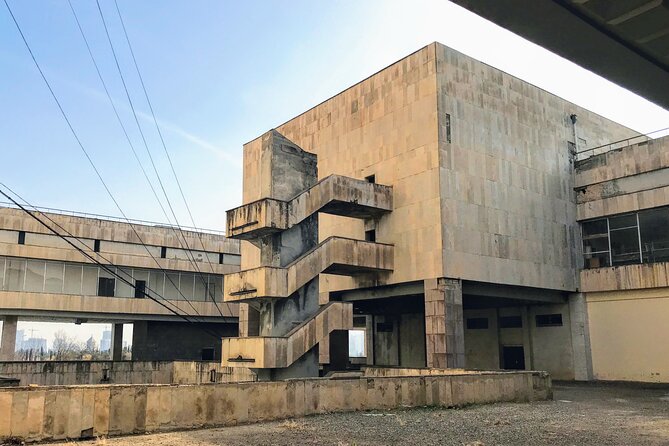
The guide is the main reason to book this rather than simply searching for the sites on a map. You get transport between scattered districts, but the real value comes from interpretation.
Guides such as Alex, Aleksi, Khatuna, Khato, Iona, and Xato are praised for several qualities:
- They explain both architecture and Georgian history.
- They answer questions and allow time for photographs.
- They adjust the pace for older members of a group.
- They bring humor into a subject that can otherwise feel heavy.
- They help you understand Soviet and post-Soviet life, not just building styles.
One person who usually prefers exploring alone found that a well-prepared guide changed their view of guided tours. That is a useful test for this experience. If you already know a great deal about Soviet architecture and only want to photograph buildings independently, you may prefer a self-guided route. If you want context, access, and conversation, the guide earns much of the $75 price.
There was also one complaint about communication. A participant felt that repeated answers such as like I told you made it harder to ask questions, possibly because of a language issue. This appears to be an exception among the supplied comments, but it is still worth remembering: guide quality can vary, and clear communication matters on a specialized tour.
Is $75 a fair price?
At $75 per person, this is not a cheap sightseeing loop. It is also not a simple walking tour. The route covers distant parts of Tbilisi, and the price includes a local guide and bottled water. Private tours include hotel pickup, while standard tours begin and end at Rose Revolution Square.
The value is strongest if you have only a short time in Tbilisi and want several outlying sites in one outing. Arranging the Ministry of Highways building, Chronicles of Georgia, former archaeology museum, Maglivi district, and Nutsubidze Skybridge independently would take planning and transport.
The price also makes more sense for architecture fans, photographers, and visitors interested in Soviet and post-Soviet history. If your main goal is Old Tbilisi food, churches, and traditional streets, spend your money elsewhere first.
Group discounts may be available. Since the promotional material describes a small group of up to six but the additional information permits as many as 14, ask for the expected group size before paying. A group of six would offer a more personal experience than a full group of 14.
Pace, transport, and what to wear
The outing lasts about four hours, with planned visits totaling roughly three hours. The remaining time is used for driving between sites and moving around the city. It is best understood as a driving and walking tour, not a continuous walk.
You meet at the Giant Bicycle monument at Rose Revolution Square, near public transportation, and return to the same point. Hotel pickup is available only on private tours. One private booking included an airport drop-off arranged by the guide, but do not treat that as a standard inclusion.
Wear shoes suitable for moderate walking and choose clothing for current weather. You may encounter outdoor hills, open spaces, stairs, bridges, and uneven surfaces. The tour is designed mainly for adults, and younger children may find the subject matter or physical demands less suitable.
Lunch is not included, so eat before the tour or plan a meal afterward. Bottled water is provided.
Who should book Brutal Tbilisi?
I would choose this tour if you like architecture, urban photography, modern history, or places that sit outside the usual sightseeing circuit. It is particularly useful after you have seen Old Tbilisi and want to understand how the city continued to change during the Soviet and post-Soviet periods.
You will probably enjoy it if you like asking questions and looking closely. The route is not built around quick photo stops alone. It asks you to think about state planning, national identity, displacement, public housing, and the way old buildings are used today.
I would hesitate if you dislike abandoned structures, heights, outdoor exposure, or moderate walking. I would also check the group size before booking if you want the intimate setting promised by the small-group description.
FAQ
How long does Brutal Tbilisi last?
The tour lasts approximately four hours, including travel between the five main stops.
Where does the tour begin and end?
It begins at the Giant Bicycle monument at Rose Revolution Square in Tbilisi and ends back at the same meeting point.
Is hotel pickup included?
Hotel pickup is available only for private tours. Standard tours use the meeting point at Rose Revolution Square.
What is included in the price?
The price includes a local English-speaking guide and bottled water. Lunch is not included.
Is the tour suitable for children?
The experience is designed mainly for adults. Children must be accompanied by an adult, and family-friendly tours are recommended for those traveling with younger children.
Can I cancel for a full refund?
You can cancel up to 24 hours before the start time for a full refund. Cancellations or changes made less than 24 hours before the tour are not accepted for a refund.
Should you book it?
Book Brutal Tbilisi if you want to see Tbilisi through its concrete buildings, difficult chapters, and everyday neighborhoods rather than only its prettiest streets. The Ministry of Highways building and Nutsubidze Skybridge provide the visual drama, while the former archaeology museum and refugee housing add human weight.
The experience is best with a strong guide, and the repeated praise for Alex, Aleksi, Khatuna, Khato, Iona, and Xato is encouraging. Confirm the group size, wear practical shoes, and be ready for a few rough edges. If that sounds appealing, $75 buys a focused and unusual look at the city that most standard tours leave out.
Just added in Tbilisi
- Wine Tasting feel the Difference of Qvevri or Classical Wine★ 4.4 · 10 reviews
- From Tbilisi: Kakheti and Kazbegi 2-Day 4X4 Jeep Tour pack★ 5.0 · 6 reviews
- Walking Tour in Old Tbilisi – Group Tour★ 4.5 · 8 reviews
- Uforgatable Kakheti Tour with wine tasting – in Georgia★ 4.9 · 5 reviews
- From Tbilisi: Uplistsikhe Caves and Mtskheta Town Day tour★ 5.0 · 2 reviews
- Tbilisi: Vintage Fashion and Secondhand Thrifting Tour★ 5.0 · 11 reviews
- Tbilisi Airport to Gudauri, Bakuriani, Batumi, Tbilisi★ 5.0 · 3 reviews
- Private Adorable City Tour of Tbilisi★ 5.0 · 3 reviews
Tbilisi Tours, compared.
Day Trip to Kazbegi, Gudauri, Gergeti, and Ananuri
Read our review →
Day Trip to Kakheti Wine Region Including 9 Wine Tastings
Read our review →
Highlights of Caucasus Mountains-Jinvali,Ananuri,Gudauri,Kazbegi(Group tour)
Read our review →
Kakheti Wine Region Tour with 9 Wine Tastings
Read our review →
Mtskheta, Jvari, Gori and Uplistsikhe Day Tour
Read our review →
From Tbilisi to Kazbegi, Ananuri, Gudauri & Gergeti
Read our review →
Kakheti Wine Region Tour with 10 Wine Tastings
Read our review →