
Reviewed · FULL-DAY
All Inclusive Full Day Tour in 6 Neighborhoods in T’bilisi
Tbilisi reveals itself one neighborhood at a time. This seven-hour small-group tour links grand avenues, Orthodox churches, Soviet leftovers, food markets, old balconies, and newer creative spaces in one busy day. I like the wide view of the city, and I like that coffee, lunch, a drink, and the cable car are built into the experience. The main tradeoff is pace: you will cover a lot, but some stops are short.
The tour uses public transport three times, with walking between many sights. That gives your feet a few breaks, but you should still expect a full day on the move. One highly praised guide is George, who is described as easygoing, communicative, and strong on Tbilisi’s story. Pickup is offered, the group is limited to 10, and the price is $180 per person, so the value depends on how much you want handled in one day.
In This Review
- Key points at a glance
- Why this tour works for first-time Tbilisi visitors
- Coffee and design at Cafe Stamba
- Rustaveli Avenue and the city’s formal face
- Parks, flea markets, and a Georgian lunch
- The old city begins at Gabriadze and Anchiskhati
- The cable car and Narikala’s big city view
- Walking down through Old Tbilisi
- Meidani, Sioni, and a little vintage shopping
- Fabrika and the Dezerter Bazaar
- Optional city extensions beyond the main route
- Is $180 a fair price?
- Who should book this Tbilisi tour?
- Should you book it?
- FAQ
- How long does the tour last?
- How much does the tour cost?
- Is pickup available?
- How large is the group?
- Is lunch included?
- Is coffee included?
- Is the Tbilisi cable car included?
- Are the Chronicle of Georgia and Mount Mtatsminda included?
- What is the cancellation policy?
Key points at a glance
- Stamba begins the day with coffee: Meet at the restored former publishing house and hear the plan over coffee roasted on-site.
- Six sides of Tbilisi fit into one route: The day connects Rustaveli, Old Tbilisi, Fabrika, the Dezerter Bazaar area, and other city districts.
- Public transport is part of the design: Three rides break up the walking and show you how locals move around town.
- Lunch and a drink are included: Puri Guliani provides a Georgian meal break, followed by a drink at Fabrika.
- Narikala gives you the classic view: The cable car from Rike Park reaches the fortress with broad views over the Mtkvari River and Sololaki Hill.
- Optional extensions change the value: The Chronicle of Georgia, Mount Mtatsminda, Vake Park, the Ethnography Museum, and Turtle Lake may be added, but some carry extra fees.
Why this tour works for first-time Tbilisi visitors
Tbilisi is not one tidy postcard district. It is a city of steep hills, riverbanks, broad Soviet avenues, old religious quarters, converted factories, and neighborhood markets. Seeing only the Old Town gives you the prettiest part, but not the whole character of the city.
This route tries to solve that problem in one day. You begin at Cafe Stamba, move along Rustaveli Avenue, cross through parks and markets, enter Old Tbilisi, ride up to Narikala, and finish among newer cultural and food spaces. The result is not a slow, single-neighborhood stroll. It is more like a guided sampler of the city.
I especially like the contrast between polished Stamba and the Dezerter Bazaar. One is a carefully remade Soviet-era publishing house with coffee, food, and design. The other is a working market with produce, spices, cheese, meat, wine, and a slightly chaotic feel. That contrast tells you more about present-day Tbilisi than a string of monuments can.
The group limit of 10 matters here. The route includes narrow streets, public transport, market aisles, and stops where a large group would become awkward. A small group also gives you a better chance to ask about food, buildings, and local customs.
More things to do in Tbilisi:
- Tbilisi: Day Trip to Kazbegi, Gudauri, Gergeti, and Ananuri
★ 4.9 · 3,203 reviews - Day Trip to Kakheti Wine Region Including 9 Wine Tastings
★ 5.0 · 2,774 reviews - Highlights of Caucasus Mountains-Jinvali,Ananuri,Gudauri,Kazbegi(Group tour)
★ 5.0 · 2,682 reviews
Coffee and design at Cafe Stamba
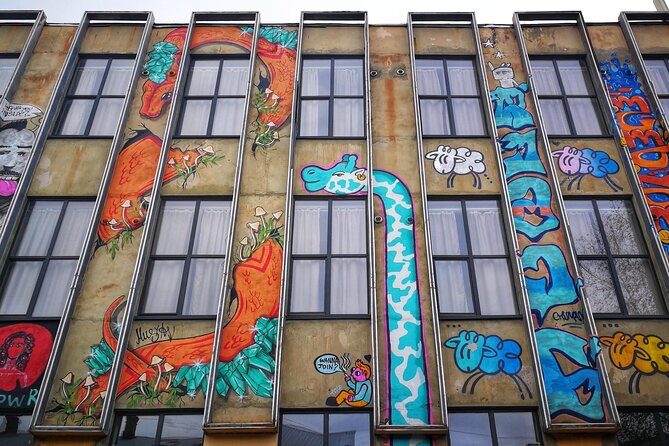
The day starts at Cafe Stamba, a former 20th-century publishing house turned into a food and design destination. The building’s old industrial character remains part of the appeal, while the ground floor now offers modern international food alongside Georgian flavors.
Your guide uses the opening 25 minutes to explain the plan. Coffee comes from beans roasted on-site at Stamba Chocolaterie and Roastery, and this is a useful first pause before the walking begins.
I see this as more than a caffeine stop. It introduces a modern side of Tbilisi that can be easy to miss if you focus only on churches and fortresses. It also lets you meet the guide in a relaxed setting. George, specifically, has been praised for communicating well before, during, and after the day, and for making the first meeting feel natural.
The stop is included, but the exact pickup arrangement deserves attention. Pickup is offered, yet the guide greets you at Cafe Stamba after pickup, so confirm where and when you will meet before setting out.
Rustaveli Avenue and the city’s formal face
Rustaveli Avenue is Tbilisi’s main central thoroughfare. It is named for the medieval Georgian poet Shota Rustaveli and is lined with government, cultural, public, and business buildings.
You spend about 40 minutes here, walking and pausing for photographs. This section gives you the city’s formal face: broad streets, major institutions, and grand historic buildings rather than the crooked lanes associated with Old Tbilisi.
The stop works best when your guide supplies context. On your own, an avenue can become a parade of façades. With explanation, you can better understand how Tbilisi presents its national identity through public buildings, monuments, and cultural institutions.
Several additional photo stops are listed around this part of the route. Do not expect every one to become a long visit. The point is to keep moving while collecting views and details that you might otherwise pass without noticing.
Parks, flea markets, and a Georgian lunch
Dedaena Park provides a short 10-minute pause beside the Mtkvari River. It has green space, recreation areas, and a skate park, so it feels more like a local gathering place than a formal garden.
Nearby, Dry Bridge Market gives you a different kind of city lesson. The open-air flea market began after the fall of communism, when people sold or exchanged possessions to make extra money. Today, you may find household objects, artworks, Soviet-era items, and unusual souvenirs.
The visit is only about 10 minutes, which is enough to look around but not enough for a serious search. If you enjoy flea markets, I would keep your expectations in check. You may spot something memorable, but you probably will not have time to inspect every table or negotiate at length.
Lunch follows at Puri Guliani. The restaurant describes itself as a Georgian bakery and kitchen, with traditional dishes, artisan bread, pastries, and desserts made with Georgian wheat and regional products. The one-hour break is included and is one of the practical strengths of the tour.
A proper sit-down meal matters on a route this active. You get time to rest, eat, and ask questions without trying to talk while crossing a street or climbing a hill. The food concept also gives you a chance to try Georgian flavors in a comfortable setting, though the supplied details do not specify the exact dishes or menu for your date.
A completely different kind of day:
- From Tbilisi: Kakheti Wine Region Tour with 9 Wine Tastings
★ 4.9 · 2,541 reviews - Tbilisi: Mtskheta, Jvari, Gori and Uplistsikhe Day Tour
★ 4.9 · 2,396 reviews - From Tbilisi to Kazbegi, Ananuri, Gudauri & Gergeti
★ 4.9 · 2,278 reviews - Tbilisi: Kakheti Wine Region Tour with 10 Wine Tastings
★ 5.0 · 2,160 reviews
The old city begins at Gabriadze and Anchiskhati
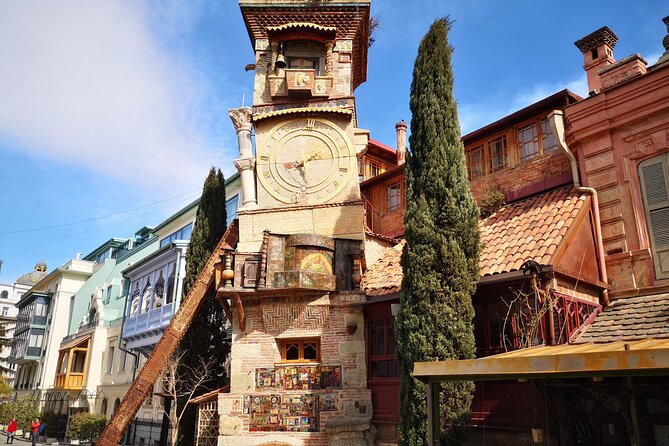
The Rezo Gabriadze Marionette Theater receives a brief five-minute stop. The theater is small, but its puppet productions have earned international respect. You should think of this as an exterior look and a bit of cultural context, not a performance visit.
Anchiskhati Basilica is also a short stop. It is the oldest surviving church in Tbilisi and belongs to the Georgian Orthodox Church. The building dates to the sixth century, though wars and later rebuilding changed it over time.
If the Anchiskhati Choir happens to be singing, the stop could become a memorable moment. Georgian polyphonic music is one of the country’s great cultural traditions, but the wording makes clear that hearing the choir is a matter of luck, not a scheduled part of the tour.
These quick church visits are useful for orientation. They show how close major religious sites can sit to theaters, shops, and cafés. You should dress and behave respectfully inside active churches, and remember that a five-minute stop may be shortened if services or access conditions require it.
The cable car and Narikala’s big city view

From Rike Park, you ride the cable car to Narikala Fortress. The cable car ticket is included, and the ride takes about 15 minutes. It provides broad views of Tbilisi, the Mtkvari River, and Sololaki Hill while giving your legs a welcome rest.
Narikala is one of the city’s defining sights. Its ruined walls date as far back as the fourth century, and the fortress was expanded or altered by Georgians, Turks, Arabs, and Persians. The remains are a clear reminder that Tbilisi has long sat at a meeting point of empires and cultures.
The fortress visit lasts about 10 minutes, so this is mainly a viewpoint and orientation stop. You will not have time for a detailed archaeological examination. Still, the setting does a lot of work. From above, the old districts, river, hills, and newer sections of the city make sense as one place.
This is one reason the route offers better value than a purely walking tour. The cable car turns a transfer into a scenic experience, and the included ticket removes one small cost and one bit of planning.
Walking down through Old Tbilisi
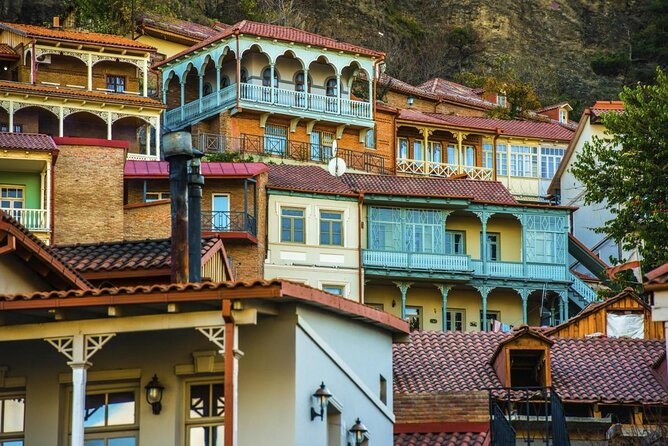
From Narikala, you walk downhill through Old Tbilisi. The route can include mosques, sulfur baths, ancient churches, traditional balconies, Art Nouveau buildings, small shops, galleries, and local places to eat.
The old district is the part of the tour where unscheduled details matter most. Look up at the wooden balconies, then look down narrow lanes for workshops, signs, and doorways. The mix is not polished in every corner, and that is part of its appeal.
Leghvtakhevi Waterfall appears in the middle of the old city, inside a canyon that has become a popular walking spot. The waterfall takes about 10 minutes, offering a quiet change from streets and buildings. Local stories connect the place with Queen Tamar’s private bathing area, while other traditions link it with poets and writers.
Abanotubani follows, marked by its domed sulfur baths and Persian-influenced design. According to the city’s founding legend, King Vakhtang Gorgasali’s falcon discovered the hot springs, helping lead to the choice of Tbilisi as a capital. By the 13th century, the area reportedly had 65 sulfur baths.
You will not bathe during this tour, but the guide can explain why the baths matter. If you want a bath experience, plan it separately. The 10-minute stop is for the district, the architecture, and photographs.
Meidani, Sioni, and a little vintage shopping

Meidan Bazaar sits beneath the tourist center of Old Tbilisi and sells Georgian wines, spices, tea, sauces, jams, postcards, and handmade goods. It is a convenient place to look for small gifts, though prices and selection can vary.
Sioni Cathedral adds another layer of religious and political history. The church was first built in the sixth and seventh centuries and has been destroyed and rebuilt several times. Inside, you may see the grapevine cross associated with Saint Nino, who helped spread Christianity in the Caucasus in the fourth century.
Both stops are brief, and some are marked optional. I would treat them as highlights along the walk rather than full guided visits. The route is strongest when you enjoy the movement between places, not when you expect a long lecture at every site.
Vintylator Vintage Shop provides a change of pace. Its handpicked clothing collection covers styles from the 1960s through the 1990s, including dresses, jackets, jeans, and coats. The store was created by two young women, giving the stop a direct connection to Tbilisi’s independent retail scene.
It is only about five minutes, so serious shoppers may want to return later. Still, it is a useful counterpoint to the religious sites and old architecture.
Fabrika and the Dezerter Bazaar
Fabrika occupies a former Soviet sewing factory that has been remade as a social and creative center. Its courtyard brings together restaurants, bars, and concept shops run by local entrepreneurs. The old industrial shell and newer design give the place a clear old meets new character.
A drink at Fabrika is included. That makes the stop more than a photo opportunity. It gives you another proper pause and lets you see where younger Tbilisi residents and creative businesses gather.
The Dezerter Bazaar offers a less arranged experience. Indoor aisles carry Georgian produce, spices, candles, cheeses, meats, and wines. The market can feel crowded and disorderly, but that is precisely why it is useful. You see food as part of daily life, not just as a restaurant menu.
The bazaar stop is listed as optional and lasts about 30 minutes. If you want to buy food products, ask the guide what travels well and what needs special care. The supplied details do not promise tastings or purchases, so think of this as a guided market visit rather than a food tour.
Optional city extensions beyond the main route
The final group of stops gives the tour flexibility, but it also makes the advertised seven-hour length harder to interpret. The main route already contains many short visits. Adding every optional stop would require a very fast schedule or extra time.
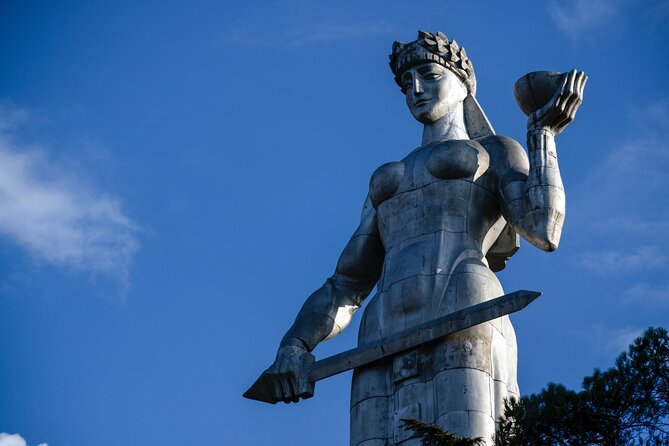
The Chronicle of Georgia sits near Tbilisi Sea. Created by Zurab Tsereteli in 1985, the unfinished monument uses 16 tall pillars to depict Georgian rulers, heroes, and scenes from Christian history. The upper sections show kings and queens, while the lower sections show stories from the life of Christ.
Admission is not included. The stop is listed at about 30 minutes, and it offers a very different view of the city from the old center.
Mount Mtatsminda is another optional extension. Known as the Holy Mountain, it offers high views over Tbilisi and includes the Funicular Restaurant Complex, television tower, Ferris wheel, amusement park, and funicular railway. Admission is not included, so confirm costs before choosing it.
Vake Park, opened in 1946, includes a World War II memorial, children’s areas, cafés, restaurants, and an open-air cinema. A cable car connects nearby Vake with Turtle Lake, and the park also has a walking route toward the lake. The supplied information says admission is included for this stop.
The Open Air Museum of Ethnography presents folk buildings and crafts from different regions of Georgia. Its 10 zones use buildings brought from around the country, making it a useful choice if you want Georgian rural architecture without leaving Tbilisi.
Turtle Lake sits on a wooded slope of Mount Mtatsminda. Cafés, benches, and trees surround the small lake, which is suited to picnics, cycling, and a break from the city. Admission is free.
I would ask the guide at the start which optional extensions are realistic for your day. The route becomes more useful when you choose one or two that match your interests, rather than trying to force all five into the schedule.
Is $180 a fair price?
At $180 per person, this is not a budget walking tour. Its value comes from the number of moving parts included: pickup is offered, the guide leads a small group, coffee and lunch are included, a drink at Fabrika is included, public transport is used, and the cable car ticket is covered.
You are also paying for route planning. Connecting Stamba, Rustaveli Avenue, Dry Bridge, Old Tbilisi, Narikala, Fabrika, and the market areas on your own would take research and careful timing. The guide’s local knowledge is especially useful when you want cultural context rather than a list of names.
The price is harder to justify if you want slow photography, long shopping stops, or detailed visits inside every church and museum. It is also important to check which optional admissions and transport costs are extra, especially for the Chronicle of Georgia and Mount Mtatsminda.
The small maximum group of 10 improves the experience. George is praised for his communication, city knowledge, and friendly manner, but guide quality always matters greatly on a route this broad. Confirm the guide’s name and the exact inclusions before paying.
Who should book this Tbilisi tour?
I would recommend it to a first-time visitor with one full day who wants a broad introduction to Tbilisi. It suits people who enjoy switching between architecture, food, markets, viewpoints, parks, and modern cultural spaces.
It is also a good choice if you prefer a guide to manage public transport and city connections. The three public transport rides are not a flaw. They are part of the experience and provide short breaks between walks.
I would be more cautious if you have limited mobility, dislike hills, or prefer a slow schedule. The route includes walking through Old Tbilisi and movement between many districts. The information says most people can participate, but it does not provide detailed accessibility notes.
Free cancellation is available up to 24 hours before the start time. Within 24 hours, the payment is not refunded, and changes are not accepted, so keep that deadline in mind.
Should you book it?
Book this tour if you want to understand how many different Tbilisis exist beyond the postcard Old Town. You will get churches, markets, food, design, Soviet-era buildings, hills, and city views in a single carefully linked day.
Skip it if you want deep time at each stop or plan to visit every optional attraction. For most first visits, I would book it, confirm the pickup point, ask which optional stops are included, and wear shoes suited to a long day of walking and public transport.
FAQ
How long does the tour last?
The experience lasts approximately seven to seven and a half hours.
How much does the tour cost?
The listed price is $180 per person.
Is pickup available?
Yes. Pickup is offered, and the guide greets the group at Cafe Stamba after pickup.
How large is the group?
The maximum group size is 10 people.
Is lunch included?
Yes. The tour includes a one-hour lunch break at Puri Guliani.
Is coffee included?
Yes. The opening stop at Cafe Stamba includes a coffee while the guide explains the plan for the day.
Is the Tbilisi cable car included?
Yes. The cable car ride from Rike Park to Narikala Fortress includes admission.
Are the Chronicle of Georgia and Mount Mtatsminda included?
No. Both stops are optional, and admission is not included for either one.
What is the cancellation policy?
You can cancel at least 24 hours before the start time for a full refund. Cancellations or changes made within 24 hours are not accepted and are not refunded.
Just added in Tbilisi
- Wine Tasting feel the Difference of Qvevri or Classical Wine★ 4.4 · 10 reviews
- From Tbilisi: Kakheti and Kazbegi 2-Day 4X4 Jeep Tour pack★ 5.0 · 6 reviews
- Walking Tour in Old Tbilisi – Group Tour★ 4.5 · 8 reviews
- Uforgatable Kakheti Tour with wine tasting – in Georgia★ 4.9 · 5 reviews
- From Tbilisi: Uplistsikhe Caves and Mtskheta Town Day tour★ 5.0 · 2 reviews
- Tbilisi: Vintage Fashion and Secondhand Thrifting Tour★ 5.0 · 11 reviews
- Private Adorable City Tour of Tbilisi★ 5.0 · 3 reviews
- Tbilisi Airport to Gudauri, Bakuriani, Batumi, Tbilisi★ 5.0 · 3 reviews
Full-Day, compared.

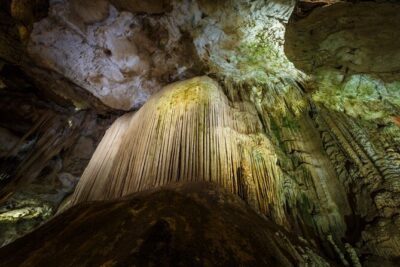
Kutaisi Canyons and Caves from Tbilisi Full Day Tour
Read our review →
Kazbegi and Gudauri Full Day Private Tour from Tbilisi
Read our review →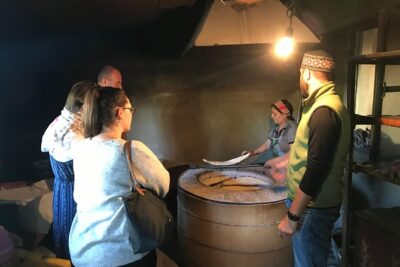
Full Day Private Wine Tour in Kakheti Region with Lunch and 3 Wine Tastings
Read our review →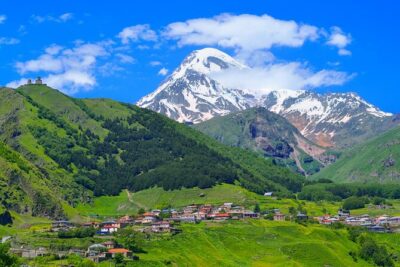
Kazbegi Full-Day Private Tour with Scenic Stops from Tbilisi
Read our review →
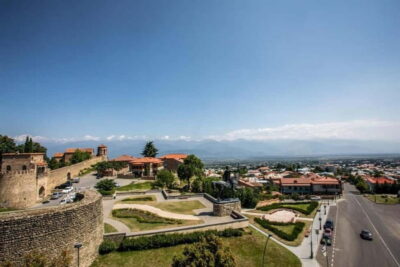
Kakheti: Bodbe, Sighnaghi, and Telavi Full-Day Tour
Read our review →